Inside J B Ecotex: A PET Fibre Manufacturer Built for Scale and Capability
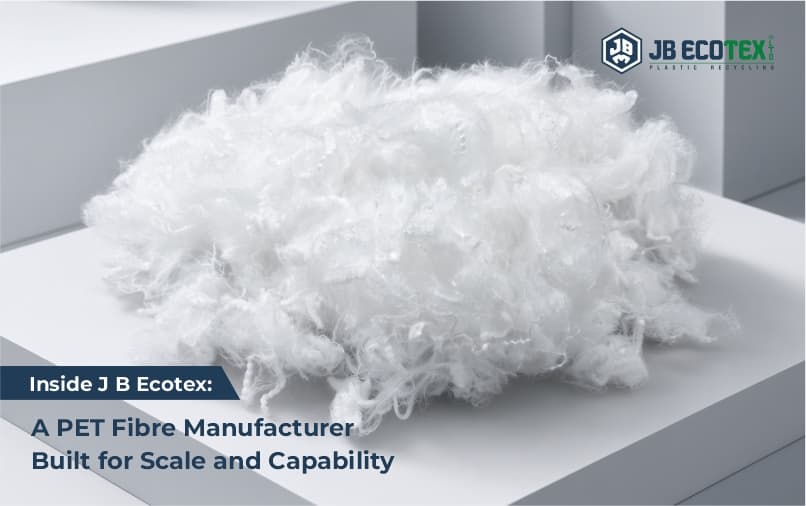
Recycled polyester fibre runs through more industries than its origin in used bottles might suggest. Apparel brands spin it into high-performance apparel. Home furnishing makers use it in pillows, cushions, quilts, and curtains. Automotive suppliers place it in car interiors. Construction, geotextile, and technical textile producers rely on it for nonwoven media where fibre geometry drives performance. Each of these industries draws on the same raw material through very different specifications.
To supply all of them reliably, a buyer looks for a manufacturer who can hold quality across repeat orders, at volume. That expectation shaped our fibre operation. At J B Ecotex, we produce recycled polyester staple fibre from post-consumer PET bottles at scale, with the process control and testing that help spinning mills, nonwoven producers, and technical textile buyers plan production with confidence. What follows is how we operate as a PET fibre manufacturer, from recycling capacity through to the fibre that reaches your line.
Scale That Supports Consistent Supply
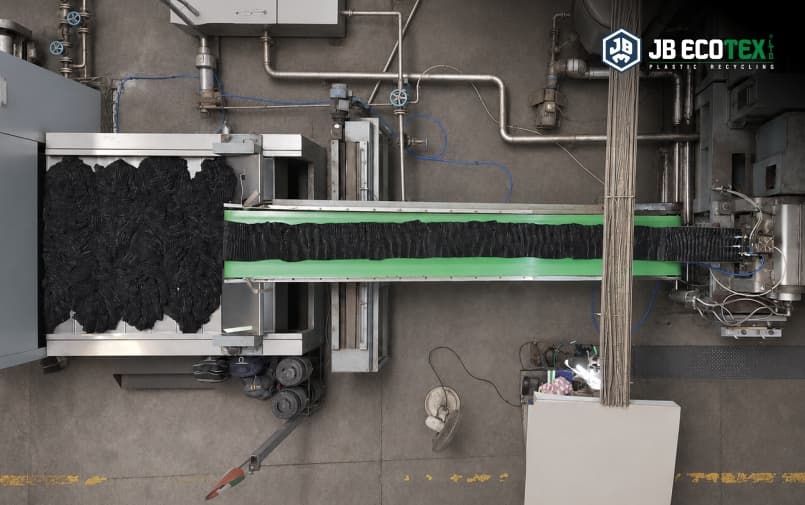
Scale matters to a fibre buyer for one reason: it underpins consistent supply. A manufacturer running at volume can hold specifications steady across large orders and keep lead times predictable. We operate our recycled polyester staple fibre plant at scale, drawing on both mechanical and chemical recycling capability to convert post-consumer PET into fibre-grade feedstock.
Two recycling routes give a buyer flexibility. Mechanical recycling supports steady, high-volume output for the bulk of textile and nonwoven demand. Chemical recycling extends what a recycled route can reach for grades that call for higher purity. Running both inside one operation means a buyer can source across a wider set of grades from a single relationship, with the volume behind each.
Reliable volume also protects a production plan. When a spinning or nonwoven line commits to recycled fibre, it needs assurance that supply will match the run and hold through the programme. Capacity gives buyers that continuity, along with the room to grow an order as demand builds, while staying with one supplier through the change.
Capability Across the Fibre Range
Capability shows in range. Different lines call for different fibre, so we produce recycled polyester staple fibre across a wide denier and cut-length span, in white and dope-dyed options, for spun yarn, nonwoven, and interlining. Deniers run from fine options suited to fine-count spun yarn through to coarse deniers used in nonwoven and filling applications. Cut lengths span the common spinning and nonwoven settings, with custom lengths available for specific lines. You can review our full fibre range when you plan a trial.
Colour is part of that range too. White grades across whiteness levels suit spun yarn and apparel that move on to dyeing. Dope-dyed grades carry colour through the melt stage, a route designed to support colour fastness for applications that value shade stability. Cationic-dyeable grades open lower-temperature dyeing and vibrant shade work for design-led fabrics.
In practice, our fibre operation gives a buyer:
- Denier and cut-length options for spun yarn, nonwoven, and interlining lines.
- White and dope-dyed grades across whiteness levels for dyeing and colour work.
- Speciality fibre for needs such as flame retardancy, cationic dyeing, cotton-like hand feel, and Ocean Bound Plastic content.
- In-house testing and batch-level traceability across production.
- Certification scope covering recycled content, tested substances, and management systems.
This breadth lets a buyer select the fibre that suits the end product and keep the line as it is, matching grade to product function without reworking a process around a single available option.
In-House Recycling, From PET Bottle to Fibre
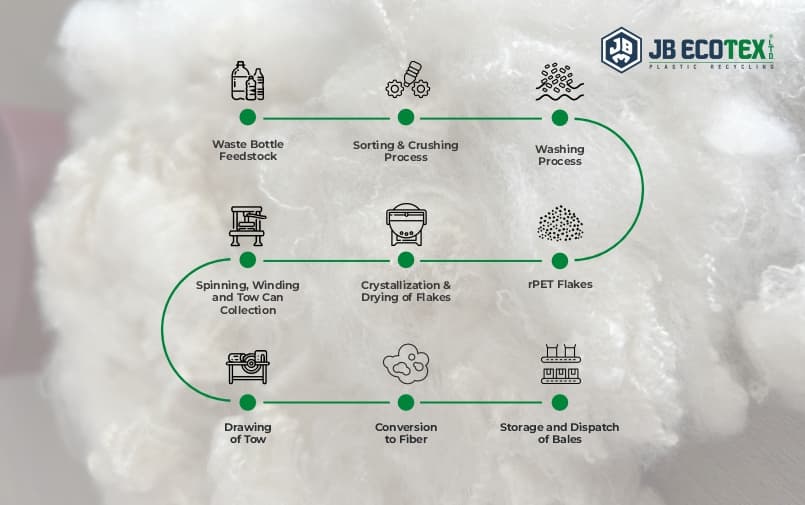
Our capability starts before the fibre stage, in how we handle the bottle. The route of PET bottle to polyester fibre runs through sorting, hot washing, and flake production, then melt spinning that draws the flake into filament. Because we run recycling and fibre production together, we hold visibility across each stage.
Collection and sorting come first. Post-consumer PET bottles arrive through recovery networks, and sorting separates PET from other polymers and from mixed colours. Cleaner sorting at this point sets the ceiling for fibre quality later, so it earns close attention.
Washing and flake production follow. Bottles are crushed and washed to strip labels, adhesives, and residues, and the resulting clean flake becomes the direct feedstock for our fibre. Producing fibre from flake in this way keeps the route short and the material well understood.
Melt spinning converts flake into filament. The clean flake is melted and extruded through spinnerets, then drawn to build molecular orientation and strength. Crimping adds cohesion for spinning, cutting sets the staple length, and a spin finish suits the fibre to the downstream process. Batch monitoring across denier, cut length, and appearance runs alongside, so output stays within the agreed window.
Handling these steps in one operation carries a practical benefit. When a buyer raises a quality question, we can trace it back through spinning, washing, and sorting quickly, because the stages sit inside one operation we control end to end.
Quality Control and Traceability
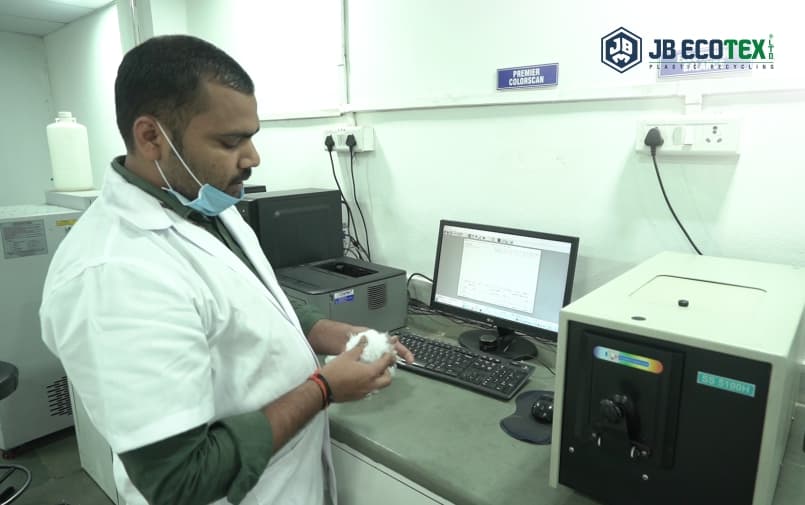
Consistency comes from testing, so we run quality control in-house. We check colour and whiteness, tensile properties, denier consistency, and thermal behaviour, and we share results with a buyer during qualification. Colour testing keeps whiteness and dope-dyed shades within range across lots. Tensile checks confirm the strength a downstream product depends on. Denier and cut-length checks support even drafting and steady web formation.
Traceability sits alongside the testing. Batch-level records tie each shipment back to feedstock and processing conditions, which supports audits and the recycled-content documentation that brands increasingly request. For buyers working under GRS, this chain of custody turns a recycled-content statement into evidence that travels with the material. Understanding a parameter such as denier and its tolerance helps a buyer set specifications that our testing then holds across a run.
How We Support a Buyer Through Qualification
Sourcing rarely ends at a specification sheet. A buyer usually runs the fibre on their own line before scaling, so we build that trial phase into how we work. We share samples matched to the target denier, cut length, and shade, along with the test data behind them, so a mill can plan a trial with a clear reference.
During the trial, our technical team stays available for questions on spinning, blending, or nonwoven bonding, and for adjustments where a line behaves differently from expectation. When the trial confirms the grade, we move to volume planning, matched to the buyer’s production schedule and growth outlook.
This support carries into repeat orders. Consistent documentation, batch records, and a stable point of contact keep qualification light on the second order and the ones after it. For a buyer, that steadiness is part of what a manufacturer relationship is worth.
Certifications Behind Our Fibre
Certifications turn capability into evidence a buyer can audit. Reviewing them together shows how much recycled content the fibre carries and how the material meets safety and management expectations.
Our recycled polyester staple fibre is produced under the Global Recycled Standard, which verifies recycled content and chain of custody along with social, environmental, and chemical criteria across processing. OEKO-TEX Standard 100 tests the material against a defined list of substances of concern. ISO 9001:2015 covers a structured quality management system, and ISO 14001:2015 covers environmental management. We share the relevant certificates during qualification so a buyer can match scope to their own requirements.

Industries and Buyers We Supply
Our fibre reaches a wide set of industries, each with its own priorities.
Apparel brands use recycled polyester staple fibre in t-shirts, uniforms, activewear, and blended fabrics. Home furnishing makers use it in pillows, cushions, and curtains, where bulk, resilience, and colour consistency lead. Automotive suppliers place it in car interiors. Construction and geotextile producers rely on higher-denier grades for nonwoven media, where airflow and structural stability shape the requirement. Interlining makers use finer grades to hold garment shape through wear.
Finer deniers move toward spun yarn and apparel. Higher deniers suit nonwoven and industrial applications. This spread reflects how our fibre fits into production across sectors, matched to each end use.
Blends and Downstream Performance
Most spun yarn runs as a blend, so blend behaviour is part of what a fibre buyer weighs. Recycled polyester staple fibre blends with cotton and viscose to balance strength, hand feel, and durability, and predictable blending keeps yarn recipes stable across runs. In cotton blends, recycled polyester adds dimensional stability and wear resistance. In viscose blends, it supports drape while holding structure.
Downstream, the fibre carries into fabric that a converter turns into apparel, furnishing, and technical textiles. Consistent shade development across bales lets that converter hold colour through a production window, and clear recycled-content records let a brand support the claims on its label. Fibre that behaves the same way from one order to the next is what makes recycled content a routine input across the value chain.
Frequently Asked Questions
What makes J B Ecotex a recycled PET fibre manufacturer?
J B Ecotex produces recycled polyester staple fibre from post-consumer PET bottles, running recycling and fibre production together. In-house testing, batch traceability, and certifications such as GRS support consistent quality for spinning, nonwoven, and technical textile buyers.
What scale does J B Ecotex operate at?
We operate our recycled polyester staple fibre plant at scale, with mechanical and chemical recycling capability. This supports reliable volumes and predictable lead times, giving buyers room to grow an order while holding specifications steady across production runs.
How does J B Ecotex support a buyer during trials?
We share samples matched to the target denier, cut length, and shade, along with test data. Our technical team stays available through the trial for questions on spinning, blending, or bonding, and for adjustments before a buyer scales to volume.
Can recycled polyester staple fibre be blended with cotton and viscose?
Yes. Recycled polyester staple fibre blends with cotton and viscose to balance strength, hand feel, and durability. Predictable blending keeps yarn recipes stable, and blend ratios are matched to the apparel or furnishing product being made.
Which industries does J B Ecotex supply?
Our recycled polyester staple fibre reaches apparel, home furnishing, automotive interiors, construction, geotextiles, and technical textiles. Finer deniers suit spun yarn and apparel, and higher deniers suit nonwoven and industrial applications where fibre geometry matters.
Working With a Manufacturer You Can Plan Around
For a buyer comparing PET fibre manufacturers, the questions come down to scale, control, and evidence. At J B Ecotex, we produce recycled polyester staple fibre at volume, run recycling and fibre production under one roof, test in-house, and back the output with certification and traceability. That combination is what lets a spinning or nonwoven line treat recycled fibre as a dependable input.
Our work also feeds a wider goal, turning post-consumer PET into material that stays in use, which sits at the centre of our approach to circularity. To review grades and specifications, or to start qualification, see our recycled polyester staple fibre page or talk to our fibre team about samples and volumes.