
Regenerated PSF Manufacturing: From Recycled PET Bottles to Good Fibre
In polyester markets, fibre quality is not defined by labels. It is defined by consistency, traceability, and performance over time. As sustainability commitments move from marketing decks to procurement contracts, regenerated polyester staple fiber has become one of the most closely evaluated raw materials in the textile and nonwoven value chain.
Yet, despite its growing adoption, regenerated PSF is still widely misunderstood. The market often treats all recycled fibres as interchangeable, even though the difference between stable fibre and problematic fibre lies entirely in how regeneration is executed.
This is where understanding regenerated PSF manufacturing becomes essential.
Understanding Regenerated Polyester Staple Fiber Beyond the Term
Regenerated polyester staple fiber refers to polyester fibre produced by reprocessing waste PET waste into staple fibre form through controlled industrial recycling. The polymer itself remains polyester. What changes is the lifecycle of the material.
In practice, regenerated PSF is not a downgraded material. When processed correctly, it retains the structural integrity required for demanding applications such as fibre filling, spinning blends, insulation, and nonwoven manufacturing.
The term “regenerated” is used deliberately. It signals that the material has been restored to a usable industrial state, not merely shredded or repurposed. This distinction matters because polyester performance is sensitive to contamination, thermal history, and polymer degradation.
Poor regeneration leads to brittle fibre, inconsistent bulk, and unpredictable behaviour during downstream processing.
Good regeneration produces fibre that behaves like fibre should.
Regenerated PSF and rPSF: One Material, Different Market Language
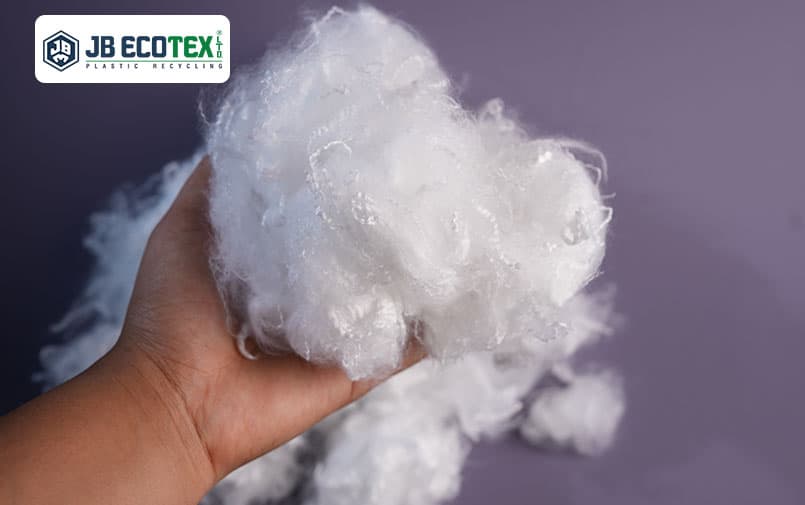
Within the industry, regenerated PSF and rPSF are often discussed as separate categories. Technically, they are the same.
rPSF, or recycled polyester staple fiber, is the abbreviated commercial term. Regenerated polyester staple fiber is the descriptive manufacturing term. Both originate from recycled PET feedstock, most commonly PET bottles.
The real differentiation in the market is not terminology. It is process discipline.
Two suppliers may sell rPSF. One fibre runs smoothly on filling machines and spinning frames. The other causes breakage, dusting, or inconsistent loft. The difference lies entirely in how regeneration is controlled at each stage of production.
That is why buyers increasingly evaluate regenerated PSF suppliers not by sustainability claims, but by process transparency and batch stability.
Why Regenerated PSF Is Not the Same as “Low-Grade Recycled Fibre”
In many markets, recycled fibre is still incorrectly associated with inconsistency or inferior performance. This perception usually comes from exposure to low-grade recycled outputs rather than true regenerated polyester staple fiber.
Low-grade recycled fibre often results from inadequate washing, uncontrolled melt processing, or poor filtration. These fibres may look acceptable visually but fail during processing or long-term use.
Regenerated PSF, when manufactured under controlled conditions, is fundamentally different. The polymer is stabilised, contaminants are removed at a molecular level, and fibre parameters are engineered for specific applications.
This distinction is important for buyers evaluating fibre for filling, spinning, or industrial use. Regenerated PSF is not a compromise material. It is a processed raw material designed to meet defined performance benchmarks.
PET Bottle to Fibre: Where Regenerated PSF Quality Is Decided
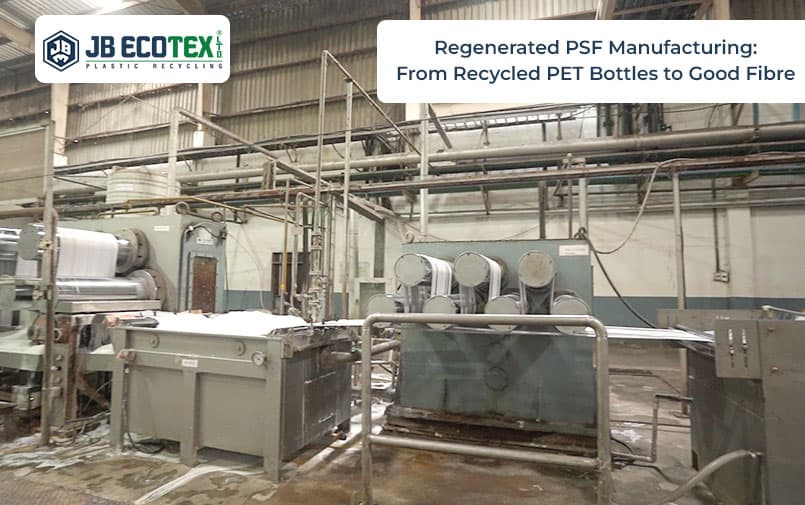
The PET bottle to fibre process is often oversimplified. In reality, it is a multi-stage material recovery and reengineering system where every shortcut directly impacts fibre performance.
Feedstock Selection and Control
Not all PET bottles are suitable for fibre-grade recycling. Feedstock must be selected, segregated, and processed based on colour, contamination level, and polymer integrity.
Mixed or poorly sorted inputs lead to inconsistent melt behaviour, which later shows up as fibre weakness or irregularity.
Washing and Decontamination
This stage defines whether a product becomes usable fibre or industrial waste. Advanced washing removes adhesives, oils, residues, and non-PET elements that degrade polymer quality during extrusion.
In a serious PET fiber recycling setup, washing is not about appearance. It is about chemical cleanliness.
Melt Processing and Filtration
During extrusion, PET flakes are melted and filtered. This step removes micro-contaminants and stabilises polymer flow. Inadequate filtration is one of the most common causes of fibre inconsistency in recycled polyester.
Fibre Formation and Cutting
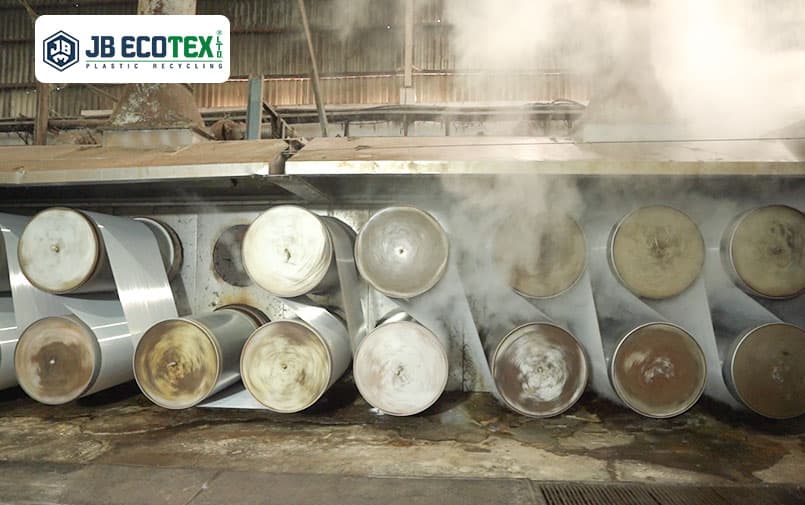
Once extruded, the fibre is drawn, crimped if required, and cut into staple lengths. Fibre geometry, resilience, and tensile behaviour are all controlled here. This is where regenerated PSF either becomes suitable for high-value applications or gets limited to low-grade use.
Polyester Fibre from Recycled PET Bottles: Performance Reality
A well-manufactured polyester fibre from recycled PET bottles behaves predictably across applications. It offers:
- Stable tensile strength
- Controlled elongation
- Reliable bulk and recovery
- Resistance to moisture and microbial growth
These properties are not accidental. They result from controlling polymer degradation and thermal stress throughout the recycling process.
When buyers experience issues with recycled fibre, it is rarely because the concept is flawed. It is because regeneration was treated as waste processing instead of fibre engineering.
Inside a Recycled Polyester Staple Fiber Plant
A high-quality recycled polyester staple fiber plant operates more like a polymer processing facility than a recycling unit.
Key characteristics include:
- Multi-stage material inspection
- Controlled residence time during melting
- Continuous filtration systems
- Process monitoring at each thermal stage
- Fibre testing aligned with end-use requirements
Plants that invest in these controls are able to produce regenerated PSF suitable for both filling and spinning markets, not just low-end insulation.
This distinction is critical for buyers who require fibre that integrates seamlessly into existing manufacturing lines.
PET Fibre Recycling and Industrial Scalability
One of the strongest advantages of regenerated PSF is scalability. PET bottles are one of the most widely available recyclable materials globally. This makes PET fibre recycling commercially viable at large volumes.
From a supply chain perspective, this creates:
- Reduced dependence on virgin polyester
- More stable long-term sourcing
- Lower exposure to fossil-based raw material volatility
For manufacturers operating at scale, regenerated PSF is not a compromise. It is a strategic material choice.
Recycled Fiber Fill: Where Regenerated PSF Delivers Immediate Value
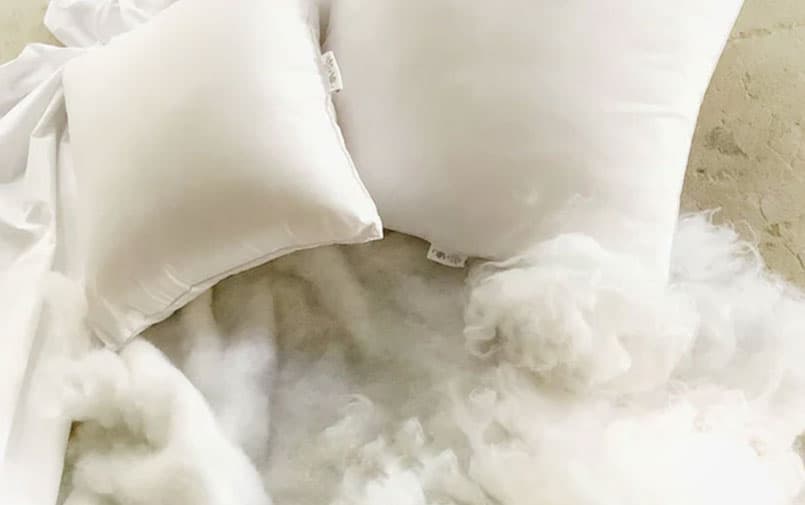
Recycled fiber fill applications are often the first entry point for regenerated PSF adoption. Pillows, cushions, quilts, mattresses, and upholstery require fibre that offers loft, resilience, and comfort.
Regenerated PSF performs well here because:
- Crimp can be engineered for bulk
- Fibre softness can be controlled
- Compression recovery remains stable over time
When manufactured correctly, recycled fibre fill, also known as micro silconised fibre, meets both comfort expectations and sustainability goals without altering product performance.
PET Fibre in Nonwoven and Industrial Uses
Beyond filling, PET fibre derived from recycled bottles is widely used in nonwoven applications such as insulation, filtration media, acoustic panels, and geotextiles.
These applications prioritise:
- Structural stability
- Moisture resistance
- Long service life
Regenerated PSF is particularly suitable here because polyester’s inherent properties remain intact even after recycling when processing is controlled.
Regenerated PSF Grades and Application Mapping
Not all regenerated polyester staple fiber is produced for the same end use. Fibre characteristics such as denier, cut length, and crimp structure are adjusted based on application requirements.
Common regenerated PSF grades include:
- Filling grade
Designed for recycled fiber fill in pillows, cushions, quilts, and upholstery. Focuses on loft, softness, and recovery. - Nonwoven grade
Used in insulation, padding, filtration, and acoustic applications. Prioritises structural stability and moisture resistance. - Industrial grade
Applied in automotive interiors, technical textiles, and composite layers where durability and consistency are critical.
Selecting the correct regenerated PSF grade is essential. Mismatched fibre specifications can lead to processing inefficiencies and product performance issues downstream.
Quality Parameters Buyers Should Evaluate in Regenerated PSF
For procurement teams, evaluating regenerated polyester staple fiber requires looking beyond certificates and price points.
Critical parameters include:
- Fibre length consistency
- Tensile strength variation
- Crimp retention
- Moisture content
- Processing behaviour on customer machinery
A credible RPSF fibre manufacturer provides clarity on these parameters and aligns fibre grades to specific applications rather than offering generic products.
Compliance, Traceability, and Documentation in Regenerated PSF Supply
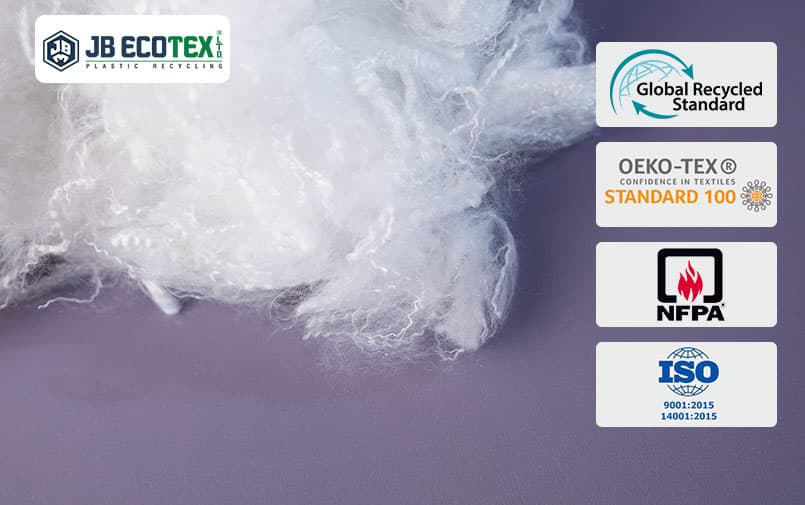
As regenerated PSF becomes part of formal procurement processes, compliance and traceability have become non-negotiable. Buyers increasingly require documentation related to input sourcing, processing controls, and material consistency.
A responsible RPSF fibre manufacturer maintains clear records of PET feedstock sourcing, batch processing parameters, and quality testing. This transparency supports regulatory compliance and internal sustainability reporting for downstream brands.
Traceability also protects buyers from performance risk. When fibre behaviour can be linked back to controlled processes, long-term consistency becomes predictable rather than assumed.
These are essential when trying to choose between regenerated and virgin fiber.
JB Ecotex and Regenerated PSF Manufacturing
At JB Ecotex, regenerated PSF manufacturing is built on the principle that recycled fibre must perform like engineered fibre, not like waste-derived material.
The company’s approach to regenerated polyester staple fiber focuses on:
- Controlled PET feedstock selection
- Process stability across recycling and extrusion
- Fibre grades designed for specific end uses
- Consistent quality across production batches
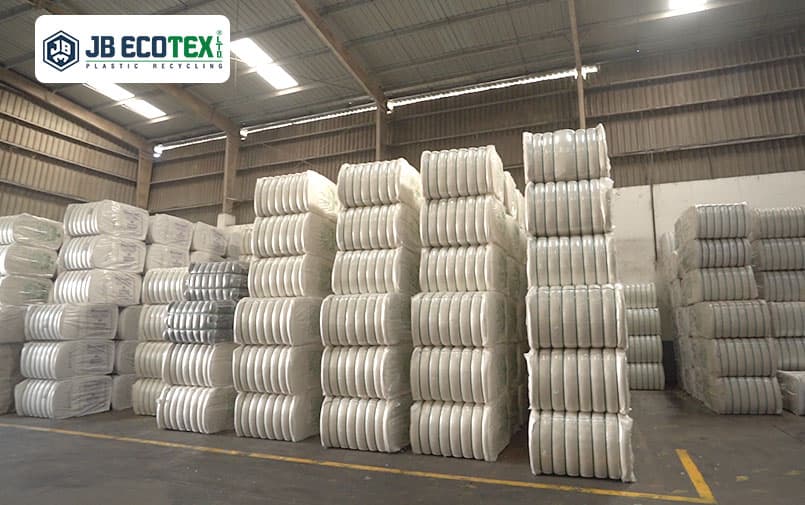
JB Ecotex supplies regenerated PSF suitable for recycled fiber fill, nonwoven applications, and industrial uses where performance consistency is critical.
Rather than positioning recycled fibre as a sustainability compromise, JB Ecotex treats regeneration as a material optimisation process.
Regenerated PSF in Long-Term Sustainability Strategies
As regulatory frameworks and brand commitments tighten, regenerated PSF offers a practical route to circularity without operational disruption.
Because polyester fibre from recycled PET bottles integrates easily into existing manufacturing systems, it allows brands and manufacturers to transition toward sustainability without redesigning products or processes.
This makes regenerated PSF one of the few materials where environmental responsibility aligns directly with industrial practicality.
Regenerated PSF as a Long-Term Procurement Strategy
For procurement teams, the shift toward regenerated polyester staple fiber is no longer driven only by sustainability targets. It is increasingly shaped by supply stability, cost predictability, and material performance assurance.
Virgin polyester pricing remains closely tied to crude oil volatility. In contrast, regenerated PSF sourced through PET bottle to fibre systems benefits from a broader and more decentralised raw material base. This reduces exposure to sudden pricing swings and supply disruptions.
From a sourcing perspective, regenerated PSF allows procurement teams to secure polyester fibre with defined specifications while aligning with internal sustainability mandates. When fibre grades are engineered correctly, downstream processing behaviour remains consistent, which limits operational risk.
Another critical factor is traceability. Regenerated PSF produced through controlled PET fibre recycling offers clearer documentation of input sources and processing history. This transparency supports audits, ESG reporting, and long-term supplier relationships.
As recycled polyester markets mature, procurement strategies are shifting away from spot purchasing toward stable supply partnerships. Buyers increasingly prioritise RPSF fibre manufacturers that demonstrate process discipline, batch consistency, and application-specific fibre development rather than those competing solely on price.
In this context, regenerated PSF is not a temporary substitution for virgin polyester. It is a strategic raw material choice that supports continuity, compliance, and performance at scale.
FAQs on Regenerated Polyester Staple Fiber
What is regenerated polyester staple fiber made from?
Regenerated polyester staple fiber is primarily made from waste PET bottles. These bottles are processed through washing, melting, filtration, and fibre formation to create usable polyester fibre.
Is regenerated PSF the same as rPSF?
Yes. Regenerated PSF and rPSF refer to the same material. The difference lies in terminology, not composition. Quality depends on the manufacturing process, not the name used.
How does PET bottle to fibre recycling impact fibre quality?
Fibre quality depends on feedstock selection, washing efficiency, melt filtration, and thermal control. Proper PET bottle to fibre processing ensures stable polymer properties and consistent fibre performance.
Is polyester fibre from recycled PET bottles suitable for filling applications?
Yes. When manufactured correctly, polyester fibre from recycled PET bottles performs well as recycled fiber fill in pillows, cushions, quilts, and upholstery due to its resilience and loft.
How can buyers evaluate a reliable RPSF fibre manufacturer?
Buyers should assess process transparency, fibre consistency, application-specific grades, and the manufacturer’s ability to provide quality documentation and batch traceability.
Does regenerated PSF perform differently from virgin polyester fibre?
In most filling, nonwoven, and industrial applications, regenerated PSF performs comparably to virgin fibre when produced under controlled conditions.
What industries commonly use PET fibre derived from recycling?
PET fibre is widely used in home textiles, nonwovens, automotive interiors, insulation, filtration, and industrial padding applications.
Why Regenerated Polyester Staple Fiber Will Continue to Grow
The future of polyester is not virgin versus recycled. It is controlled versus uncontrolled manufacturing.
Regenerated PSF succeeds when PET bottle to fibre systems are designed around polymer integrity, not waste throughput. As industry standards mature, buyers are becoming more discerning, and fibre quality is becoming the deciding factor.
For manufacturers who invest in process discipline, regenerated polyester staple fiber is not an alternative material. It is a core raw material for the next phase of textile and nonwoven production.
Final Perspective
Regenerated PSF manufacturing demonstrates that circularity does not require lowering standards. When PET fibre recycling is executed with engineering intent, recycled fibre becomes reliable fibre.
That is the difference between recycled material and good fibre.