
Super-White Recycled Polyester Staple Fibre That Dyes True, Every Batch
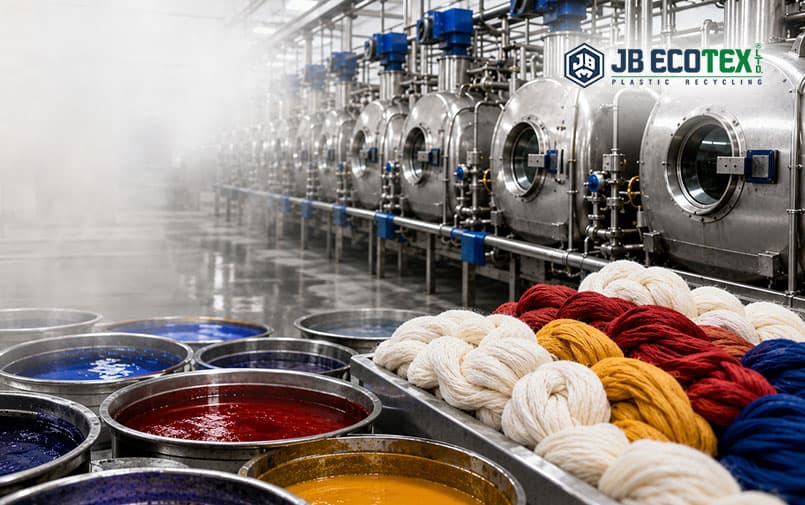
Most recycled polyester carries a compromise: a yellow cast, unpredictable dye uptake, shade variation between runs. The 3001 from J B Ecotex is built to remove all three from your production conversation.
Made from 100% post-consumer PET bottles and manufactured with over 85% renewable energy, 3001 is a GRS-certified, OEKO-TEX Standard 100 and ZDHC-compliant super-white recycled polyester fibre in 1.2D and 1.4D, with cut lengths customised to your requirement. It delivers optical white clarity combined with consistent, reproducible dye performance across pale pastels and deep shades.
If you source white rPET staple fibre for spinning, home textiles, or institutional wear and spend too much time compensating for shade inconsistency, this is the grade to evaluate.
Explore the full recycled polyester staple fibre range
The Dyeing Problem With Most White Recycled Fibre
White fibre that dyes inconsistently creates a cascade of downstream costs: reruns, auxiliary chemical additions, batch rejection, and strained mill schedules. The root cause is usually one of two things: the base whiteness of the fibre was achieved through optical brighteners that interfere with dye chemistry, or the recycled polymer quality was inconsistent to begin with, which shows up as shade drift between lots.
The 3001 is engineered at the polymer stage to address this. Its optical reflectance is a function of clean polymer processing, not surface treatments. The result is a fibre that accepts dye uniformly across the shade range and reproduces the same outcome from one batch to the next.
What this means for your dye floor:
- Pale pastels develop cleanly without the muddy undertones typical of lower-grade recycled white fibre
- Deep and dark shades reach full saturation without requiring extended dye cycles
- Shade reproducibility across production lots reduces rework
- The fibre runs ready-to-dye, with no pre-treatment required on your end
- Dye affinity is built into the melt-spun polymer structure, not applied after spinning
For buyers sourcing optical white rPET staple fibre for yarn that will be piece-dyed or yarn-dyed downstream, the 3001's consistent dye pickup is the technical property that matters most operationally.
What Makes 3001 Different From Standard Recycled White PSF
Recycled polyester staple fibre is a broad category. Within it, the performance gap between grades is significant. Most white recycled PSF on the market is produced from mixed-source PET, processed without rigorous IV control, and delivers whiteness ratings that deteriorate under processing heat.
The 3001 is in a different product class. Here is why it performs differently:
Optical purity through controlled polymer processing. The high optical reflectance comes from quality-controlled post-consumer PET processed through precision melt spinning. No surface brightening agents are used to mask yellowing. The base white is structurally clean.
Consistent IV for spinning stability. IV consistency across batches means the fibre behaves predictably on ring frame, vortex (MVS), open-end, and air-jet systems. Mill teams familiar with virgin-like performance will find the 3001 transitions without surprises.
1.2D fineness for high-quality yarn construction. At 1.2D, the 3001 is positioned for fine-count spinning where fibre uniformity and surface smoothness determine end-fabric quality. The 1.4D variant broadens the range for medium-count applications.
Produced with over 85% renewable energy. For buyers building supply chains that meet scope 3 emissions targets or brand-level sustainability commitments, this is documented and available as part of the product's certification package.
GRS, OEKO-TEX Standard 100, and ZDHC certification. These are the three certifications your compliance team and brand partners will check. All three are active for the 3001 grade.
The broader J B Ecotex polyester staple fibre portfolio covers grades from flame-retardant to ocean-bound plastic to cationic dyeable variants. The 3001 is the standard-bearer of the white spinning grades, engineered for buyers where dye performance and whiteness are the primary selection criteria.
Recycled vs Virgin White PSF — What Actually Changes on Your Line
This is the question procurement teams ask before switching input materials, and it deserves a straight answer.
On spinning performance, the 3001 is engineered to behave like virgin-grade fibre. IV consistency, denier uniformity, crimp stability, and cut length control are maintained through the same precision melt-spinning process used for virgin PSF. Mills trialling the 3001 on ring frame or vortex systems do not need to modify machine settings or accept lower productivity.
On dye performance, the 3001 has an advantage that some virgin grades do not. Because the base polymer is optically clean and free of surface treatments, dye affinity is predictable and consistent. Virgin fibre with optical brighteners can create complications in certain shade ranges. The 3001 does not carry that variable.
On certification, recycled outperforms virgin by definition. GRS-certified recycled content documentation is available for the 3001. Virgin fibre carries no equivalent. For brands with recycled content targets in sourcing policies, this is the deciding factor.
On cost, virgin and recycled white PSF operate in comparable price ranges at commercial volumes. The question for most procurement teams is whether the certification value and supply chain claim justify any differential. For brands under retailer pressure on recycled content, it typically does.
The only area where a switch requires attention is traceability documentation. If your downstream brand partner requires GRS transaction certificates at the yarn or fabric level, your spinning mill needs to be GRS-certified as well. The 3001 is GRS-certified at the fibre level. The chain-of-custody step beyond that sits with your mill.
For buyers still evaluating whether to move from virgin to recycled white PSF, a conversation with our team.
Where 3001 Fits in Your Production
The 3001 is a 1.2D and 1.4D solid fibre with customisable cut lengths. It performs across all four major spinning technologies. In practical terms, this is what that means for specific end uses:
Spinning mills producing fine yarn for apparel
The fibre's uniformity and spinning stability make it suitable for ring and vortex systems where count consistency and low breakage rates are requirements. Whether you are producing casualwear yarn, uniform fabric, or base-layer material, the 3001 delivers virgin-like spinning behaviour from a recycled input.
Home textile manufacturers sourcing for export bedding and curtains
The optical white base is directly suitable for white-finished home textile products and equally suited for yarn that will be dyed into solid or printed designs. Export buyers in Europe and North America increasingly require GRS certification as a sourcing condition. The 3001 carries it.
Institutional textile converters
Healthcare, hospitality, and corporate wear applications require fibre that maintains shade consistency across large production runs. Batch-to-batch reproducibility in dyeing is a non-negotiable for this segment, and the 3001 is specifically engineered for it.
Brands building traceable circular supply chains
The 3001 is produced from post-consumer PET bottles with full traceability documentation available. For brands publishing annual sustainability reports or meeting retailer supply chain questionnaires, verified recycled content with GRS certification is the input requirement. The 3001 qualifies.
If your application requires a different variant, the full RPSF product range includes grades for nonwovens, interlining, ocean-bound plastic routes, flame-retardant properties, and biodegradable options.
Specifications at a Glance
Grade: 3001 – Super-White Recycled Polyester Staple Fibre
Raw material: 100% post-consumer PET bottles
Deniers available: 1.2D and 1.4D
Cut lengths: Customised upon request
Whiteness: High optical reflectance – clean, bright white base
Dye compatibility: Wide shade range, reproducible results from pale pastels to deep shades
Spinning system compatibility: Ring Frame, Vortex (MVS), Open-End, Air-Jet
Energy source: Over 85% renewable energy in manufacturing
Certifications: GRS, OEKO-TEX Standard 100 (Class 1), ZDHC, ISO 14001
Samples, technical data sheets, and volume pricing are available on request. Contact the J B Ecotex technical sales team directly.
Processing Notes for Mill Teams
The 3001 runs on standard polyester staple fibre spinning lines without modifications. A few points that help mill teams integrate it cleanly on first trial.
The fibre is supplied in a ready-to-dye condition. Standard disperse dyeing workflows for polyester apply directly. No pre-scouring or optical brightener stripping is needed before entering the dye bath.
On blending: the 3001 blends with cotton, viscose, wool, and acrylic on conventional blending lines. Blend ratios and crimp settings should follow your standard protocol for fine denier polyester inputs. The fibre's denier uniformity supports even web formation in carding.
On spinning system behaviour: the IV consistency of the 3001 means fibre-to-fibre behaviour is stable within and across batches. End breakage rates on ring and vortex systems are comparable to virgin PSF inputs at equivalent count. If your mill is trialling a new recycled input grade and wants to minimise adjustment variables, starting with a blend rather than 100% substitution is the standard approach.
Cut length is customisable to your requirement. Standard cut lengths for spun yarn applications are 38 mm and 44 mm. If your line runs different parameters, specify at the time of enquiry.
For technical questions specific to your spinning setup, the J B Ecotex technical sales team handles pre-trial consultation directly. Contact details are at the bottom of this page.
Certifications and What They Mean for Your Business
GRS-certified, OEKO-TEX Standard 100 Class 1, ZDHC-compliant, ISO 14001-audited production. These four certifications cover the compliance questions your brand partners, retailers, and procurement teams will raise.
GRS (Global Recycled Standard) gives you verified recycled content documentation at the fibre level, which cascades through your supply chain claim. OEKO-TEX Standard 100 Class 1 covers chemical safety and is the highest class of the standard. ZDHC compliance supports mills and brands operating under manufacturing restricted substance lists. ISO 14001 covers environmental management systems at the production facility level.
For buyers sourcing GRS optical white PSF for dyeing, the 3001 removes the documentation burden. The certification stack is already in place.
How the Sampling and Procurement Process Works
Send your enquiry with the denier, cut length, and end-use application. The J B Ecotex technical sales team will confirm specification fit and dispatch samples with the relevant data sheet. For buyers requiring certification documentation at the sample stage, GRS and OEKO-TEX certificates are available on request.
Trial the fibre on your line. Most mills run an initial blend trial before full substitution. The technical team is available for pre-trial consultation if you want to align on process parameters before the run.
Once the trial is complete, move to volume order with agreed specifications locked. Cut length, denier, and packaging format are confirmed at the purchase order stage.
Samples are dispatched from the J B Ecotex manufacturing facility in Surat, Gujarat. Lead times for trial quantities and bulk orders are confirmed at the enquiry stage based on current production scheduling.
To start, contact the team or use the enquiry form on this page.
Why Source From J B Ecotex
J B Ecotex is a Surat-based manufacturer and exporter of recycled polyester staple fibre with over 10 years in the recycling industry. The facility operates at 25,000 MT per annum capacity for RPSF, with in-house washing, spinning, and drawing operations supported by laboratory-level quality control.
The 3001 is produced in-house, which means technical queries, sample requests, and specification adjustments go directly to the production and technical sales team, not through an intermediary. For buyers who have experienced inconsistency from trading-house sourcing, this is a meaningful operational difference.
The broader product portfolio at J B Ecotex includes 20 RPSF variants, food-grade rPET resin, and hot-washed rPET flakes, giving procurement teams a single manufacturer source across multiple recycled PET material categories.
Request a Sample or Technical Data Sheet →
Related Products
Exploring the full recycled polyester staple fibre range at J B Ecotex includes:
- 3002 – Low BPA Super-White RPSF for skin-contact and babywear applications
- 3011 – Ultra White High-Tenacity RPSF for sewing thread manufacturers
- 2003 AquaLoop – White rPET fibre from Ocean Bound Plastic for brands with marine impact claims
- Ketonik – Cationic dyeable recycled PSF for vibrant colour development at lower temperatures
- KotLyke 5001 – Cotton-like recycled PSF for matte-finish apparel
All grades are available for sample request and technical consultation through the J B Ecotex sales team.
FAQs: 3001 Super-White Recycled Polyester Staple Fibre
What is super-white recycled polyester staple fibre and how is it different from standard recycled PSF?
Super-white recycled polyester staple fibre is produced from quality-controlled post-consumer PET through precision melt spinning, achieving high optical reflectance without surface brightening agents. Standard recycled PSF often carries a yellow or off-white tone due to mixed polymer input. The 3001 delivers cleaner, brighter white from the base polymer, which directly improves dye pickup and shade clarity in downstream processing.
Does 1.2D white recycled polyester fibre maintain shade consistency across production batches?
Yes. The 3001 is engineered for batch-to-batch reproducibility. IV control during production and consistent raw material input keep the dye affinity stable across lots, so shades matched in development translate reliably into bulk production without requiring dye formula adjustments between runs.
Can I use GRS optical white PSF for dyeing into both light and dark shades?
Yes. The 3001 accepts dye across the full shade range, from pale pastels to deep, saturated tones. The optical white base provides the neutral starting point that allows accurate shade development in both directions. No pre-treatment is required before dyeing.
What spinning systems is bright white rPET staple fibre compatible with?
The 3001 is tuned for ring frame, vortex (MVS), open-end, and air-jet spinning systems. It behaves predictably across all four technologies, which means mills running multiple spinning lines can source a single fibre grade for different yarn programmes.
What certifications does J B Ecotex's virgin-like white recycled fibre carry?
The 3001 is certified under GRS (Global Recycled Standard), OEKO-TEX Standard 100 Class 1, ZDHC, and ISO 14001. These certifications cover recycled content traceability, chemical safety, manufacturing restricted substance compliance, and environmental management systems. Documentation is available per shipment on request.
Is the 3001 ready-to-dye or does it require pre-treatment?
The 3001 is supplied ready-to-dye. No additional pre-treatment is required. The dye affinity is built into the melt-spun polymer structure, so it integrates directly into standard polyester dyeing workflows without modifications to your process or auxiliary chemistry.
Why should I buy white polyester fibre from a recycled route rather than virgin PSF?
Recycled white PSF from a certified source like the 3001 delivers comparable spinning performance to virgin fibre while carrying GRS traceability, reducing scope 3 emissions in your supply chain, and meeting the recycled content requirements that major brand partners increasingly specify in sourcing policies. The 3001 is also produced with over 85% renewable energy, which strengthens the environmental case further.
What applications are best suited for the 3001 super-white recycled polyester staple fibre?
The 3001 is suited for spun yarn for apparel, base layers, and casualwear; home textiles including export bedding, curtains, and soft furnishings; institutional textiles for healthcare and hospitality; and knitting and weaving yarns requiring consistent shade performance. It is also used by brands building traceable circular textile supply chains where GRS certification at the fibre level is a sourcing requirement.