
Non Woven Polyester Manufacturing: How Polyester Fiber Behaves in Non-Woven Production
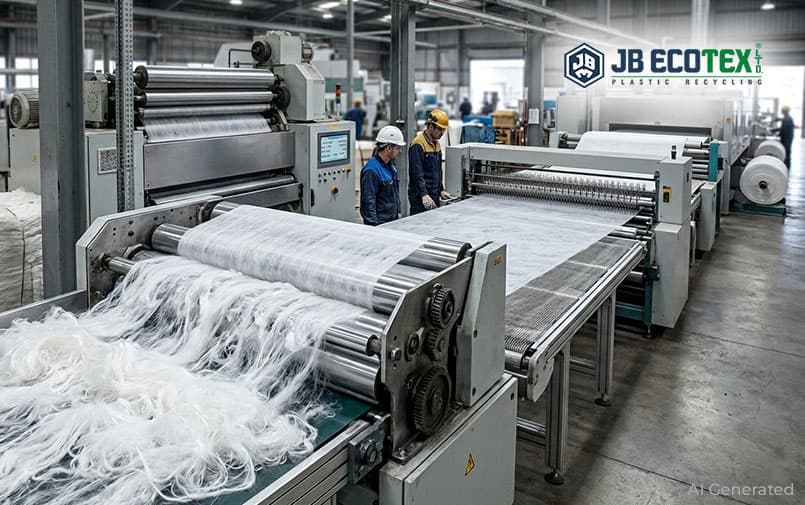
Non-woven fabrics have become one of the fastest growing segments of the technical textile industry. Unlike woven textiles that rely on yarn interlacing, non-woven fabrics are produced by directly converting fibers into a bonded fabric structure.
For manufacturers operating in the non-woven sector, the most critical variable in the production process is fiber behavior. The way fibers open, distribute, entangle, and bond during manufacturing determines the strength, uniformity, and performance of the final fabric.
Among all synthetic fibers used in the non-woven industry, polyester remains the most widely used material. Polyester fibers offer a combination of mechanical strength, dimensional stability, chemical resistance, and processing reliability that makes them particularly suitable for non-woven production lines.
Today, many manufacturers also rely on recycled polyester fibers as a primary raw material. Recycled polyester staple fiber produced from PET bottle waste can deliver consistent fiber properties while supporting sustainability goals in industrial manufacturing.
For buyers sourcing fibers for non-woven manufacturing, understanding the relationship between fiber characteristics and production processes is essential. Fiber length, denier, crimp structure, and bonding behavior all influence how efficiently fibers run on carding machines, air-lay systems, or spunbond lines.
This article examines how polyester fibers are used in non-woven production, the manufacturing methods used to create non-woven polyester fabrics, and what fiber characteristics non-woven manufacturers prioritize when selecting suppliers.
What is Non Woven Polyester
Non woven polyester refers to fabric structures made by bonding polyester fibers into a web without weaving or knitting yarns. Instead of converting fibers into yarn first, the fibers are distributed into a sheet-like structure and stabilized through thermal, mechanical, or chemical bonding processes.
Polyester fibers are widely used in non woven manufacturing because they provide high tensile strength, dimensional stability, and resistance to moisture and chemicals. These properties allow nonwoven polyester fabrics to perform reliably in applications such as filtration, geotextiles, automotive insulation, and industrial textiles.
Why Polyester Fiber Dominates Non-Woven Manufacturing
Non-woven production processes demand fibers that behave predictably under mechanical and thermal stress. Polyester fibers meet these requirements better than most alternatives.
The popularity of polyester in non-woven production comes from several processing advantages.
Polyester fibers have excellent tensile strength and maintain structural stability during mechanical entanglement processes such as needle punching. This allows manufacturers to create durable fabrics without excessive fiber breakage.
Another important advantage is polyester’s thermal bonding capability. Polyester fibers can be engineered to soften at controlled temperatures, allowing them to bond effectively when heat is applied during production.
Polyester fibers also resist moisture absorption and microbial degradation. This makes polyester non-woven fabrics suitable for applications such as filtration systems, geotextiles, and automotive components where environmental exposure is common.
For many manufacturers, polyester fibers also provide a cost-efficient raw material compared to specialty fibers such as aramid or polypropylene blends.
Because of these processing and performance advantages, polyester fiber has become the backbone of many non-woven production lines worldwide.
Fiber Specifications That Directly Affect Non-Woven Production
Non-woven manufacturers evaluate fiber suppliers based on how well the fibers perform inside the production process. Several fiber specifications have a direct impact on production efficiency.
Cut Length
Cut length determines how fibers behave during web formation. If fibers are too short, the resulting web may lack structural integrity. If fibers are too long, they may wrap around rollers or create uneven distribution during carding.
Maintaining consistent cut length during fiber production is therefore critical for stable non-woven manufacturing.
Denier
Denier describes the thickness of individual fibers. Fiber fineness affects both web uniformity and final fabric characteristics.
Fine denier fibers allow manufacturers to produce softer fabrics with higher surface area, which is beneficial for filtration applications.
Higher denier fibers provide structural strength and are commonly used in geotextiles and reinforcement fabrics.
Crimp Structure
Crimp refers to the waviness introduced into the fiber during production. Proper crimp allows fibers to interlock and entangle during web formation.
Without adequate crimp, fibers may slip during processing and reduce fabric strength.
This is why fiber suppliers carefully engineer crimp characteristics when producing polyester staple fibers for non-woven applications.
Fiber Cleanliness
Contaminants such as dust, polymer residues, or inconsistent PET inputs can cause processing problems during non-woven production.
Clean fiber inputs ensure smooth machine operation and reduce downtime.
Manufacturers interested in understanding how recycled fibers are produced can explore the procedure of manufacturing recycled polyester staple fibre, which explains how PET bottles are processed into clean fiber suitable for industrial use.
Step-by-Step Manufacturing Flow of Non-Woven Polyester Fabrics
Non-woven polyester fabrics are produced through a sequence of operations that convert loose fibers into a stable bonded structure.
Although the exact configuration varies between factories, most production lines follow a similar process.
Fiber Opening and Blending
The process begins with fiber opening machines that separate compressed fiber bales into individual fibers.
Opening ensures that fibers are evenly distributed before entering the web formation stage.
Blending machines may also combine fibers with different denier or bonding characteristics depending on the desired fabric properties.
Web Formation
Once opened, fibers are distributed into a thin web structure.
This can be done through several methods.
Carding machines align fibers in a directional orientation to produce uniform webs.
Air-lay systems distribute fibers randomly using airflow.
Each method creates different structural characteristics in the resulting non-woven fabric.
Web Bonding
After the fiber web is formed, it must be stabilized through bonding.
The three most common bonding methods used in polyester non-woven production include:
Needle punching
Thermal bonding
Chemical bonding
Needle punching mechanically entangles fibers using barbed needles that repeatedly penetrate the web.
Thermal bonding uses heat to partially melt fiber surfaces so they bond together.
Chemical bonding uses binders or adhesives to stabilize the fiber web.
The choice of bonding method depends on the desired fabric strength, flexibility, and durability.
Major Non-Woven Polyester Production Technologies
Different manufacturing technologies produce different types of non-woven polyester fabrics.
Spunbond Polyester
Spunbond technology produces non-woven fabrics directly from molten polymer.
Polyester polymer is melted and extruded
through spinnerets to form continuous filaments.
These filaments are laid
randomly onto a conveyor belt to form a web.
Heat and pressure bond the filaments together to create a strong and uniform fabric.
Spunbond fabrics are widely used in construction materials, geotextiles, and agricultural textiles.
Needle-Punched Polyester Non-Wovens
Needle punching is commonly used for thicker non-woven fabrics.
Barbed needles repeatedly penetrate the fiber web, pulling fibers through the structure and entangling them.
This mechanical bonding method creates strong fabrics suitable for heavy-duty applications such as geotextiles and industrial insulation.
Thermal Bonded Polyester Non-Wovens
Thermal bonding relies on heat to bond fibers together.
In many cases manufacturers incorporate low-melt polyester fibers that soften at lower temperatures.
When heat is applied, these fibers melt slightly and act as bonding points within the fabric.
Thermal bonding is commonly used in hygiene products, furniture padding, and automotive materials.
Industrial Applications of Non-Woven Polyester
Non-woven polyester materials are used in a wide range of industries where durability, filtration performance, or structural reinforcement is required.
Geotextiles
Polyester non-woven geotextiles are widely used in road construction and civil engineering projects.
These materials help stabilize soil structures, improve drainage, and prevent erosion.
Automotive Manufacturing
Non-woven polyester fabrics are used in automotive insulation systems, interior panels, and filtration components.
Their lightweight structure helps improve fuel efficiency while maintaining durability.
Filtration Systems
Non-woven polyester fabrics are commonly used in air filters, liquid filtration systems, and industrial dust collection equipment.
The fiber structure allows efficient particle capture while maintaining airflow.
Furniture and Bedding
Non-woven polyester materials are used as cushioning layers in mattresses and upholstered furniture.
These materials provide comfort and structural support.
The Growing Role of Recycled Polyester in Non-Woven Manufacturing
Sustainability is becoming an increasingly important factor in the non-woven textile industry.
Many manufacturers are shifting toward recycled polyester fibers as their primary raw material.
Recycled polyester fibers are typically produced from post-consumer PET bottles that are processed into flakes and converted into polyester fibers through melt spinning.
Modern recycling technology allows these fibers to achieve consistent specifications suitable for industrial applications.
Manufacturers seeking detailed technical information about fiber specifications and industrial applications can explore resources on polyester staple fiber used in textile and non-woven manufacturing.
Using recycled fibers helps reduce plastic waste while maintaining the performance characteristics required for industrial non-woven fabrics.
How Fiber Quality Impacts Non-Woven Fabric Performance
The quality of the fibers used in non-woven production directly influences the characteristics of the final fabric.
Consistent fiber length ensures uniform web formation.
Proper crimp improves fiber entanglement during needle punching.
Controlled denier helps manufacturers achieve the desired balance between strength and flexibility.
Manufacturers therefore place significant importance on sourcing fibers from suppliers who can maintain consistent production standards.
Reliable fiber supply helps ensure stable machine performance and consistent fabric quality.
Recycled Polyester Fiber for Non-Woven Manufacturing
JB Ecotex supplies recycled polyester staple fiber designed for non-woven manufacturing processes including dry-laid, needle-punched, and filtration applications.
Our fibers are produced from recycled PET materials and engineered to provide consistent denier, cut length, and crimp characteristics for reliable web formation and bonding.