
Performance Comparison of Recycled Polyester Staple Fiber in Nonwoven Applications
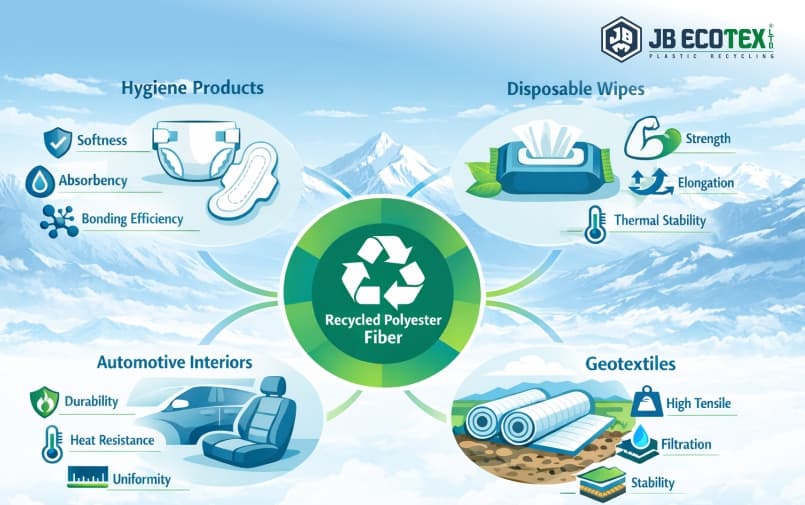
The nonwoven industry has evolved from being a low-cost alternative to woven textiles into a high-performance engineering domain. From geotextiles and filtration media to hygiene products and automotive interiors, nonwoven structures today are engineered for tensile strength, durability, thermal stability, and long service life.
At the center of this transformation is polyester staple fiber, a material that combines mechanical strength with processing versatility. As sustainability pressures intensify across global markets, the shift toward recycled inputs has accelerated. That shift has brought renewed focus on how polyester staple fiber derived from recycled streams performs in demanding nonwoven applications.
This blog provides a technical, performance-driven comparison of recycled grades against virgin material in nonwoven manufacturing, with emphasis on mechanical properties, bonding efficiency, thermal behavior, and end-use reliability. The objective is not to promote generalized sustainability claims but to analyze measurable performance parameters relevant to converters and procurement teams.
Understanding Polyester Staple Fiber in Nonwoven Manufacturing
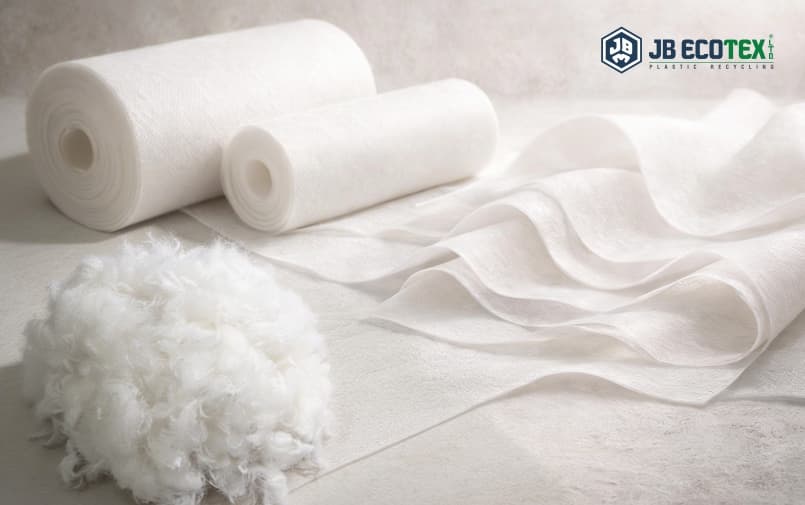
Polyester staple fiber is a discontinuous synthetic fiber typically cut to lengths between 32 mm and 64 mm for nonwoven and spinning applications. Unlike filament yarns, it is engineered for entanglement, carding efficiency, and bonding performance.
In nonwoven manufacturing, polyester staple fiber is used across:
- Needle-punched geotextiles
- Thermal-bonded waddings
- Automotive acoustic panels
- Filter media
- Insulation materials
- Mattress padding
- Technical felts
Its dominance in these sectors stems from:
- High tensile strength-to-weight ratio
- Chemical resistance
- Thermal stability
- Controlled crimp for web cohesion
- Excellent dimensional stability
The manufacturing of polyester fiber traditionally begins with polymerization of PET, melt spinning, quenching, drawing, crimping, and cutting. In recycled grades, the upstream polymer source changes, but downstream processing follows similar mechanical steps with tighter contamination controls.
For converters evaluating polyester staple fiber, the key question is not simply recycled versus virgin. It is whether performance metrics remain within acceptable industrial tolerance.
Types of Polyester Staple Fiber Used in Nonwovens
Before comparing performance, it is important to define fiber categories.
1. Virgin Polyester Staple Fiber
Produced from petrochemical feedstock through controlled polymerization. Offers consistent intrinsic viscosity and predictable denier distribution.
2. Recycled Polyester Staple Fiber
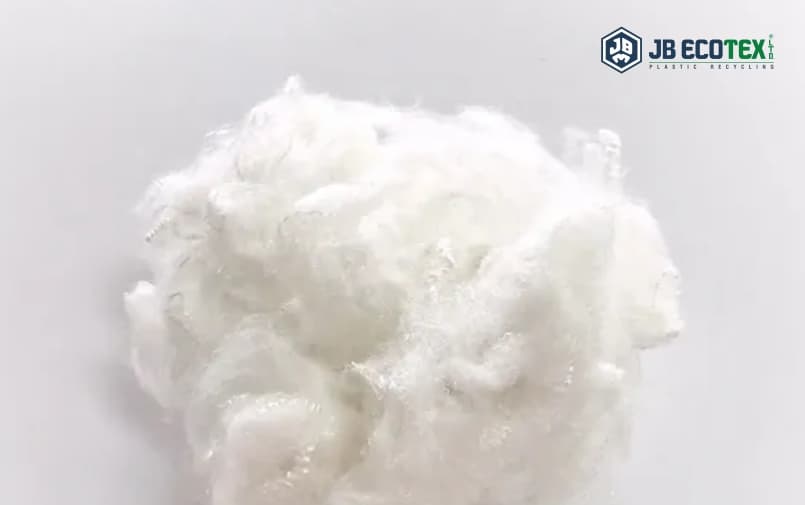
Produced from mechanically recycled PET inputs such as post-consumer bottles or post-industrial waste. Often referred to as recycled polyester staple fiber or recycled PSF in technical documentation.
3. Specialty Functional Grades
Including hollow conjugate fibers, low-melt binder
fibers, and siliconized finishes for loft and softness enhancement.
From a nonwoven standpoint, polyester staple fiber
selection is based on:
- Denier
- Cut length
- Crimp level
- Finish
- Tenacity
- Elongation
The recycled category, especially high-quality recycled PSF, has narrowed the performance gap significantly over the last decade due to improved sorting, washing, and melt filtration technologies.
Performance Parameters for Nonwoven Applications
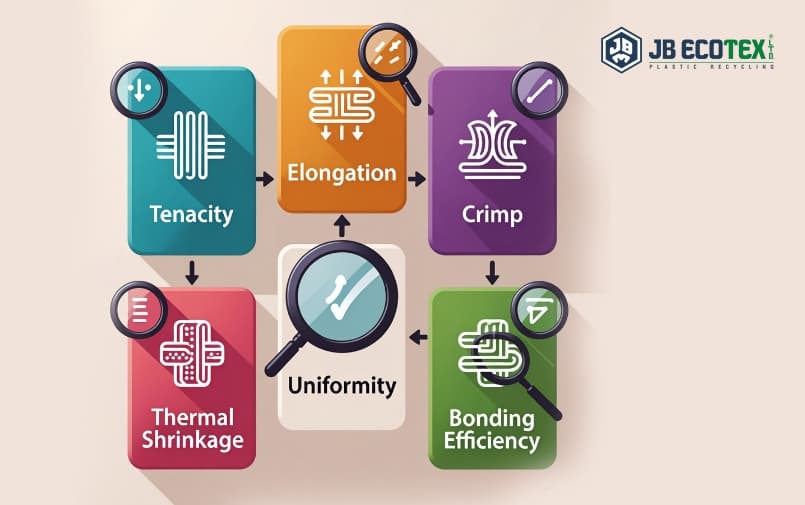
When assessing polyester staple fiber for nonwoven use, performance must be evaluated across quantifiable criteria:
| Parameter |
Relevance in
Nonwoven |
| Tenacity |
Determines tensile strength of web |
| Elongation |
Affects flexibility and durability |
| Crimp |
Influences bulk and cohesion |
| Thermal shrinkage |
Thermal shrinkage |
| Bonding efficiency |
Critical in thermal and needle punching |
| Uniformity |
Ensures consistent GSM |
High-quality recycled polyester staple fiber can meet industrial standards if contamination levels are controlled and melt filtration systems are robust during the manufacturing of polyester fiber.
Mechanical Performance of Polyester Staple Fiber in Nonwoven Structures
Tensile Strength and Tenacity
In needle-punched and thermally bonded webs, fiber tenacity directly affects product durability. Polyester staple fiber typically exhibits slightly higher tenacity when there are consistent polymer chains.
In practical application:
- Automotive acoustic nonwovens show comparable tear strength
- Geotextile grades maintain structural integrity under soil stress
- Insulation panels retain compressive resilience
High-grade recycled polyester staple fiber performs reliably when polymer degradation is minimized during reprocessing.
Elongation at Break
Elongation impacts flexibility and resilience. Properly processed polyester staple fiber retains adequate elongation even in recycled grades. The performance difference is marginal when melt filtration and extrusion control are optimized.
Thermal Stability and Bonding Efficiency
Thermal bonding relies on fiber softening temperature and melting behavior. Thus, careful monitoring during the manufacturing of polyester fiber ensures consistent thermal behavior.
In thermally bonded waddings:
- Low-melt binder fibers integrate effectively with recycled polyester staple fiber
- Web integrity remains stable under heating cycles
- Shrinkage levels remain within acceptable industrial thresholds
Thermal shrinkage control is especially critical in automotive interiors and filtration media, where dimensional consistency defines product performance.
Processability in Nonwoven Manufacturing Lines
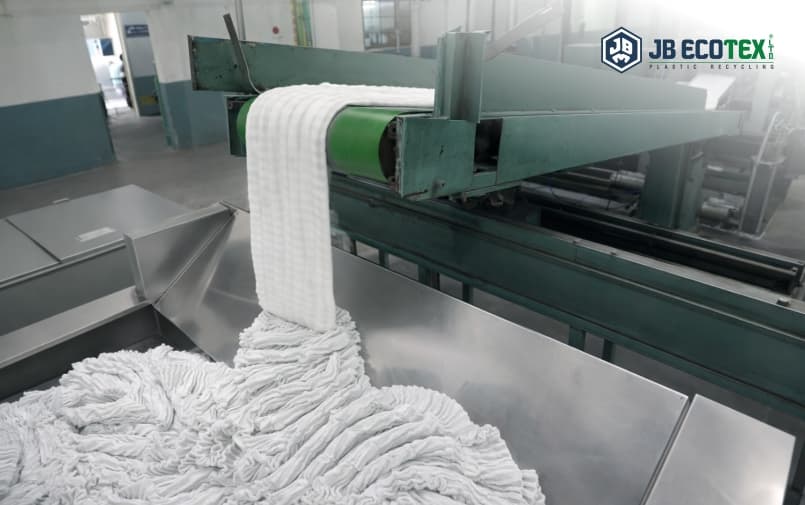
A critical evaluation metric for polyester staple fiber versatility is carding efficiency and web uniformity.
Carding Performance
Uniform denier and cut length ensure smooth processing. Advanced recycled PSF shows minimal fly generation and acceptable static levels when finish oils are properly applied.
Needle-Punch Efficiency
Fiber strength and crimp influence entanglement. In practice, needle penetration resistance and web compaction in recycled grades align closely with virgin material when fiber geometry is controlled.
Thermal Bonding Lines
Low contamination in recycled polyester staple fiber ensures no black specks or polymer inconsistencies, which can otherwise compromise surface appearance.
For converters, the reliability of supply from established polyester staple fibre manufacturers becomes critical. Consistency batch-to-batch determines production uptime.
Environmental and Material Considerations
The nonwoven sector is increasingly examining lifecycle impact. While performance remains the primary evaluation factor, sustainability alignment influences procurement decisions.
Resource Efficiency
Using recycled PSF reduces dependency on virgin petrochemical inputs in the manufacturing of polyester fiber.
Energy Considerations
Mechanical recycling generally consumes less energy than full polymerization from virgin feedstock.
Biodegradability Context
It is important to clarify that polyester staple fiber is not inherently biodegradable. The term biodegradable nonwoven typically refers to alternative non-woven manufactured from biodegradable fibre. Polyester-based nonwovens offer durability and recyclability rather than rapid degradation.
Accurate terminology prevents misleading sustainability claims.
Performance Comparison Summary
Below is a practical comparison for nonwoven converters:
| Property |
Virgin Polyester
Staple Fiber |
Recycled
Polyester Staple Fiber |
| Tensile Strength |
High |
Comparable, slightly variable |
| Elongation |
Elongation |
Within acceptable range |
| Thermal Stability |
Predictable |
Stable with controlled IV |
| Bonding Efficiency |
Excellent |
Comparable in quality grades |
| Contamination Risk |
Contamination Risk |
Dependent on recycling controls |
| Sustainability Profile |
Petrochemical-based |
Reduced virgin dependency |
When sourced from reliable polyester staple fibre manufacturers, recycled grades offer stable performance across nonwoven sectors.
Supply Chain and Quality Control
For nonwoven converters, the role of textile raw material suppliers extends beyond fiber delivery. It includes:
- Batch traceability
- Intrinsic viscosity documentation
- Contamination testing
- Moisture control certification
- Denier consistency reports
Professional polyester staple fibre manufacturers implement strict quality control during the manufacturing of polyester fiber to maintain structural integrity.
Consistency is particularly critical in automotive and filtration applications, where regulatory specifications must be met.
Key Technical Specifications Buyers Should Evaluate Before Procuring Polyester Staple Fiber
Industrial buyers should request technical documentation covering:
- Denier range tolerance
- Cut length consistency
- Intrinsic viscosity range
- Moisture content
- Crimp frequency
- Tensile strength data
- Elongation at break
- Thermal shrinkage percentage
Because variations in the manufacturing of polyester fiber can affect downstream bonding behavior, pre-procurement validation reduces production risk.
Application-Specific Insights
Automotive Nonwovens
Acoustic and insulation panels rely heavily on polyester staple fiber for dimensional stability. Recycled grades perform reliably when fiber resilience is preserved.
Filtration Media
Uniform fiber diameter ensures consistent pore structure. High-quality recycled polyester staple fiber supports stable air permeability values.
Geotextiles
Needle-punched geotextiles require strong fiber entanglement. Industrial-grade recycled PSF supports tensile performance benchmarks for infrastructure applications.
Bedding and Upholstery
Bulk and loft retention are crucial. Siliconized polyester staple fiber maintains recovery after compression cycles.

Application Spotlight: Polyester Staple Fiber in Technical Textile Like Tents and Shelter Systems
In technical textiles, particularly temporary and semi-permanent shelter systems, polyester staple fiber plays a critical role in layered nonwoven structures used for insulation, reinforcement, and thermal buffering.
Where Polyester Staple Fiber Is Used in Tent Systems
- Insulation batting layers inside multi-layer tent walls
- Acoustic dampening in modular shelters
- Reinforcement felt layers in coated textile systems
- Ground protection and separation layers in relief shelters
In such applications, performance parameters differ from hygiene or automotive nonwovens. Here, the focus shifts to:
- Dimensional stability under fluctuating temperature
- Moisture resistance
- UV durability when laminated
- Tear resistance in needle-punched structures
High-quality recycled polyester staple fiber used in needle-punched felt layers maintains tensile strength even under repeated folding and mechanical stress. For disaster relief tents and military shelters, this consistency is critical.
Because tents are frequently deployed in high-humidity or high-heat environments, thermal shrinkage stability of polyester staple fiber becomes a decisive parameter. Fiber that exhibits excessive shrinkage can distort laminated coatings or compromise seam alignment.
Modern recycled psf processed under controlled intrinsic viscosity conditions can meet the mechanical resilience requirements of these technical textile applications.
Advancements in Manufacturing of Polyester Fiber
Technological improvements in the manufacturing of polyester fiber have strengthened recycled fiber reliability:
- Advanced melt filtration systems
- Multi-stage washing processes
- Optical contamination sorting
- Controlled extrusion temperature management
- Inline denier monitoring
These developments ensure recycled polyester staple fiber approaches virgin-grade performance in industrial nonwoven use. And hence, the virgin polyester v recycled polyester debate now seems to lack gravitas.
Addressing Common Industry Concerns
Is recycled PSF suitable for
high-stress applications?
Yes, provided intrinsic viscosity and contamination levels are controlled.
High-grade recycled PSF can meet structural performance criteria in
geotextiles and automotive felts.
Does recycled fiber affect
bonding?
In thermally bonded nonwovens, bonding efficiency remains stable when melting
behavior is consistent. This depends on process control during the manufacturing
of polyester fiber.
Is polyester biodegradable?
Standard polyester staple fiber is not classified as biodegradable.
Claims regarding biodegradable nonwoven materials must refer to
alternative polymer systems.
Is recycled polyester staple fiber suitable for
tent and shelter nonwovens?
Yes. When processed under controlled intrinsic
viscosity and contamination standards, recycled grades can meet mechanical and
dimensional stability requirements for insulation and reinforcement layers.
How does recycled PSF compare with virgin in
geotextiles?
In medium-load geotextiles, high-grade recycled psf performs within
acceptable tensile and elongation tolerance ranges.
Is polyester staple fiber biodegradable?
Standard polyester-based nonwovens are not classified as biodegradable
nonwoven materials. Alternative polymers are required for compostable
applications. At JB Ecotex, we also make biodegradable RPSF. Contact us to know
more.
What factors influence bonding efficiency in thermal
nonwovens?
Melting behavior, fiber finish, denier uniformity, and process temperature
control during the manufacturing of polyester fiber all influence bonding
performance.
JB Ecotex’s Role in the Recycled Polyester Staple Fiber Value Chain
The performance reliability of recycled polyester staple fiber in nonwoven applications is directly linked to upstream raw material processing and polymer consistency.
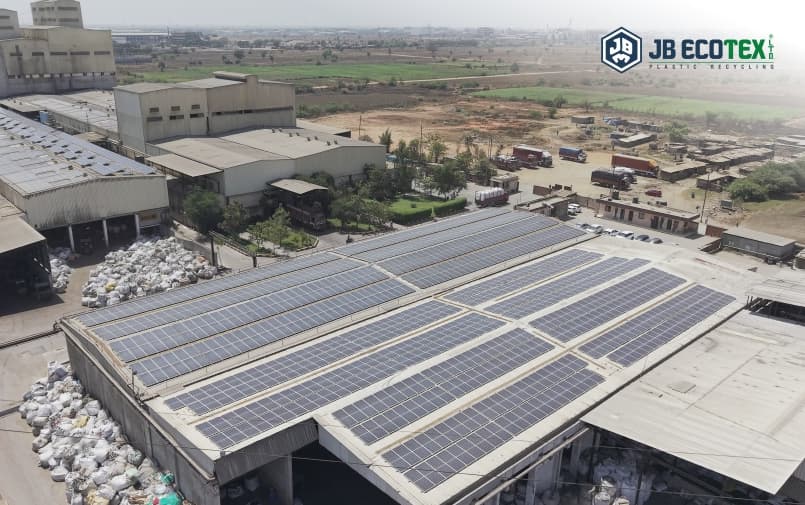
JB Ecotex operates within the recycled polyester ecosystem with a focus on controlled sourcing, contamination management, and process discipline across the manufacturing of polyester fiber chain.
In the context of industrial nonwovens, this translates into:
- Stable intrinsic viscosity control
- Consistent denier and cut length
- Controlled crimp parameters
- Low contamination risk
- Batch-level traceability
For converters evaluating recycled polyester staple fiber, performance is determined not just by fiber origin but by process integrity.
As demand grows across geotextiles, automotive felts, insulation, and technical textile applications such as tent systems, fiber suppliers must meet structural reliability standards rather than rely solely on sustainability positioning.
JB Ecotex’s placement in this industry aligns with the growing demand for performance-oriented recycled PSF suited to nonwoven applications that require mechanical durability, dimensional stability, and predictable processing behavior.
Performance, Process Control, and the Future of Polyester Staple Fiber in Nonwovens
The performance comparison between virgin and recycled polyester staple fiber in nonwoven applications reveals a clear trend: the performance gap has significantly narrowed due to advancements in recycling and processing technologies.
High-quality recycled polyester staple fiber demonstrates competitive mechanical strength, reliable thermal stability, and efficient processability across needle-punched and thermally bonded applications. When sourced from established polyester staple fibre manufacturers and supported by responsible textile raw material suppliers, recycled grades can deliver consistent industrial performance.
The evaluation of polyester staple fiber today is no longer limited to origin. It is defined by measurable performance metrics, controlled processing, and application-specific validation.
For nonwoven manufacturers seeking both performance reliability and material efficiency, engineered recycled solutions offer a technically sound and commercially viable pathway forward.