
What the Latest Plastic Waste Management Rules Mean for Packaging, rPET, and EPR Compliance in India
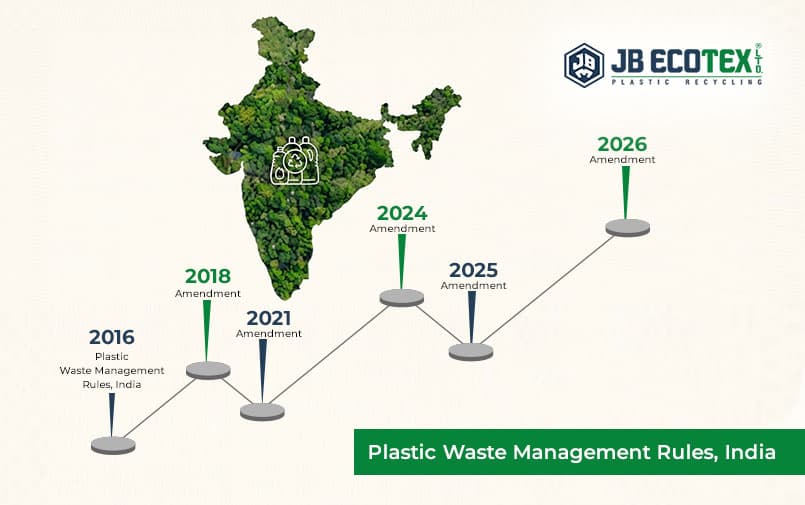
On 31 March 2026, India's Ministry of Environment, Forest and Climate Change published the Plastic Waste Management (Amendment) Rules, 2026 in the Gazette of India (G.S.R. 237(E)). These rules amend the Plastic WasteManagement Rules, 2016, and take effect from the date of their publication.
For manufacturers, importers, brand owners, and recyclers, this is a significant update. The rules introduce binding recycled content targets, revised reuse obligations, new enforcement structures, and updated definitions that directly affect how plastic packaging is sourced, used, and reported. Brands working toward EPR compliance will want to read this carefully.
This blog breaks down exactly what changed, what it means across the supply chain, and where rPET fits in.
What the Latest Plastic Waste Management Rules Actually Changed
1. Recycled Content Targets Are Now Mandatory and Phased
The most consequential change in the 2026 amendment is the introduction of binding, year-on-year targets for the use of recycled plastic in packaging. These apply separately to producers, importers, and brand owners, across three categories of plastic packaging.
Category I covers rigid plastic packaging. Category II covers flexible plastic packaging. Category III covers multi-layered plastic packaging (MLP).
Mandatory recycled plastic use (% of plastic packaging manufactured, imported, or used in the year):
| Packaging
Category |
2025-26 |
2026-27 |
2027-28 |
2028-29 onwards |
| Category I |
30% | 40% |
50% | 60% |
| Category II |
10% | 10% | 20% | 20% |
| Category III |
5% | 5% | 10% | 10% |
These targets apply to producers, importers, and brand owners. For Category III (MLP), the recycled content target is calculated against the weight of plastic layers only, excluding any non-plastic components.
There is a carry-forward provision for food contact packaging. If a producer, importer, or brand owner falls short of the 2025-26 target for food contact applications specifically, they may carry that shortfall forward across the following three years (2026-27 through 2028-29), provided they clear at least one-third of the carried forward amount each year.
Exemptions apply where law or mandatory Indian Standards prohibit the use of recycled plastic. FSSAI, the Central Drugs Standard Control Organisation (CDSCO), and the Central Insecticide Board are the named statutory bodies whose rules can trigger this exemption. Any brand claiming an exemption must declare the relevant law or standard in their annual return on the centralised online portal.
2. Reuse Obligations for Rigid Plastic Packaging (Category I)
Brand owners using Category I rigid plastic packaging face a separate and parallel obligation: a minimum percentage of that packaging must be reused. The targets are specific to pack size and product type.
Minimum reuse obligation for Category I rigid plastic packaging:
Packs of 0.9 litre/kg to less than 4.9 litre/kg:
- 2025-26: 10%
- 2026-27: 15%
- 2027-28: 20%
- 2028-29 onwards: 25%
Packs of 4.9 litre/kg or more, used for drinking water:
- 2025-26: 70%
- 2026-27: 75%
- 2027-28: 80%
- 2028-29 onwards: 85%
Packs of 4.9 litre/kg or more, used for products other than drinking water:
- 2025-26: 10%
- 2026-27: 10%
- 2027-28: 15%
- 2028-29 onwards: 15%
The high reuse targets for large drinking water containers (70% in 2025-26) reflect the volume of plastic used in packaged water, where rPET and refillable containers are already common in industrial and commercial supply chains. Brand owners may carry forward unfulfilled reuse targets from 2025-26 across the next three years, with the same one-third per year floor.
Brand owners must also report total sales, virgin plastic use, and recycled plastic use in rigid packaging through the CPCB centralised portal in their annual return.
3. Updated Definitions: What Counts as Recycling vs. End of Life Disposal
The 2026 amendment rewrites the definition of "end of life disposal" (clause ga) in a way that matters for how plastic waste processing is classified.
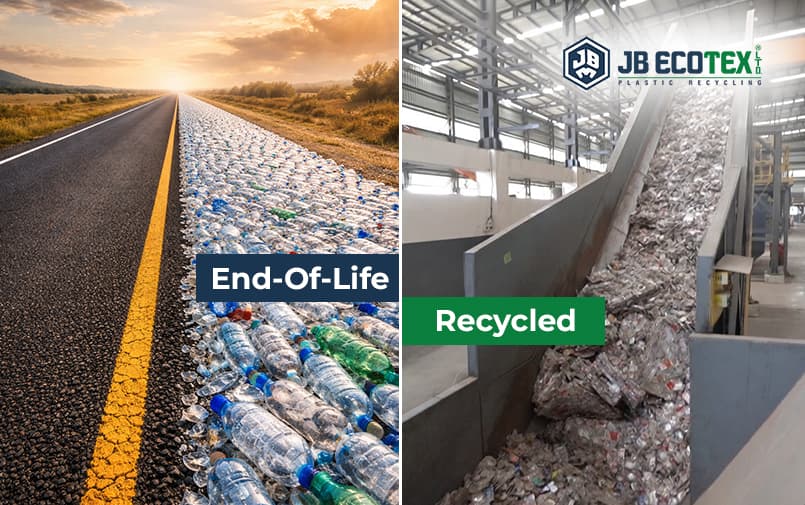
Under the updated definition, end-of-life disposal means the use of plastic waste for energy recovery. This covers co-processing in cement or steel industries, waste-to-energy processes, waste-to-oil conversion, and road construction as per applicable guidelines.
The new definition includes an explicit carve-out: processes that convert plastic waste into feedstock chemicals, or into new plastic, are classified as recycling, not end of life disposal. This distinction has regulatory and reporting implications for plastic waste processors.
The definition of "recycling" (clause qa) has also been updated to include "or generation of energy" alongside the existing phrase "transformation into new products." This means energy-generating processes can in some contexts count as recycling, provided they meet the other conditions in the rule.
The definition of "Plastic Waste Processors" (clause qb) now covers two types of entities: those involved in recycling plastic waste, and those engaged in end of life disposal. The previous definition was narrower.
A new definition of "seller" (clause uc) has been introduced. A seller is defined as a person who sells plastic raw material such as resins, pellets, or intermediate material used for producing plastic packaging. This brings resin and pellet suppliers explicitly within the regulatory scope of the plastic waste management framework for the first time.
4. Recycled Plastic Labelling Requirements
Rule 11(2) has been rewritten. Every recycled plastic packaging or commodity must now conform to IS 14534:2023, the Indian Standard titled "Plastics Recovery and Recycling of Plastics Waste Guidelines." Products must bear the resin identification code label shown in the Gazette (the standard triangular recycling symbol with numbers 1 through 7, corresponding to PET, HDPE, PVC, LDPE, PP, PS, and Other resins).
For food contact applications, labelling must also comply with FSSAI marking and labelling requirements. This applies to rPET packaging used in food and beverage contact applications, including bottles and containers made from food grade rPET resin.
5. Enforcement Is Now Explicitly Decentralised
Rule 12 has been amended to add three new sub-rules (3A, 3B, and 3C) that clarify which local body has enforcement authority for plastic waste rules.
- Rule 12(3A): Urban Local Bodies (ULBs) have enforcement authority in their jurisdiction for waste management rules, restrictions on plastic carry bags and packaging, and items banned under Rule 4. Where ULB and local authority jurisdictions overlap, the ULB takes precedence. In peri-urban areas outside the ULB jurisdiction, the local authority has enforcement power.
- Rule 12(3B): Gram Panchayats have enforcement authority in rural jurisdictions.
- Rule 12(3C): District-level Panchayats have enforcement authority in their jurisdiction.
This decentralisation means enforcement of CPCB plastic waste rules is less dependent on state-level action and more likely to reach manufacturing units, waste generators, and suppliers at the local level.
6. State Level Monitoring Committees Restructured
Rule 16(1) has been replaced with a detailed composition for State Level Monitoring Committees. The new structure includes representation from:
- Chief Secretary of the State (Chairman)
- Departments responsible for municipal administration, Panchayati Raj, urban development, rural development, and environment
- Member Secretary of the State Pollution Control Board
- Municipal Commissioners from cities with populations above and below one million
- CEOs of District Level Panchayats
- Experts from NGOs involved in waste management, industry associations, the industrial sector, and academia
The expanded committee structure means more oversight at the state level. Rule 16(2) has also been amended to allow these committees to invite district-level government officials, expanding the reach of monitoring beyond senior state officials.

7. Registered Environment Auditors Can Now Verify Compliance
Rules 17(5), Schedule II para 12(12.4), and Schedule II para 13(13.1) have all been amended to allow compliance verification "through a designated agency or Registered Environment Auditor." The definition of "registered environment auditor" in clause (ua) points to the Environment Audit Rules, 2025.
Previously, only a designated agency could carry out this verification. The inclusion of registered environment auditors creates a wider pool of qualified verifiers and may make EPR compliance audits more accessible for manufacturers and importers of varying sizes.
Key Terms Defined in the 2026 Amendment
Six definitions in Rule 3 were updated or introduced in the 2026 amendment. These terms set the boundaries for how recycled content, waste processing, and compliance verification are classified under the rules.
End-of-life disposal means the use of plastic waste for energy recovery. Covered processes include co-processing in cement and steel industries, waste-to-energy processes, waste-to-oil conversion, and road construction as per applicable guidelines. Conversion of plastic waste into feedstock chemicals or new plastic falls outside this definition and classifies as recycling.
Recycling means transformation of plastic waste into new products or generation of energy. The 2026 amendment adds "or generation of energy" to the previous definition, which covered only transformation into products.
Plastic Waste Processors means entities involved in recycling plastic waste, or entities engaged in end of life disposal. The previous definition covered recyclers only. The expanded definition now brings waste-to-energy operators and co-processors into this classification.
Registered Environment Auditor means an environment auditor as defined under the Environment Audit Rules, 2025. These auditors can verify EPR compliance and recycled content use as an alternative to designated agencies under Rules 17, 12.4, and 13.1 of Schedule II.
Reuse means using an object or resource material again for the same or a different purpose without changing its structure. This definition applies to the reuse obligations on brand owners using Category I rigid plastic packaging.
Seller means a person who sells plastic raw material such as resins, pellets, or intermediate material used for producing plastic packaging. This is a new definition. It brings raw material suppliers into the regulatory framework explicitly for the first time.
What This Means for the rPET Supply Chain
The plastic waste management rules 2026 make demand for recycled plastic a compliance requirement, across every link of the packaging supply chain. The recycled content mandates, when read alongside the existing Extended Producer Responsibility (EPR) framework, create strong and measurable incentives for brands to source verified recycled materials.
For packaging material suppliers, the implications are direct:
- Demand for food grade rPET resin and pellets increases as brands bring recycled content into food contact packaging.
- Documentation requirements become more rigorous. Brands need to prove the recycled content percentage in their packaging and submit this in annual returns. Suppliers who can provide GRS certification, food safety approvals, and verified IV specifications are better positioned.
- The "seller" definition in clause (uc) means resin and pellet suppliers are now explicitly within the regulatory framework, which may lead to greater documentation requirements at the point of sale.
- The IS 14534:2023 labelling requirement ties directly to the type of rPET used. Food contact labelling under FSSAI rules requires the underlying resin to meet food safety standards.
Brands with FMCG packaging in Category I, particularly in beverages, personal care, and household products, face the steepest and fastest escalation: 30% recycled content in 2025-26, rising to 60% by 2028-29. That is a significant procurement shift if they are starting from zero.
Why J B Ecotex Supplies the rPET These Rules Demand
J B Ecotex manufactures food grade rPET resin at scale from its facility in Surat, using EREMA VACUNITE technology. This production process is specifically designed for closed-loop recycling of post-consumer PET, and it produces resin suitable for direct food contact applications.
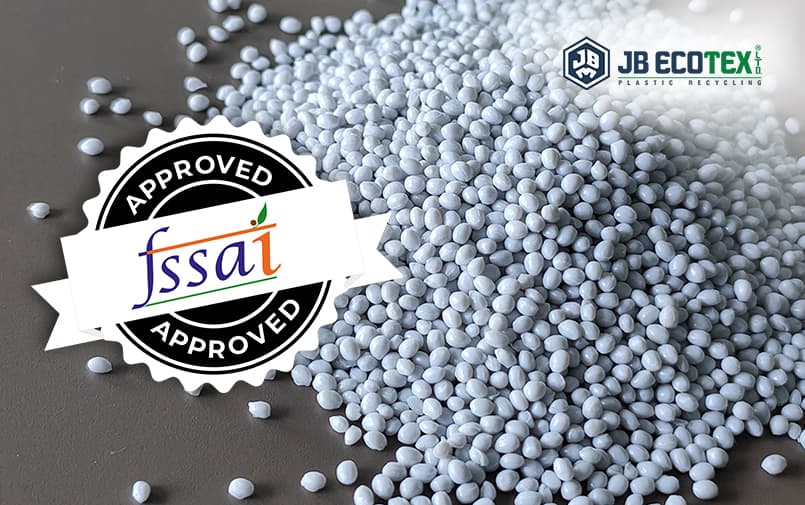
The company holds an FSSAI approval (File No. STD/SP-20/T-RPET-07) along with FDA No Objection Letter (NOL) for its food grade rPET resin. It is also GRS certified. For brands sourcing recycled plastic for food and beverage packaging, these certifications are required documentation for demonstrating compliance under the plastic waste management rules 2026.
What J B Ecotex supplies:
- Food grade rPET resin with IV range 0.72 to 0.84 dl/g
- Contamination levels below 50 ppm
- GRS certified, FSSAI approved, FDA NOL and EFSA authorised
- Material suitable for bottle-to-bottle recycling, thermoforming, and sheet extrusion
- Full traceability documentation for recycled content claims and EPR compliance reporting
As a domestic manufacturer and exporter with 10+ years in industrial-scale recycling, J B Ecotex works with brands and packaging converters who need verified rPET that meets both Indian and international food safety requirements.
For any brand working toward meeting the recycled content targets in the 2026 amendment, sourcing from a certified food grade rPET supplier with FSSAI approval is the cleaner path to annual return compliance.
How Brands Can Meet EPR Compliance Under the 2026 Rules
EPR compliance under the plastic waste management rules 2026 now covers three parallel obligations: collection, recycled content use, and reuse of rigid packaging. The 2026 amendment primarily strengthens the second and third.
Here is the practical sequence for a brand and companies working toward compliance.
Classify your packaging. All plastic packaging must be assigned to Category I (rigid), Category II (flexible), or Category III (multi-layered). Each category carries different recycled content targets, and Category I carries additional reuse obligations by pack size.
Calculate your recycled content obligation. For 2025-26, the baseline is 30% for Category I, 10% for Category II, and 5% for Category III, calculated against total plastic packaging manufactured, imported, or used in the year. For food contact applications where recycled plastic is restricted under FSSAI or another statutory body, document the applicable law before claiming an exemption.
Source certified recycled materials. For food contact packaging, rPET resin should carry FSSAI approval, GRS certification, and FDA No Objection Letter or EFSA authorisation for brands with export requirements. The IS 14534:2023 labelling requirement means packaging must conform to the Indian Standard and bear the correct resin identification code.
Verify through a registered environment auditor. A registered environment auditor or designated agency can verify recycled content use and EPR compliance. Engaging one early in the reporting cycle gives brands time to address documentation gaps before the annual return deadline.
File annual returns on the CPCB centralised portal. Producers, importers, and brand owners must submit annual returns covering recycled content use, virgin plastic use, reuse data for rigid packaging, and any exemption claims with supporting documentation. For Category I packaging specifically, total sales volume, recycled content percentage, and virgin plastic use must all be declared.
Brands that fall short of the 2025-26 food contact recycled content target may carry the shortfall forward across 2026-27, 2027-28, and 2028-29, with at least one-third of the outstanding amount fulfilled each year.
Key Things to Know About the 2026 Amendment: A Summary
- Effective date: 31 March 2026 (date of gazette publication)
- Recycled content targets apply to producers, importers, and brand owners for 2025-26 onward
- Category I packaging (rigid) reaches 60% mandatory recycled content by 2028-29
- Reuse obligations for rigid packaging are separate from recycled content obligations
- Food contact carry-forward is allowed from 2025-26 across three years, with a minimum one-third per year floor
- Sellers of resins and pellets are now defined entities under the rules
- IS 14534:2023 is the mandated standard for recycled plastic labelling
- Registered Environment Auditors can now verify EPR compliance
- Local bodies have explicit enforcement authority at the ULB, Gram Panchayat, and district level
- Exemptions apply for food, pharma, and pesticide packaging where law prohibits recycled content, but must be declared in annual returns
What Changed from the 2016 Rules to the 2026 Amendment
The Plastic Waste Management Rules have been amended multiple times since their original publication in March 2016. The 2026 amendment is the most substantive update to recycled content and reuse obligations to date.
| Area |
Before 2026 |
After 2026
Amendment |
| Recycled content
targets |
No binding percentage
targets |
30–60% for Category
I, phased annually from 2025-26 to 2028-29 |
| Reuse obligations |
General obligation on
brand owners |
Specific percentage
targets by pack size, phased annually |
| End of life disposal
definition |
Covered energy recovery broadly |
Feedstock chemical production and new plastic
manufacturing explicitly excluded — both now classified as recycling |
| Plastic Waste Processors definition |
Recyclers only |
Expanded to include entities engaged in end of life
disposal |
| Seller definition |
No definition existed |
Resin, pellet, and intermediate material suppliers
now explicitly defined and within regulatory scope |
| Compliance verification |
Designated agencies only |
Registered Environment Auditors now eligible
alongside designated agencies |
| Local enforcement |
State-level administration |
ULBs, Gram Panchayats, and district-level Panchayats
have explicit jurisdiction |
| Food contact carry-forward |
No provision |
2025-26 shortfall can be carried forward across three
years, with one-third minimum cleared annually |
The carry-forward provision for food contact packaging is practically important for any brand sourcingr PET packaging material for beverages, edible oils, or other food categories. The 2025-26 baseline year gives brands a window to build their recycled content supply chains before the 2026-27 and 2027-28 targets tighten.
Key Terms Defined in the 2026 Amendment
Six definitions in Rule 3 were updated or introduced in the 2026 amendment. These terms set the boundaries for how recycled content, waste processing, and compliance verification are classified under the rules.
End of life disposal means the use of plastic waste for energy recovery. Covered processes include co-processing in cement and steel industries, waste-to-energy processes, waste-to-oil conversion, and road construction as per applicable guidelines. Conversion of plastic waste into feedstock chemicals or new plastic falls outside this definition and classifies as recycling.
Recycling means transformation of plastic waste into new products or generation of energy. The 2026 amendment adds "or generation of energy" to the previous definition, which covered only transformation into products.
Plastic Waste Processors means entities involved in recycling plastic waste, or entities engaged in end of life disposal. The previous definition covered recyclers only. The expanded definition now brings waste-to-energy operators and co-processors into this classification.
Registered Environment Auditor means an environment auditor as defined under the Environment Audit Rules, 2025. These auditors can verify EPR compliance and recycled content use as an alternative to designated agencies under Rules 17, 12.4, and 13.1 of Schedule II.
Reuse means using an object or resource material again for the same or a different purpose without changing its structure. This definition applies to the reuse obligations on brand owners using Category I rigid plastic packaging.
Seller means a person who sells plastic raw material such as resins, pellets, or intermediate material used for producing plastic packaging. This is a new definition. It brings raw material suppliers into the regulatory framework explicitly for the first time.
Where This Leaves Brands, Converters, and Recyclers in 2026
The 2026 amendment tightens the framework across every stage: how recycled content is defined, how it must be used, how it must be labelled, and how it will be verified. The carry-forward provisions for food contact packaging give brands some operational flexibility in the first year, but the escalating targets leave little room for delay beyond that.
For FMCG packaging brands in India, the recycled content mandate for Category I now functions as a procurement specification. Sourcing rPET packaging material from a supplier with food grade certifications, verified recycled content, and documentation aligned to IS 14534:2023 is the practical path to meeting the 2025-26 baseline and building toward the 60% target by 2028-29.
The rules also expand the scope of who is accountable, from individual brand owners up to the resin sellers who supply them. Recycling standards in India are being enforced with more precision. The window for informal or unverified sourcing is closing.
For product specifications, certifications, and supply inquiries, visit jbecotex.com.
Frequently Asked Questions: Plastic Waste Management Rules 2026
Who does the recycled content mandate apply to?
The mandatory recycled content targets apply to producers, importers, and brand owners. Targets are calculated as a percentage of plastic packaging manufactured, imported, or used in a given financial year, depending on which category the entity falls under.
What is Category I plastic packaging?
Category I covers rigid plastic packaging. Bottles, jars, tubs, and containers made from rigid plastic all fall here. The recycled content target for Category I reaches 60% by 2028-29, and brand owners using Category I packaging also face separate minimum reuse obligations that vary by pack size.
Does the mandate apply to food packaging?
Yes. Where FSSAI or another statutory body restricts the use of recycled plastic in food contact applications, brands may claim an exemption by submitting the relevant law in their annual return on the CPCB portal. Where recycled plastic is permitted in food contact use, the 2025-26 shortfall can be carried forward across the following three years, with a floor of one-third per year.
What certifications does food grade rPET resin need for compliance?
For food contact packaging in India, rPET resin used to meet recycled content targets should carry FSSAI approval and GRS certification for recycled content verification. FDA No Objection Letter is also relevant for brands with international requirements. All recycled plastic packaging must also conform to IS 14534:2023 and bear the appropriate resin identification code label.
What is the difference between recycling and end-of-life disposal under the new rules?
Recycling covers transformation of plastic waste into new products, feedstock chemicals, new plastic, or energy generation. End-of-life disposal covers energy recovery through co-processing in cement or steel industries, waste-to-energy processes, waste-to-oil conversion, and road construction. The classification affects how plastic waste processors are registered and how compliance is reported.
Can a Registered Environment Auditor verify EPR compliance?
Yes. The 2026 amendment adds Registered Environment Auditors as eligible verifiers alongside designated agencies for compliance verification under Rules 17, 12.4, and 13.1 of Schedule II.
What recycling standards apply to recycled plastic packaging in India?
Amended Rule 11(2) mandates conformance to IS 14534:2023, the Indian Standard for plastics recovery and recycling. Packaging must carry the resin identification code label as shown in the standard. For food contact applications, FSSAI marking and labelling requirements apply alongside the IS standard.
Where do brands file their annual return for plastic waste compliance?
Annual returns are filed on the centralised online portal developed by the Central Pollution Control Board. The return covers recycled content use, reuse data, virgin plastic use, and any exemption claims with supporting documentation.