
Bottle-to-Bottle rPET Resin: Process, Quality Parameters, and Compliance
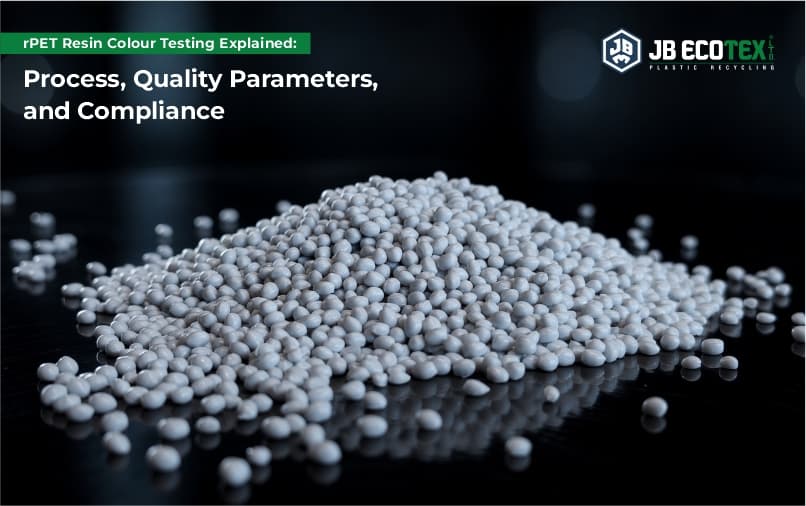
A PET bottle finishes its first life on a supermarket shelf, gets collected, cleaned and reprocessed, and returns to the same shelf as a brand-new bottle. That closed loop is bottle-to-bottle recycling, and the material that makes it possible is bottle-to-bottle rPET resin. Plastic stays in use and stays out of the environment, in a loop elegant enough for a circular economy to be built around it. The idea sounds simple. The engineering behind it is anything except that, because a bottle destined to hold food or drink must clear safety standards that ordinary recycled plastic will simply miss.
At J B Ecotex, we manufacture food-grade rPET resin through this route every day, turning post-consumer bottles into certified pellets ready for food and beverage packaging. What follows is the full picture a procurement or packaging team needs: how the material is made, the quality parameters that define it, and the Indian regulatory mandate that has turned recycled content from a preference into a legal obligation.
What Is Bottle-to-Bottle rPET Resin?
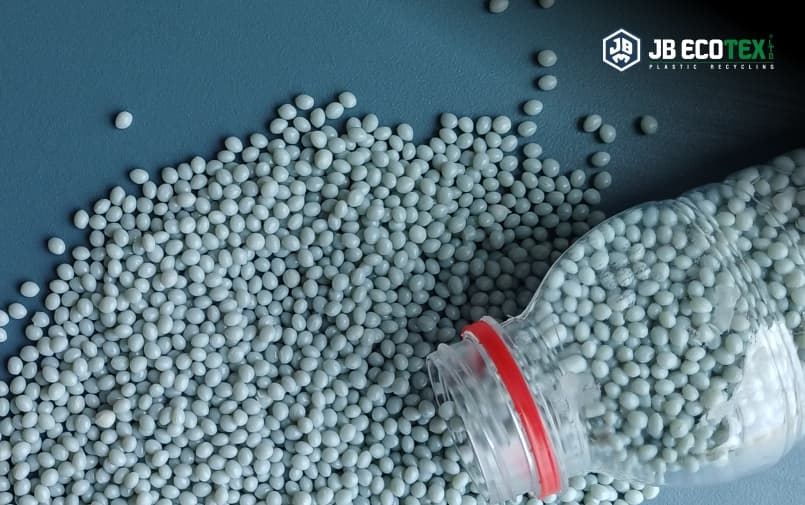
PET, short for polyethylene terephthalate, is among the most widely used plastics in food and beverage packaging. Lightweight, transparent and strong, it also suits being recycled again and again. Collect post-consumer PET bottles, reprocess them to a standard where they can safely become bottles again, and the resin you get carries the name bottle-to-bottle rPET resin.
The food-contact requirement is what separates this material from general purpose recycled plastic. Bottle-to-bottle rPET resin must satisfy strict safety standards laid down by regulators across major markets: the US FDA, EFSA in Europe, and India's FSSAI. Those standards ask for three things at once. The resin must be free from contaminants. It must hold its physical and chemical integrity. And it must perform on par with virgin PET on high-speed bottle manufacturing lines, where the pace leaves little room for weak material. Meeting all three simultaneously is the entire challenge of food-grade rPET manufacturing, and it explains why so much engineering sits behind a material that looks, to the eye, like simple clear pellets.
The Bottle to Bottle Recycling Process, Step by Step
Our process is a carefully engineered, multi-stage journey along a mechanical recycling route, taking material from post-consumer waste to certified food-grade pellets. Here is how a bottle becomes a bottle again:
- Waste bottle feedstock: post-consumer PET bottles are sourced and segregated with care, so only the right quality of material enters the recycling line.
- Washing and crushing: the collected bottles pass through a fully automatic washing and crushing system that cleans the material thoroughly and reduces it in size.
- rPET flakes: the crushed, cleaned bottles emerge as rPET flakes, small and even pieces of recycled plastic that become the working material for everything downstream.
- Pre-treatment: the flakes enter a critical stage combining high temperature with high vacuum, decontaminating the material towards food-safe standards.
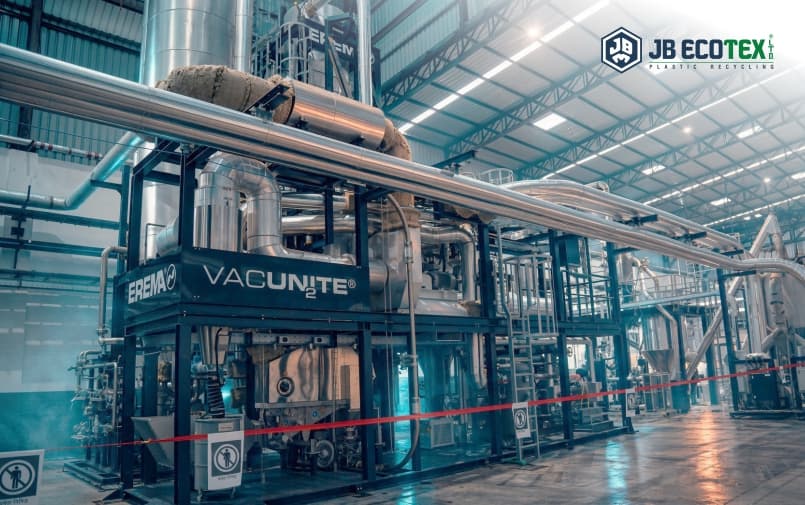
- Vacurema extrusion: the pre-treated flakes feed into the Vacurema Extrusion System, which processes rPET under vacuum for purity, IV consistency and food-grade compliance.
- Underwater pelletisation: the extruded material is pelletised underwater, giving each pellet uniform shape, size and cooling for a consistent output.
- Crystallisation: the pellets pass through a crystallisation unit that improves their thermal and structural properties for demanding packaging applications.
- Vacuum-based SSP in nitrogen: crystallised pellets undergo Solid State Polycondensation using Polymetrix technology in a nitrogen environment, raising molecular weight and driving decontamination deeper.
The final output is certified food-grade rPET pellets, ready for use in food and beverage packaging. Mechanically recycled rPET produced this way completes the circle: bottle to flake to pellet to bottle.
A parallel testing regime runs alongside these stages. Colour values are measured from incoming flakes through to final bags, black speck checks run on amorphous material during production, and ash content is verified batch by batch. The process makes the material. The testing proves it.
Solid State Polycondensation: Where Food Grade Is Earned
Of all the stages above, solid state polycondensation SSP deserves the closest look, because it does the heavy lifting that separates bottle grade material from the rest.
By the time pellets reach SSP they are already clean, crystallised and uniform. SSP then holds them in a nitrogen environment where polycondensation continues in the solid state, building molecular weight step by step. Longer chains mean stronger material, and the same conditions raise decontamination efficiency further still. The pellets that leave this stage carry the molecular weight a bottle needs and the purity a food regulator demands. In our plant this stage runs on Polymetrix technology under vacuum-based, nitrogen-blanketed conditions.
For a buyer reading a specification sheet, SSP is the stage that explains the numbers. The IV grade a batch achieves and the depth of decontamination it reaches both trace back to how this final step was run, which is why serious purchasers ask their supplier what SSP technology sits at the end of the line.
The Quality Parameters That Define Food-Grade rPET
Quality in this material is engineered at every step and then verified as numbers on a certificate. Each parameter is tested separately and reported batch by batch, so a buyer holds evidence rather than assurances. Five parameters matter most.
Intrinsic viscosity
The intrinsic viscosity of rPET measures average molecular weight and chain length, and it directly shapes mechanical strength, clarity and processability. It is the headline figure on any resin specification sheet. Our bottle grade range runs at three standard IV points: 0.76 dl/g, 0.80 dl/g and 0.84 dl/g, with the upper end serving buyers who need high IV rPET resin for demanding formats. Matching the right value to the right application is a conversation we have with buyers at specification stage.
Acetaldehyde content
Acetaldehyde, or AA, is a byproduct generated while PET is processed. Acetaldehyde content in PET matters enormously in food and beverage packaging because AA can affect the taste and odour of the product inside.
Colour values
Optics are read as CIE Lab colour values. A clear bottle application calls for a high L* for lightness, an a* sitting close to zero, and a low b* to keep yellowness at bay. We hold every batch to these colour requirements as part of routine testing.
Moisture content
PET absorbs moisture from the surrounding atmosphere. For example, moisture picked up during storage or handling can enter the melt during processing and contribute to hydrolytic degradation. The resin is therefore dried before processing.
Heavy metals
Every batch of our rPET resin is tested for heavy metal content in support of food-contact safety. The panel covers antimony, calcium, cobalt, manganese, tin, zinc and more, with each metal held well within globally accepted safe limits. Clean numbers here underpin the wider case for safe recycled packaging.
India's Recycled Content Mandate and the Compliance Clock
The regulatory ground in India has shifted. Under the Plastic Waste Management Rules, the Government of India has made it mandatory for brand owners, producers and importers to build a minimum percentage of recycled plastic into their packaging. A fuller picture of India's waste management rules sits in our dedicated guide. The recycled content mandate India now operates under the Extended Producer Responsibility framework, monitored by CPCB, with targets that rise every year.
- 2025 to 2026: 30% recycled content
- 2026 to 2027: 40% recycled content
- 2027 to 2028: 50% recycled content
- 2028 to 2029: 60% recycled content
The CPCB EPR portal is where compliance gets tracked. To stand compliant on it, a business needs valid Recycled Content Certificates, known as RCC, and those certificates can only come from registered recyclers. Falling short attracts strict Environmental Compensation penalties.
The certificate mechanism carries a quiet implication for procurement teams. Because RCC flows exclusively through registered recyclers, your choice of resin supplier has become a compliance decision as much as a materials decision. A supplier outside the registration net leaves your recycled content unprovable on the portal, whatever the material itself is like. Our explainer on EPR credits walks through how the certificate system works in practice. Recycled content has moved from a sustainability preference to a legal requirement, and the targets climb steeply enough that sourcing decisions made this year shape compliance positions for the next four. For packaging teams planning ahead, the arithmetic is plain. A target rising ten percentage points a year rewards early supplier qualification, because qualification, trials and line approvals all take time before the first compliant tonne ships.
How We Support Your EPR Compliance
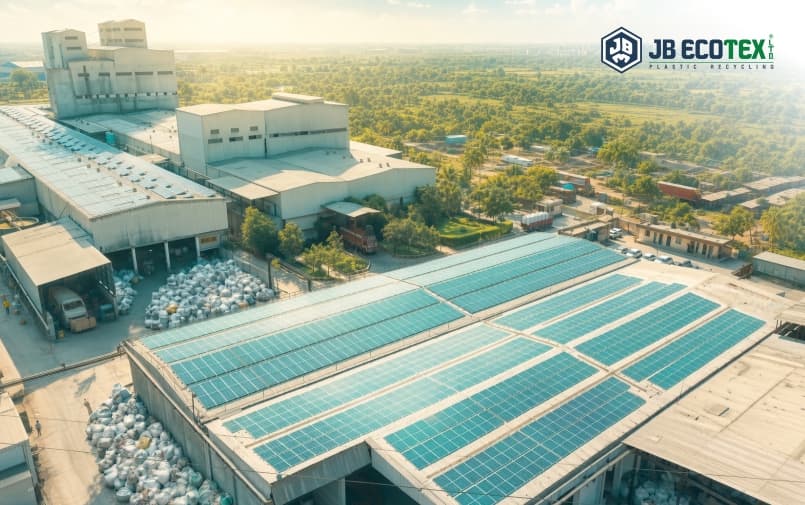
This is where material quality and regulatory paperwork meet. We operate as a CPCB-registered recycler, and our certified food-grade resin comes out of FSSAI-approved processes under strict quality control, which lets us help brand owners and manufacturers on both fronts at once.
On the compliance side, buying from a registered recycler lets you meet your mandatory Recycled Content Obligations, receive valid Recycled Content Certificates, and keep your standing on the CPCB EPR portal in order. On the material side, you receive consistent, food-safe resin that satisfies FSSAI food-grade recycled plastic requirements alongside FDA no objection certification, so the pellets that solve your legal obligation also run cleanly on your bottling lines. Our food-grade bottle-to-bottle recycled PET resins (Food Grade B2B rPET Resins) are built to serve both purposes in the same bag, and every tonne contributes to India's circular economy goals.
Common Questions About Bottle-to-Bottle rPET Resin
What is bottle-to-bottle rPET resin?
Bottle-to-bottle rPET resin is recycled PET made from post-consumer bottles and processed to a standard fit for manufacturing new food and beverage bottles. It must meet food-contact safety requirements set by the US FDA, EFSA and India's FSSAI.
How is food grade rPET resin made?
Post-consumer bottles are sorted, washed and crushed into flakes, decontaminated under high temperature and vacuum, extruded through a Vacurema system, pelletised underwater, crystallised, and finished with solid state polycondensation in nitrogen to raise molecular weight and purity.
What IV value is used for rPET bottles?
Bottle grade rPET resin at J B Ecotex comes in three standard intrinsic viscosity grades: 0.76 dl/g, 0.80 dl/g and 0.84 dl/g. IV reflects average molecular weight and chain length, which shape a bottle's strength, clarity and processing behaviour.
What is acetaldehyde in PET and why does it matter?
Acetaldehyde forms as a byproduct while PET is being processed. Food and beverage packaging treats it seriously because it can alter the taste and odour of whatever the bottle holds.
What is the recycled content mandate in India?
Under the Plastic Waste Management Rules and the EPR framework monitored by CPCB, brand owners, producers and importers must use minimum recycled content in packaging: 30% in 2025 to 2026, rising annually to 60% by 2028 to 2029.
What is SSP in PET recycling?
Solid State Polycondensation is a finishing stage where crystallised pellets are held in a nitrogen environment so polycondensation continues in the solid state. It raises molecular weight for bottle strength and pushes decontamination deeper for food-contact use.
A Bottle's Second Life, Engineered Properly
Bottle-to-bottle recycling works when every stage earns its place: sorting that guards the feedstock, washing that removes the visible, vacuum stages that remove the invisible, and SSP that rebuilds the polymer for another round of duty. The numbers on the certificate, IV, acetaldehyde, colour, moisture and heavy metals exist to prove each stage did its job. Regulation has added its own reason to care, with recycled content targets rising year on year and certificates flowing only through registered recyclers. The material case and the compliance case for bottle-to-bottle rPET resin now point in the same direction.
At J B Ecotex, every pellet that leaves our plant carries the whole journey inside it: responsibility in how the bottles were sourced, engineering in how they were remade, and a cleaner tomorrow in the second life they begin. For a conversation about resin grades, certification documents or EPR compliance support for your packaging line, our team is one message away. Recycling responsibility. Delivering quality. Building tomorrow.