
EF-R Flame-Retardant Recycled Polyester Staple Fibre
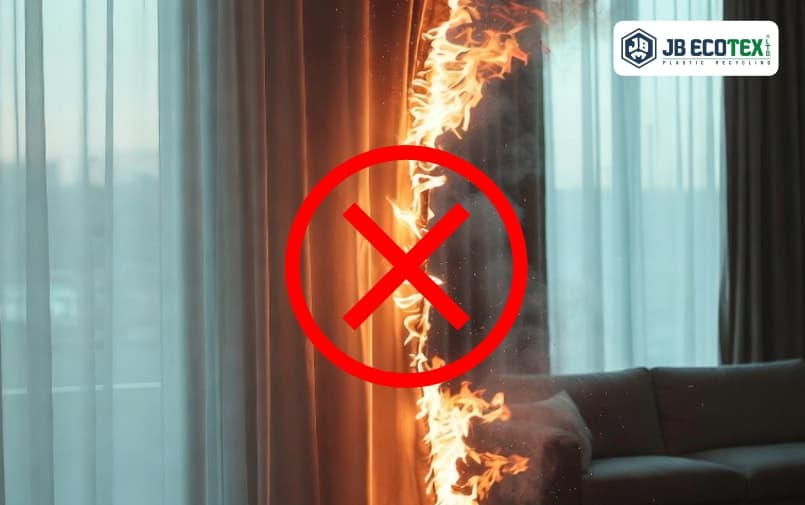
Flame-retardant recycled polyester staple fibre lets a mill meet a fire safety specification and a recycled content target from the same bale. EF-R is made for home textile mills, transport interior suppliers, technical nonwoven manufacturers and public interior producers. What sets it apart is where the chemistry sits: a phosphorus-based additive is locked into the polymer during melt spinning, so the fibre stays permanently self-extinguishing without any added coating or finish.
Spun entirely from post-consumer PET bottles at our Surat facility, EF-R sits within our wider recycled polyester staple fibre range.
Who EF-R Is Built For
Four groups of buyers specify FR recycled polyester fibre, and each arrives with a different requirement.
Home textile mills producing curtains, upholstery, mattress covers and recycled FR wadding. FR PSF for upholstery and curtains has to hold its fire performance across repeated laundering, which is where surface treatments struggle.
Transport interior suppliers making automotive seat padding, roof liners and aircraft curtains. EF-R suits railway, metro, bus, marine and aviation programmes, including seat covers, curtains and uniforms.
Technical nonwoven manufacturers working on acoustic insulation, FR filtration and protective linings through thermal-bonded, needle-punched and spunlace routes.
Public interior producers supplying office partitions, theatre seating, wall panels and sound boards, along with healthcare, hospitality and education interiors.
Protective workwear producers also use EF-R for lab coats, industrial garments and factory uniforms. For requirements outside FR, our broader polyester staple fibre range covers spun yarn, nonwoven and interlining grades.
Inherent FR Versus Coated FR
A coated flame retardant finish is applied to the surface of a fabric after it has been made. It sits on top of the material as a separate layer, which means laundering, dry cleaning and surface abrasion act directly on the thing doing the protecting.
Inherent flame retardant rPET fibre works from the inside. In EF-R, the phosphorus additive is infused directly into molten polyester, creating a uniform inherent FR matrix through the fibre itself. The chemistry is intrinsic and non-leaching, so EF-R maintains its flame-retardant performance through washing, abrasion and re-processing. This is the property that matters most in phosphorus FR polyester staple fibre, because carding, drawing, crimping and needling all work the fibre mechanically before it ever becomes a fabric. When a buyer asks how your fire retardant polyester will behave after years of commercial washing, an inherent fibre lets you answer from the material specification.
EF-R Fibre Specifications
EF-R is supplied in two deniers and two standard cut lengths, with custom cuts available on volume orders. The grey-white grade arrives dyer-ready for conventional dyeing, and the dope-dyed black FR polyester fibre carries its shade infused at the polymer stage, which removes the post-dyeing step altogether.
- Denier: 1.5 and 2.0
- Cut length: 38 mm and 44 mm, with custom cuts available for volume orders
- Colour options: Grey-white (dyer-ready) or dope-dyed black with in-polymer shade
- Phosphorus content: 6,800 ± 200 ppm for lasting fire performance
- Limiting Oxygen Index: Above 35 percent, self-extinguishing in open air
- Tenacity: 5.8 ± 0.4 GPD, durable in heavy-duty applications
- Dyeing guideline (grey-white): 130 °C for 30 to 45 minutes at pH 4.5, avoiding flammable carriers
- Raw material: 100 percent post-consumer PET bottles
- Packing: baled for dispatch
Tenacity at 5.8 GPD keeps EF-R workable in constructions that place real tension on the fibre, covering both apparel and technical end uses. Buyers know this grade by several names, including green FR, sustainable FR, recycle FR and r-PET FR.
Performance Through Washing, Abrasion And Re-Processing
Because the flame-retardant chemistry is intrinsic to the polymer rather than applied to the surface, EF-R maintains its performance through washing, abrasion and re-processing. The additive is integrated into the polymer backbone, which makes it non-leaching and wash-durable. Repeated laundering and surface wear leave the fire performance intact.
The same chemistry holds at end of life. EF-R can be reintegrated into circular polyester recycling systems, so converted product retains recycling value rather than exiting the loop. For OEMs running circular textile programmes alongside fire safety obligations, self-extinguishing polyester fibre that stays recyclable removes a constraint that used to be built in.
Sustainability performance comes from the raw material itself. EF-R uses waste PET bottles to make high-value flame-safe textiles, keeping plastic out of landfills and oceans.
Fire Safety Standards
EF-R has been evaluated against ASTM D2863, EN ISO 12952, NFPA 701, DIN 4102-B1, BS 5852 and IS 11871. Laboratory testing confirms a Limiting Oxygen Index above 35 percent.
One point is worth stating plainly for buyers assembling tender documentation. Several of these methods, including NFPA 701, BS 5852 and DIN 4102-B1, are run on a finished fabric or an assembled component rather than on loose staple fibre. The result depends on the construction: fabric weight, weave or web structure, backing, blend ratio and any finish applied downstream. EF-R gives your fabric a base with the flame-retardant chemistry already inside it, and the certification itself belongs to what you build from it.
Request EF-R samples and full data sheets from our technical sales team to begin that evaluation.
Processing Compatibility
EF-R runs on standard polyester staple fibre lines, so it slots into existing production without equipment changes. It is compatible with ring spinning, vortex, open-end and air-jet systems, and it handles thermal-bonded, needle-punched and spunlace nonwoven routes. The FR additive leaves strength, elongation and spinnability intact.
The area that needs attention is chemistry introduced downstream, since several common auxiliaries can compromise the inherent FR performance of the fibre beneath them.
- Avoid oils during blending and finishing
- Avoid waxes and paraffins
- Avoid silicones, including softeners applied for hand feel
- Avoid combustible binders and resins
- Dye grey-white EF-R at 130 °C for 30 to 45 minutes at pH 4.5, using flammable-carrier-free auxiliaries
Always pre-test before and after applying any chemical finish to confirm LOI and vertical burn performance on your own construction. A fabric can carry a compliant fibre and still underperform because of a softener applied at the finishing stage.
Applications By Sector
Home textiles. Curtains, upholstery, mattress covers and mattress ticking, and recycled FR wadding. Flame retardant polyester from a recycled route answers a fire specification and a recycled content line in the same submission.
Transport interiors. Automotive seat padding, roof liners and aircraft curtains, extending across railway, metro, bus, marine and aviation applications including seat covers and uniforms.
Technical nonwovens. Acoustic insulation, FR filtration and protective linings. Flame retardant fibre for nonwovens carries fire performance into web structures where an even surface coating is difficult to achieve.
Public interiors. Office partitions, theatre seating, wall panels and sound boards, plus institutional environments across healthcare, hospitality and education.
Protective workwear. Lab coats, industrial garments and factory uniforms where flame resistant polyester is specified alongside wash durability.
The complete fibre portfolio, including non-FR grades, sits on our recycled polyester staple fibre product page.
Certifications And Compliance
As a GRS flame retardant polyester fibre manufacturer, J B Ecotex supplies EF-R against recognised international standards.
- Global Recycled Standard (GRS) certified, supporting traceable recycled content claims
- OEKO-TEX® Standard 100, Class I, certified for human-ecological safety and suitable for skin-contact applications
- ISO 14001 environmental management, with production carried out in ISO-audited facilities
Certificates are shared as documents with every commercial enquiry.
Related Grades in the RPSF Range
EF-R is one grade within J B Ecotex’s full recycled polyester staple fibre range. If your application calls for a different colour, chemical or performance specification, the following grades may be relevant:
RPSF for Non-Woven – Grades for needle-punched, thermal-bonded and spunlace non-woven production.
Black 6001 Dope-Dyed Black RPSF – Pigment locked in at the melt stage for a deep, uniform black that skips the dyehouse.
3011 Ultra White High-Tenacity RPSF – Built for sewing thread and technical yarns that need higher tenacity on a bright white base.
PSF for Interlining – White grades for interlining where whiteness and shrinkage control matter.
View the full RPSF product range
How To Order EF-R Or Request A Sample
Tell us the standard you are working to and the construction you are building, and our technical sales team will respond with the right starting point.
Request the EF-R technical data sheet. The TDS covers denier and cut length options, phosphorus content, LOI, tenacity and dyeing parameters.
Request samples. Trial quantities are arranged against your specification, in 1.5D or 2.0D at 38 mm or 44 mm, in grey-white or dope-dyed black.
Request a volume quote. EF-R is baled for dispatch. Custom deniers, cut lengths and shades are available for bulk and contract requirements.
Write to connect@jbecotex.com with your target standard, monthly volume and preferred denier.
Frequently Asked Questions
What is flame-retardant recycled polyester staple fibre?
Flame-retardant recycled polyester staple fibre is polyester spun from post-consumer PET bottles with fire performance built into the polymer. J B Ecotex produces it as EF-R, using a phosphorus additive infused during melt spinning to deliver permanent fire safety without chemical coatings.
How does inherent FR differ from a coated flame retardant finish?
Inherent FR integrates flame-retardant chemistry into the polymer backbone during fibre production, making it non-leaching and wash-durable. A coated finish is applied to the fabric surface after manufacture, where laundering and abrasion act directly on the protective layer itself.
Does EF-R keep its flame retardancy after repeated washing?
Yes. Since the additive is intrinsic to the polymer rather than applied to the surface, EF-R remains flame-retardant after repeated laundering, surface wear and abrasion. The same chemistry survives re-processing through carding, drawing and needle-punching.
What LOI does EF-R achieve?
Laboratory tests confirm a Limiting Oxygen Index above 35 percent, with the fibre self-extinguishing in open air. Buyers should compare this figure against the LOI threshold written into their own specification or governing fire code.
Which deniers and cut lengths are available?
EF-R is supplied in 1.5D and 2.0D, with standard cut lengths of 38 mm and 44 mm. Custom cut lengths are available for volume orders. Colour options cover grey-white for conventional dyeing and dope-dyed black with in-polymer shade.
Which fire safety standards has EF-R been evaluated against?
EF-R has been evaluated against ASTM D2863, EN ISO 12952, NFPA 701, DIN 4102-B1, BS 5852 and IS 11871. Several of these methods test a finished fabric, so the final result also depends on your construction, blend ratio and downstream finish.
Can EF-R be dyed on our existing equipment?
Yes. Grey-white EF-R is supplied dyer-ready for conventional dyeing at 130 °C for 30 to 45 minutes at pH 4.5, using flammable-carrier-free auxiliaries. A dope-dyed black grade carries the same FR integrity with the dyeing stage removed.
Which finishes should we avoid when processing EF-R?
Avoid oils, waxes, silicones, paraffins and combustible binders or resins during blending and finishing, since these can compromise FR performance. Always pre-test LOI and vertical burn on your own construction before and after applying any chemical finish.