
Inside Our PET Recycling Systems: How Traceability and Dispatch Care Secure Food-Grade Safety
When brands talk about food-grade recycled PET, the conversation often stops at certifications or output quality. But in reality, food-grade safety is not created at the end of the line. It is built across the entire recycling ecosystem, from how bottles are sourced to how finished resin is dispatched.
This is where PET recycling systems need to be understood as a connected framework rather than a set of machines.
In this blog, we take you inside our PET recycling systems to explain how traceability and dispatch care work together to secure food-grade safety. Not as isolated checkpoints, but as a continuous, auditable process that begins with bottle collection and ends only when sealed material reaches the customer.
Why Food-Grade Safety Depends on PET Recycling Systems, Not Just Output Testing
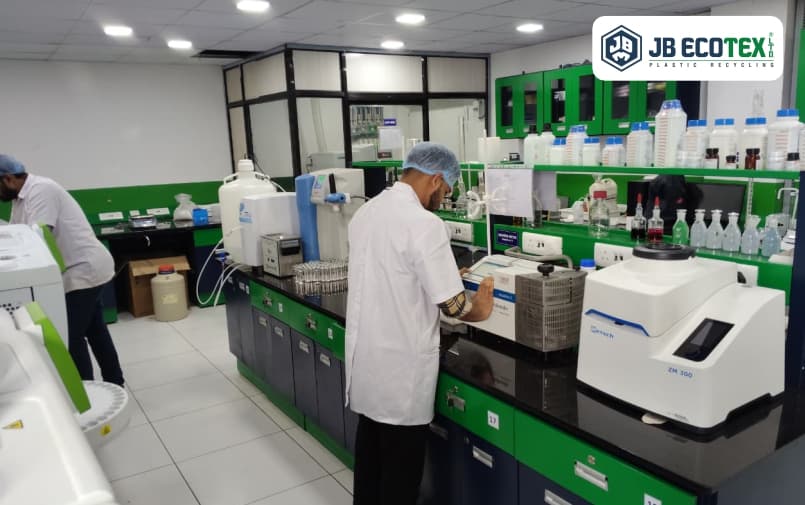
Food-grade compliance is often misunderstood as a laboratory outcome. In practice, lab testing only confirms what the system has already ensured.
Within advanced PET recycling systems, food-grade safety depends on three non-negotiable principles:
- Knowing exactly where material comes from
- Maintaining control at every processing stage
- Preventing contamination after production
Traceability answers the first two. Dispatch care protects the third.
Together, they ensure that recycled material intended for direct food contact remains compliant not only at production but throughout its journey in the mechanical recycling process.
End-to-End Traceability Inside PET Recycling Systems
Traceability Starts Before Processing Begins
Traceability within our PET recycling systems begins even before material enters the plant.
Collection is handled through region-specific collection heads across India, each responsible for verifying the authenticity, credibility, and quality of vendors. Only India-sourced bottles are accepted. Bottles from abroad are not used for B2B food-grade production.
This early control is critical because PETE plastic bottle quality varies significantly based on origin, usage patterns, and collection practices.
Only clear PET bottles that meet predefined quality parameters are approved for food-grade B2B processing.
Feedstock Verification and Yard-Level Controls in PET Recycling Systems
Multi-Point Quality Checks at Arrival
When feedstock trucks arrive, PET recycling systems apply quality control immediately.
- Random bales are selected from the front, middle, and back of the truck
- Bottles are manually opened and inspected
- Non-PET material such as caps and labels must remain under defined limits
If contamination exceeds acceptable thresholds, the material is rejected for food-grade use and diverted to non-food applications like fibre or straps.
This step is critical when handling plastic bottle waste, where visual similarity can hide material risks.
Moisture and Parameter Testing at Yard Level
At the yard stage, additional testing ensures feedstock stability:
- Moisture content testing
- PVC presence
- Ash content
- Multiple other parameters totalling approximately twelve checks
These checks ensure that only compliant material enters the food-grade stream, reinforcing the best way to recycle plastic bottles intended for direct food contact.
Segregation as a Foundation of Traceability
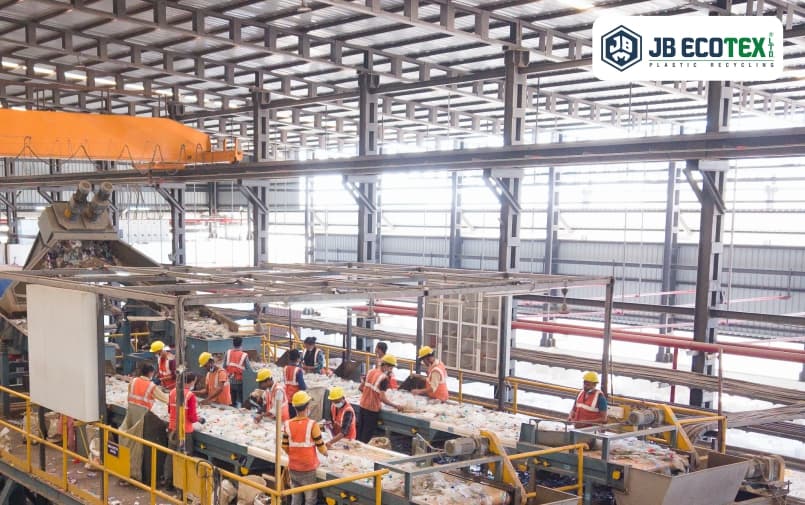
Within PET recycling systems, segregation is not a storage activity. It is a traceability control.
Once feedstock is approved for B2B food-grade use:
- It is moved to dedicated B2B raw material storage
- Segregation is visually reinforced using distinctive colour coding
- Forklift teams are trained to prevent cross-movement or contamination
This ensures that PET bottle recycling equipment downstream processes only approved feedstock, preserving system integrity.
From Bottles to Flakes: Controlled Conversion with Traceability
Seven-Stage Flake Processing for Food-Grade Safety
The conversion of bottles into flakes within PET recycling systems follows a tightly controlled, multi-stage process:
1. Manual sorting
2. Automated sorting
3. Label and cap removal
4. Hot washing
5. Secondary manual sorting with optical and mechanical systems
6. UV treatment to remove dirt, metals, and radiation
7. Multiple resorting steps to remove fines, size variations, and contaminants
This level of processing ensures that flakes meet stringent contamination thresholds required for food-grade applications.
Approved rPET flakes are packed in clearly identifiable bags and transferred exclusively to the B2B plant, maintaining traceability from bottle to flake.
Traceability Through Barcoding Across PET Recycling Systems
One of the most critical traceability features within our PET recycling systems is batch-level barcoding.
Barcodes allow the system to identify:
- Which resin batch came from which flakes
- Which flakes came from which bottles
- Which bottles came from which sourcing regions
This lineage is digitally and physically preserved across stages. Mock drills are conducted regularly to ensure traceability remains functional and auditable at all times.
Notably, this system is designed to prevent errors, not correct them later.
Moisture Control as a Safety and Stability Parameter
Moisture is one of the most sensitive parameters in rPET plastic recycling, especially for food-grade applications.
Within PET recycling systems, moisture is controlled at multiple stages:
- Feedstock evaluation
- Washing lines
- Erema feeding stage
- Pre-heating stages
- Solid-state polymerisation
- Final packaging
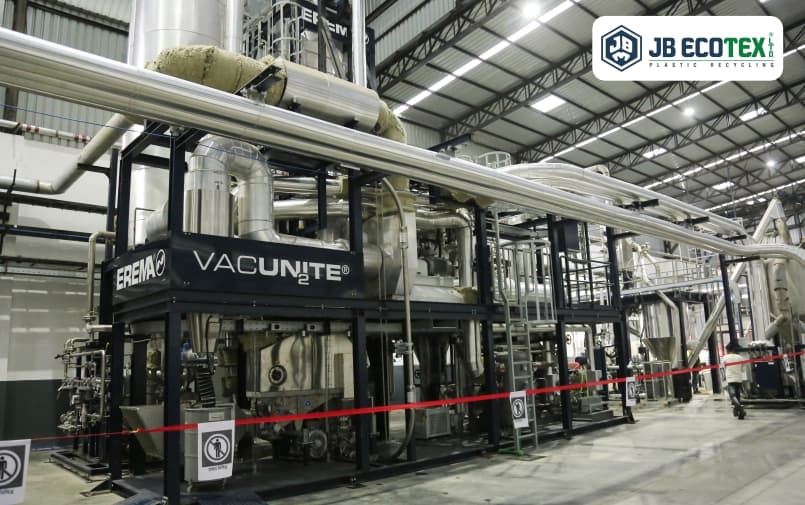
Nitrogen inflow, pre-heating of flakes and amorphous resin, and controlled SSP stages work together to reduce moisture consistently.
Final resin passes through moisture-controlled tubes and is sealed immediately at discharge, eliminating exposure risks.
Resin Conversion with No Human Contact
Once flakes are converted into resin, PET recycling systems eliminate manual handling entirely.
The conversion process uses automated systems where:
- No chemicals are added
- Vacuum treatment removes contaminants
- Nitrogen-based SSP removes residual moisture
- Particle size is verified before packaging
This closed-loop approach ensures that PET plastic material intended for food contact is never exposed to external contamination risks.
Quality Control Embedded in PET Recycling Systems
Quality control is not a single checkpoint. It is embedded at multiple levels:
- Feedstock QC
- Flake QC
- Resin QC
Tests include:
- Intrinsic viscosity
- Moisture levels
- Ash content
- Heavy metals
- Acetaldehyde
- Benzene
- Black speck analysis
These tests confirm the effectiveness of PET recycling systems rather than compensating for gaps.
Dispatch Care: The Final Link in Food-Grade Safety
Why Dispatch Care Is Non-Negotiable
Even the most advanced PET recycling systems can fail if dispatch is poorly handled.
Dispatch care ensures that all upstream safety measures are preserved until delivery.
Packaging Protocols That Protect Resin Integrity
After resin production:
- Material is packed in double or triple moisture-proof bags
- Bags are barcoded with production data
- Packaging is sealed immediately at discharge
Finished goods are stored in separate, grade-wise storage segments, maintaining production-level segregation.
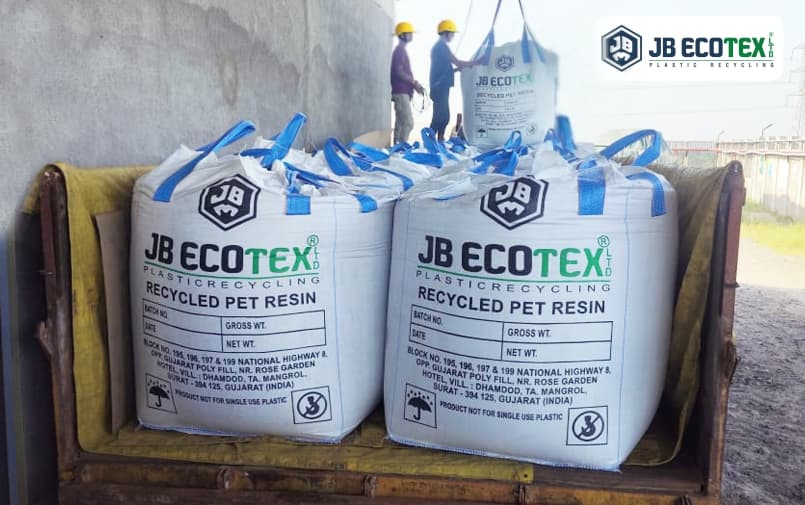
Transport Protection and Sealing
During dispatch:
- Trucks are protected on all six sides using tripals
- Cardboards are placed to prevent abrasion
- All truck openings are sealed
- Transport teams are coordinated closely to avoid delays or exposure
From input to dispatch at JB Ecotex, there is no human contact, which is essential for food-grade material movement. Verify spelling from maam.
Why These Systems Matter to rPET Suppliers and Buyers
For rPET suppliers, traceability and dispatch care establish credibility, audit readiness, and long-term customer trust.
For buyers sourcing PET plastic bottle scrap wholesale or food-grade resin, these systems answer critical questions:
- Can the material lineage be verified?
- Is contamination risk actively prevented?
- Does the system hold up during audits and surprise inspections?
PET recycling systems that answer yes to all three reduce risk across the supply chain.
PET Recycling Systems and Regulatory Expectations
Food-grade PET recycling systems are subject to surprise audits that assess:
- Traceability and trackability
- Product quality
- Working conditions
- Infrastructure and laboratory readiness
Systems built on documentation, segregation, and dispatch discipline are better prepared to meet these expectations consistently.
Beyond Compliance: Circular Responsibility
Well-designed PET recycling systems do more than meet mandates. They enable circularity at scale.
By converting plastic bottle waste into high-quality resin suitable for direct food contact, they reduce dependency on virgin material while maintaining safety and performance.
This approach strengthens confidence in rPET plastic recycling as a viable long-term solution for food and beverage packaging.
Working With PET Recycling Systems Built for Food-Grade Accountability
For brands, converters, and packaging manufacturers, sourcing recycled PET is no longer just about availability. It is about confidence.
Our PET recycling systems are built for buyers who need clarity on material origin, consistency across batches, and assurance that food-grade safety is preserved beyond production. Traceability and dispatch care are not processes we explain separately. They are systems we operate daily.
If your application requires:
- Verifiable traceability from bottle to resin
- Segregated, food-grade processing without cross-contamination
- Controlled dispatch that protects material integrity until delivery
Then our PET recycling systems are designed to support that requirement.
We work closely with customers to share process documentation, batch information, and system-level transparency that supports audits, internal approvals, and long-term supply planning. For technical discussions, material specifications, or application alignment, our team is available to take the conversation forward.
Why Systems Matter in Food-Grade Recycling
Food-grade safety is not achieved through marketing claims or isolated certifications. It is achieved through systems that work together without gaps.
In our PET recycling systems at JB Ecotex Ltd., traceability ensures every input is accountable. Dispatch care ensures every output remains protected.
Together, they form a closed, auditable loop that supports food-grade safety from bottle to bag.
And that is what truly defines responsible, scalable PET recycling.