
Next-Gen Nonwoven Fabrics: The Role of Micro Denier in Advanced Textile Design
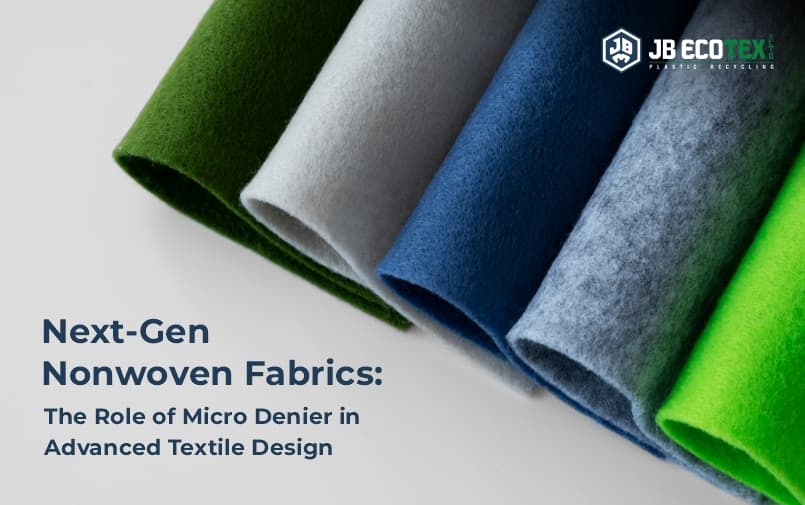
In July 2025, Autoneum, an automotive acoustic systems suppliers, presented a nonwoven fiber product at the Automotive Acoustics Conference in Konstanz, Germany, that replaced polyurethane foam in vehicle carpets and inner dashboards with a felt made almost entirely from recycled polyester staple fibre. The material, called Flexi-Light PET, is manufactured from a blend of recycled PET fibres with up to 90% recycled content, and according to Autoneum delivers acoustic and mechanical performance comparable to the foam it replaces, while being fully recyclable at end of vehicle life. It is now available globally for automotive carpet applications.
The engineering behind it comes down to one specification above almost everything else: fiber denier. Specifically, fine and micro denier fiber, recycled polyester staple fibre engineered below 1.5 denier per filament, where more fibres per gram means smaller pore openings in the web, larger total surface area, and performance that standard 3 to 6 denier grades simply cannot match at the same fabric weight.
What makes Autoneum's product commercially significant is not that someone used recycled polyester in a non woven fiber structure. That has been happening for years. What is significant is that a Tier 1 automotive supplier is now engineering fine denier recycled PET fibre into a safety-critical, acoustically specified component and winning OEM approval for it at production scale. The performance bar in automotive NVH components is not forgiving. A felt that dampens cabin noise by the required amount, holds its shape through 3D moulding into a complex carpet geometry, and survives the thermal and mechanical environment of an automotive interior cannot be made from imprecise feedstock. Fiber denier, crimp configuration, IV consistency, and contamination control all have to be held within tight tolerances to make it work.
Autoneum's product is one visible example of a direction the nonwoven industry has been moving in across multiple segments simultaneously. Hygiene manufacturers are specifying finer denier recycled polyester staple fibre in topsheet and acquisition layers to meet softness targets that standard grades cannot achieve. Filtration engineers are using fine denier rPSF to improve particle capture efficiency in HVAC and industrial media without increasing fabric weight. Building insulation manufacturers have published research demonstrating that replacing standard polyester with 40% recycled PET fibre in dry-laid carded nonwovens measurably reduces thermal conductivity in the finished batt. (published in the Journal of the Textile Institute in June 2024) Denier is the variable running through all of it. The finer the fibre, the more fibres per gram, the smaller the pore openings, the larger the surface area in contact with air, sound, or heat, and the softer the hand. That relationship between fibre fineness and nonwoven performance is what the rest of this piece covers, including what it actually means to specify and source fine denier recycled polyester staple fibre correctly.
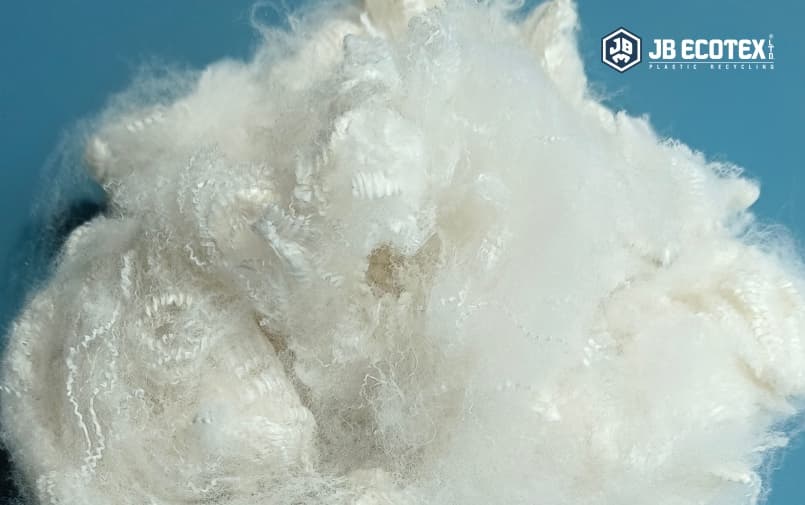
What Fiber Denier Measures
Denier is a unit of linear mass density. One denier is defined as one gram per 9,000 metres of fibre. A lower denier number means a finer, lighter fibre. A higher number means a coarser, heavier one.
Polyester staple fibre for nonwoven and spinning applications is commercially available across a wide denier range. Standard grades used in apparel spinning run from 1.4 to 3 denier. Coarse grades for geotextiles and industrial padding range from 6 to 15 denier. The fine end of the spectrum, the range most relevant to advanced nonwoven design, sits between 1.0 and 1.5 denier. Below 1.0 denier per filament, fibre is classified as micro denier. Above that threshold, grades in the 1.0 to 1.5 range are widely referred to as fine denier in the staple fibre industry.
The physical consequence of a finer denier is straightforward: more individual fibres per gram of material. More fibres per gram means a denser web at any given fabric weight, smaller inter-fibre pore openings, greater surface area in contact with whatever passes through the structure, and a softer handle. These four effects drive almost every performance advantage attributed to fine and micro denier fibre in nonwovens.
Why the Nonwoven Industry Is Moving to Finer Recycled Polyester
In spinning, the yarn count can partially compensate for fibre thickness. In a carded or air-laid nonwoven, the fibre denier sets pore size, bonding area, and fabric weight directly.
Filtration efficiency: Finer fibre produces more fibres per gram, and more fibres in a web means smaller pore openings at any given basis weight. Smaller pores improve particle interception, the mechanism by which a particle contacts and sticks to a fibre surface rather than passing through the gap between fibres. Research on multilayer nonwoven filtration structures published in the Journal of Textile Engineering and Fashion Technology confirmed that finer fibre construction at the same grams per square metre improves capture of particles in the 0.3 to 2 micron range. For HVAC filtration, automotive cabin air filters, and liquid filtration media, shifting from 3 denier to 1.5 denier polyester in the substrate layer produces a measurable improvement in filtration efficiency without adding fabric weight.
Softness in hygiene and medical applications: The tactile softness of a nonwoven surface is driven primarily by fibre fineness. A carded web produced from 1.2 to 1.4 denier recycled polyester staple fibre is measurably softer than the same web construction at 2 to 3 denier. This difference matters in diaper topsheets, feminine hygiene covers, and wound contact layers, where softness is specified to protect sensitive or compromised skin.
Acoustic performance: The connection between fibre denier and acoustic performance is well established in the literature. Research by Tascan and Vaughn at Clemson University, published in the Journal of Engineered Fibers and Fabrics (2008), demonstrated that smaller denier fibres produce more fibres per unit weight of material, increase total fibre surface area within a fabric structure, and create more opportunities for sound waves to interact with the fibre network.
Thermal bonding efficiency: In thermally bonded nonwovens, whether calendered or through-air bonded, finer matrix fibres increase the number of fibre-to-fibre contact points per unit area. More contact points means more bonding sites during heat treatment, which improves tensile strength in the finished fabric. This allows manufacturers to reduce the binder fibre percentage in the blend, or to run lower bonding temperatures, which is useful when processing heat-sensitive recycled grades.
Fiber Crimp: What It Is and Why It Controls Processing
Denier gets most of the attention in fibre specifications, but crimp is equally important and is the variable most often misconfigured when nonwoven producers switch fibre suppliers.
Crimp is the mechanical waviness introduced into synthetic staple fibre after extrusion and drawing, before cutting. Recycled polyester fibre that exits the spinneret and drawing process is straight. Straight synthetic fibre has no inter-fibre cohesion, i.e., fibres cannot interlock at the microscopic level during carding, and the result is a fragmented web that falls apart before bonding. Research from NC State University's Nonwovens Institute established this clearly: uncrimped synthetic staple fibres cannot be processed on conventional carding equipment.
Crimp is described by three measurable parameters.
Crimp frequency is the number of crimp bows per centimetre of fibre length. Macro-crimp configurations produce 2 to 5 waves per centimetre. Micro-crimp configurations produce 8 to 14 waves per centimetre. For fine denier recycled polyester used in carded nonwovens, a higher crimp frequency (typically 10 to 14 waves per centimetre) is specified because it provides cohesion scaled to the finer filament diameter.
Crimp amplitude is the height of each individual crimp bow. High-amplitude crimp creates a more voluminous, lofty web structure before bonding, which matters for thermal insulation batts and filling materials. Lower amplitude gives a flatter, denser web with smaller pore openings, which suits filtration and hygiene substrates.
Crimp stability is how much crimp the fibre retains after passing through the carding cylinder and doffer. Carding exerts significant mechanical force on the fibre. Under-set crimp pulls out during processing, straightening fibres and reducing web cohesion. Over-set crimp causes fibres to stick in card clothing, generating neps and web defects. The NC State research on PET fibre with different crimp levels showed that both under-set and over-set crimp resulted in measurably worse basis weight uniformity and tensile strength in needle-punched fabrics compared to correctly set crimp. Crimp stability is controlled by the heat-setting temperature and dwell time during fibre production. It is a manufacturing variable, not something a nonwoven converter can correct downstream.
The interaction between crimp and denier is more sensitive at fine denier. A 1.2 denier fibre has lower bending stiffness than a 3 denier fibre. It requires a higher crimp frequency to achieve the same level of inter-fibre locking, and it needs a more carefully balanced spin finish to manage static buildup on high-speed cards without losing the fibre-to-fibre friction that holds the web together.
Fiber Specifications That Determine Nonwoven Performance
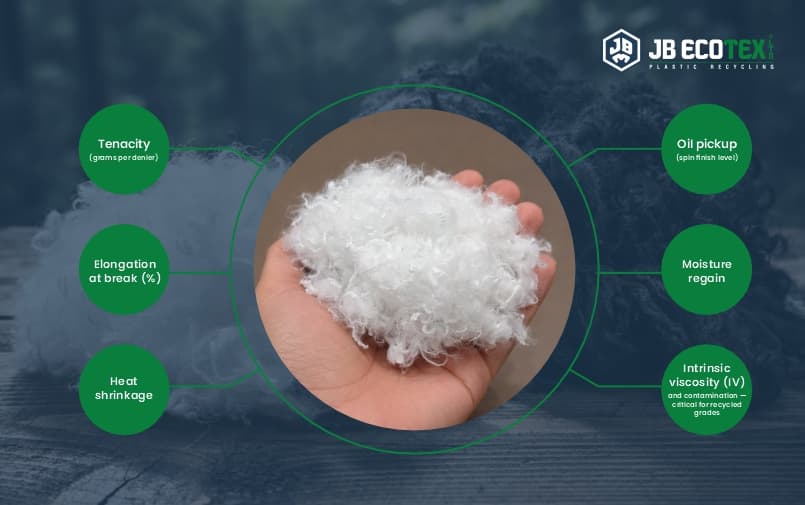
Specifying recycled polyester staple fibre for a nonwoven line means evaluating more than denier and cut length. The following parameters determine whether a fibre performs reliably on your processing line and in your end product.
Tenacity (g/denier): Tensile strength of an individual fibre. The appropriate range depends on end application; geotextiles and industrial filtration require higher values than hygiene or soft-goods.
Elongation at break (%): Stretch capacity before break. Relevant to both processing behaviour on needle-punched lines and dimensional performance in the finished fabric.
Heat shrinkage: Percentage shortening under defined heat exposure. Excess shrinkage causes dimensional instability in thermally bonded or calendered nonwovens. Confirm the acceptable tolerance range with your supplier for your bonding process.
Oil pickup (spin finish level): Finish governs fibre-to-metal and fibre-to-fibre friction. Imbalances in either direction create processing or bonding problems. The right level depends on your denier and carding equipment; specify against your line requirements.
Moisture regain: Polyester has low moisture regain. This supports dimensional stability across humidity conditions and matters for static management on carding lines.
IV and contamination -- critical for recycled grades: IV indicates polymer molecular weight. The required range varies by application; high-tenacity end uses such as geotextiles and technical filtration sit at the higher end. Contamination thresholds should be set by your end-product requirements. Batch-to-batch consistency in both IV and contamination is the quality differentiator between rPSF suppliers: a sample tells you what the fibre can be; a consistency record tells you what it reliably is.
Application-by-Application Denier and Specification Guide
Hygiene nonwovens -- diaper topsheets, feminine hygiene covers, adult incontinence
Fine denier with a hydrophilic spin finish. Heat shrinkage tolerance is tight. GRS and OEKO-TEX Standard 100 certification at the fibre stage are commonly required by brand owners.
Filtration media -- HVAC, automotive cabin air, industrial air and liquid
Layered structures combine fibre of varying denier, with finer fibre for particle interception and coarser fibre for dust-holding capacity. Industrial pulse-jet applications require high-tenacity grades to withstand repeated cleaning cycles.
Automotive acoustic and thermal insulation
Coarser fibre for loft and support, finer fibre to increase surface area in the batt for sound absorption. Flame-retardant treated grades are widely specified for interior components.
Medical nonwovens -- surgical drapes, gowns, wound contact layers
Fine denier recycled polyester. Wound contact applications require a finer grade at the contact surface. OEKO-TEX Standard 100 at the fibre stage is generally the minimum certification requirement.
Geotextiles and construction filtration
Coarser denier, longer cut length, high-tenacity grades. Specification priorities are tensile strength, creep resistance, and UV stability rather than fineness.
Nonwoven interlining and home textiles
Thermally bonded with a binder fibre component. Denier and cut length are selected against the handle, loft, and weight target of the finished product.
The Regulatory Context Nonwoven Buyers Need to Understand
If your nonwoven business sells into European brands or supplies goods for the EU market, the regulatory direction on recycled content and fibre traceability has shifted materially since 2024.
The EU Ecodesign for Sustainable Products Regulation (ESPR) entered into force on 18 July 2024. It is framework legislation and hence it does not itself set specific recycled content requirements for textiles, but it gives the European Commission the authority to do so through delegated acts. The delegated act for textiles and apparel is expected to be adopted around 2027, with compliance deadlines likely around mid-2028. What these delegated acts will specify in terms of mandatory minimum recycled fibre content percentages has not yet been legislated. The EU Textile Strategy sets a 2030 vision in which textile products placed on the EU market are "to a great extent made of recycled fibres," but no binding percentage has been enacted. The direction is unambiguous. The specific thresholds are still being determined.
What is already active under the ESPR is the Digital Product Passport framework. A
delegated act on DPPs for textiles is expected to be published in January 2026,
entering into force around July 2027. From that point, textile products will
need to carry machine-readable passports containing fibre composition, origin,
and circularity data. For nonwoven manufacturers and their customers, this
means the chain-of-custody documentation supporting any recycled content claim
needs to be in place at the fibre supplier level, not assembled
retrospectively.
The Global Recycled Standard (GRS), administered by
Textile Exchange since 2011, is the supply chain reference for recycled content
verification. GRS covers recycled content, chain of custody traceability,
social and environmental manufacturing requirements, and chemical restrictions.
Products carrying a GRS product-specific claim must contain a minimum of 50%
recycled content. Importantly, the GRS scope certificate must cover the fibre
manufacturer (not just the PET recycler) meaning the full production chain from
bale to finished staple fibre needs to sit within a valid GRS scope.
For US buyers: Presidential Proclamation 10857, effective November 2024, established a zero-quota restriction on imports of fine denier polyester staple fibre under temporary importation bond entries through November 2025, with graduated limits thereafter. Combined with additional tariff pressure on Chinese PSF that brought the effective rate to approximately 24% from March 2025, the sourcing landscape for fine denier fibre in North America has shifted significantly toward non-Chinese supply. India is among the beneficiaries of this shift.
OEKO-TEX Standard 100 certification at the fibre stage confirms the absence of harmful substances including restricted dyes, formaldehyde, heavy metals, and other substances on the OEKO-TEX restricted substances list. For hygiene and medical nonwoven applications, holding this certification at the fibre input stage significantly simplifies downstream product safety documentation for the nonwoven converter.
Why Recycled Polyester Staple Fibre Works in These Applications
Mechanically recycled rPET loses some molecular weight during reprocessing. IV drops compared to the virgin polymer. For standard nonwoven applications, hygiene, filtration substrates, acoustic insulation, IV in the 0.62 to 0.72 dl/g range is adequate and well within normal processing parameters. For high-tenacity applications requiring tensile performance comparable to virgin high-tenacity grades, IV needs to be maintained at 0.72 to 0.84 dl/g, which requires either tight feedstock selection or solid-state polycondensation (SSP) as part of the recycling process.
Contamination is the other variable that separates acceptable rPSF from problematic rPSF in nonwoven production. In filling and insulation applications, contamination tolerance is wider. In hygiene and medical nonwovens, sub-50 ppm contamination is the accepted standard, and maintaining it requires rigorous PET bottle sorting, washing, and melt filtration at the recycling stage. The EREMA VACUNITE process combines extrusion with solid-state polycondensation under vacuum, which both decontaminates the melt stream and restores IV, making it particularly relevant for nonwoven-grade fibre supply where both parameters need to be held simultaneously.
Practical Specification Starting Points
These are working starting points, as actual specifications need to be confirmed against your carding equipment, bonding method, and end-product requirements.
For hygiene topsheets and covers: 1.2 to 1.5 denier, 32 to 38 mm cut length, 10 to 12 crimps per centimetre, hydrophilic finish, heat shrinkage below 5%, OEKO-TEX Standard 100 certified and GRS certified for recycled content claims. Thermal calendering or through-air bonding.
For HVAC and general filtration substrate: 1.5 to 2.5 denier, 38 to 51 mm cut length, 8 to 10 crimps per centimetre, anti-static finish, standard tenacity 3.5 to 4.5 g/denier. Thermal bonding or resin bonding.
For automotive acoustic and thermal batt: 4 to 7 denier structural fibre blended with 1.5 to 2.5 denier acoustic fibre, 51 to 64 mm cut length, through-air bonding or needle punching. FR-treated recycled polyester for interior-grade applications.
For geotextiles and construction felt: 6 to 15 denier, 64 to 102 mm cut length, high-tenacity grade at 5.5 to 7 g/denier, needle punching.
For medical drapes and gowns: 1.5 to 2 denier, 38 mm cut length, OEKO-TEX Standard 100 certified input fibre, spunlace or thermal bonding.
In each case, validate specification with multiple consecutive production batches before scaling. Single-sample results tell you what the fibre can be. Batch records tell you what your line will actually run on.
Where Fine Denier rPSF Development Is Heading
The practical lower bound for fine denier recycled polyester in dry-laid carded nonwoven production sits at approximately 0.9 to 1.0 denier. Below that threshold, conventional staple fibre carding becomes unreliable. The fibre is too fine for standard card clothing geometry and opening equipment to handle consistently. Processing below 1 denier on conventional lines is possible but requires modified card clothing and careful process management, and is not yet routine at commercial scale for recycled fibre grades.
The most active product development in the fine denier rPSF space is in the 1.0 to 1.4 denier range, where conventional carding equipment works reliably and the performance benefits over 2 to 3 denier standard grades are substantial. Within this range, three areas are seeing the most development activity.
Dope-dyed black recycled PSF at fine denier is one. Producing a consistent black at 1.2 to 1.4 denier from rPET requires a carbon black dispersion that is stable through fine spinneret orifices, with particle size and cleanliness controlled tightly enough that melt filtration pressure doesn't spike during production.
Cationic dyeable recycled polyester at fine denier is another. Cationic dyeable fibre accepts cationic dyes at lower temperature and with a different colour response than standard disperse-dyed polyester, which is useful for mélange and colour-effect nonwovens. Producing cationic dyeable grades from rPET feedstock adds complexity, since the cationic modifier needs to be introduced at the polymer stage and maintained through recycling.
Bicomponent configurations at fine denier (sheath-core or side-by-side) generate self-crimp through the differential shrinkage of two polymers during cooling, removing the need for mechanical crimping. This approach is commercially established at 1.5 to 3 denier in recycled grades. Below 1.5 denier in bicomponent rPSF at commercial production scale, the number of available suppliers is very small.
The overall direction is fine denier, certified recycled content, documented batch traceability, and application-specific grades rather than general-purpose fibre. Nonwoven manufacturers who are still specifying a single 2 denier recycled polyester for all their product lines will find themselves behind both the performance expectations of their brand customers and the documentation requirements of incoming EU regulation.
J B Ecotex's RPSF for Nonwoven Applications
At J B Ecotex, our recycled polyester staple fibre plant in Surat operates with GRS, OEKO-TEX Standard 100, and ISO certification. We process post-consumer PET bottle feedstock through EREMA VACUNITE technology, which maintains IV and contamination within specification for nonwoven-grade supply.
Our RPSF range for nonwoven applications includes solid grades at 1.2D and 1.4D for hygiene and fine filtration; dope-dyed black at standard and fine denier for automotive and technical textiles; cationic dyeable grades for colour-effect nonwovens; and high-tenacity grades for geotextile and industrial applications. Cut lengths are available at 32 mm, 38 mm, and 44 mm as standard, with customisation available for specific processing requirements. Each grade ships with full batch traceability from PET bale origin through finished fibre, supporting chain-of-custody documentation for GRS downstream product claims.
If you are evaluating rPSF supply for a nonwoven line, the starting point is your denier target, cut length, carding machine specification, and bonding method. From there we can confirm crimp configuration and finish chemistry aligned to your processing conditions.
J B Ecotex manufactures and exports recycled polyester staple fibre from Surat, India, with GRS, OEKO-TEX, and ISO certification. Our technical team supports trial specification, bulk supply planning, and application-specific grade selection across spinning, nonwoven, filling, and technical textile end uses.