
Non Woven Polyester Fabric and the Polyester Fiber Behind Its Manufacturing
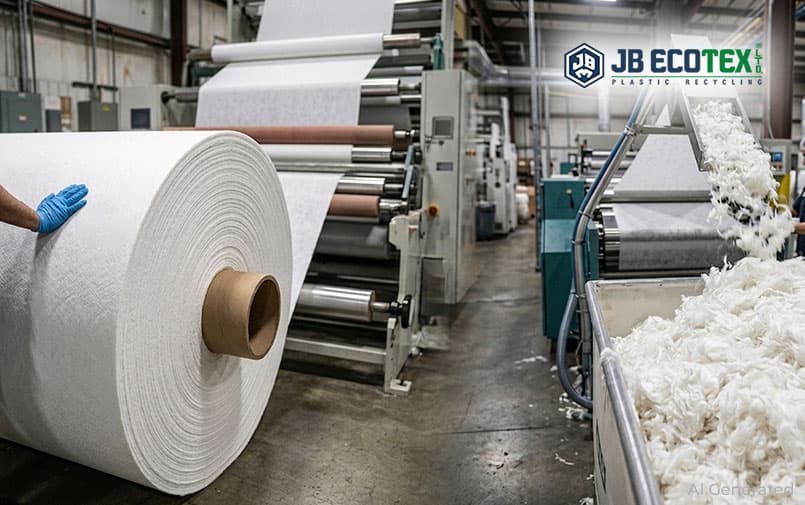
Non woven polyester fabric has become one of the most widely used materials in modern industrial textiles. Industries such as infrastructure development, filtration systems, automotive manufacturing and furniture production rely on these materials because they combine mechanical strength, lightweight structure and cost-efficient production.
Unlike traditional woven fabrics, which rely on yarn interlacing to build structural strength, non woven fabrics are created by bonding fibres directly into a web structure. Fibres are distributed into a loose sheet and then stabilised through mechanical entanglement, thermal bonding or chemical bonding.
This production approach allows manufacturers to design fabrics with very specific performance characteristics such as controlled permeability, insulation capability or structural reinforcement.
Among the different fibres used in non woven manufacturing, polyester fibre has become one of the most important raw materials. Polyester provides a balance of tensile strength, dimensional stability and chemical resistance that makes it particularly suitable for industrial non woven applications.
Many manufacturers now use recycled polyester staple fibre derived from PET bottle waste. These fibres allow companies to maintain consistent performance while reducing reliance on virgin polymer production.
For non woven manufacturers, the behaviour of polyester fibres during web formation and bonding is a critical factor that determines the quality and reliability of the finished fabric.
What is Non Woven Polyester Fabric
Non woven polyester fabric refers to a textile structure formed by bonding polyester fibres into a sheet without weaving or knitting.
Instead of converting fibres into yarn first, fibres are distributed directly into a web structure and stabilised through bonding processes. The resulting fabric consists of interconnected fibres that form a durable material with controlled porosity and mechanical strength.
This manufacturing method offers several advantages compared with traditional woven textiles.
Production speeds are significantly higher because yarn formation and weaving stages are eliminated. Fibre orientation can be controlled during web formation, allowing manufacturers to engineer fabrics with directional strength or uniform mechanical properties.
Because of these characteristics, non woven polyester materials are widely used in applications where durability, filtration capability or insulation performance is required.
How Polyester Fibre Functions as the Raw Material of Non Woven Fabric
Polyester fibre is widely considered the primary raw material of non woven fabric manufacturing.
Polyester staple fibres are particularly suitable for non woven production because the crimp introduced during fibre processing allows fibres to interlock during web formation. This mechanical interlocking improves cohesion within the fibre web before bonding occurs.
Polyester fibres also maintain high tensile strength during mechanical processing. During carding and needle punching operations the fibres can withstand repeated mechanical stress without breaking or deforming.
Another important property is thermal behaviour. Polyester fibres soften at controlled temperatures during thermal bonding, allowing bonding points to form between fibres while maintaining structural integrity.
These characteristics allow non woven fabric manufacturers to produce stable fibre webs that can be bonded into durable fabrics.
Manufacturers evaluating fibre suppliers often review technical information about polyester staple fiber used in textile and non woven manufacturing when selecting raw materials.
Major Manufacturing Technologies for Non Woven Polyester Fabric
Different production technologies create different types of non woven polyester materials. Each method produces a unique fibre structure that determines the performance characteristics of the fabric.
Polyester Spunbond Nonwoven Fabric
Polyester spunbond nonwoven fabric is produced directly from molten polymer rather than staple fibres.
Polyester polymer is melted and extruded through spinnerets to create continuous filaments. These filaments are laid onto a moving conveyor belt where they form a random web structure.
Heat and pressure are then applied to bond the filaments together, creating a uniform fabric.
Spunbond fabrics are commonly used in construction materials, agricultural textiles and geotextile applications where high tensile strength and dimensional stability are required.
Because the fibres remain continuous rather than being cut into staple lengths, spunbond fabrics often demonstrate excellent mechanical strength.
Dry Laid Nonwoven Fabric Production
Dry laid nonwoven fabric production relies on staple fibres rather than continuous filaments.
In this process compressed fibre bales are opened and individual fibres are separated. These fibres are then distributed into a web using carding machines or air lay equipment.
Carding machines align fibres in a directional orientation, producing fabrics with high strength in specific directions. Air lay systems distribute fibres randomly, producing more uniform fabric structures.
Once the web is formed it is stabilised using bonding processes such as needle punching or thermal bonding.
Dry laid non woven fabrics are widely used in automotive insulation, geotextiles, mattress padding and industrial filtration materials.
Wet Laid Nonwoven Manufacturing
Wet laid nonwoven manufacturing follows a process similar to paper production.
Fibres are dispersed in water to form a slurry. The slurry is deposited onto a forming screen where water drains away, leaving behind a uniform fibre mat.
The mat is then bonded and dried to create the final fabric.
Wet laid processes allow manufacturers to achieve extremely uniform fibre distribution and are commonly used in filtration materials, battery separators and specialty industrial textiles.
Needle Punched Non Woven Polyester Fabric
Needle punching is one of the most widely used techniques for producing durable non woven polyester materials. In this process, a loose fiber web is repeatedly penetrated by thousands of barbed needles. As the needles move through the fiber web, the barbs catch and pull fibers vertically through the structure, entangling them with surrounding fibers.
This mechanical entanglement creates a dense and highly stable fabric structure without the need for chemical binders.
Polyester staple fibers are particularly suitable for needle punched non woven fabrics because their crimped structure helps fibers interlock during the entanglement process. Fibers with consistent cut length and controlled crimp allow the needle punching process to create strong bonding points across the web.
Needle punched non woven polyester fabrics are widely used in applications where durability and structural strength are required, including:
- geotextiles for road construction and soil stabilisation
- filtration media used in dust collection systems
- carpet backing materials
- industrial insulation fabrics
Because needle punching mechanically entangles fibers across the thickness of the web, the resulting fabrics demonstrate strong resistance to tearing and delamination.
Fiber Orientation and Web Structure in Non Woven Polyester
One of the most important aspects of non woven polyester manufacturing is fibre orientation within the web.
During carding processes fibres are typically aligned in the machine direction. This creates fabrics with higher tensile strength along the direction of fibre orientation.
Air lay systems produce more random fibre orientation, creating isotropic fabrics where strength is distributed more evenly across the material.
Needle punching further modifies fibre orientation by mechanically entangling fibres throughout the thickness of the fabric. This increases structural cohesion and improves resistance to delamination.
Understanding how fibre orientation affects mechanical behaviour allows manufacturers to tailor fabrics for different industrial applications.
Fiber Specifications Required by Non Woven Manufacturers
Non woven manufacturers typically evaluate fibre suppliers based on how fibres perform during production.
Several fibre properties have a direct influence on web formation and bonding performance.
Cut length determines how fibres behave during carding and air lay operations. Fibres that are too short may reduce web cohesion, while excessively long fibres can wrap around rollers during processing.
Denier determines fibre thickness. Fine denier fibres create fabrics with higher surface area and are often used in filtration applications. Coarser fibres provide higher structural strength for geotextiles and reinforcement materials.
Crimp structure influences how fibres interlock during web formation. Proper crimp helps fibres entangle during needle punching and improves bonding strength.
Fibre cleanliness also plays a critical role. Contaminants such as dust or polymer residues can accumulate in carding equipment and disrupt production.
Because of these factors, consistent fibre quality is essential for stable non woven manufacturing.
Role of Recycled Polyester Staple Fibre in Non Woven Fabric Manufacturing
Recycled polyester staple fibre has become one of the most important materials used in non woven production.
These fibres are produced by recycling post-consumer PET bottles and converting them into polyester fibres through melt spinning processes.
The process begins with the collection and sorting of PET bottle waste. Bottles are cleaned and shredded into flakes before being melted and extruded into polyester filaments.
The filaments are then crimped and cut into staple fibres suitable for textile manufacturing.
Manufacturers interested in the recycling and fibre production stages often review the procedure of manufacturing recycled polyester staple fibre.
Once produced, recycled polyester staple fibres are used in non woven production lines where they are opened, distributed into fibre webs and bonded into fabric structures.
These fibres are widely used in geotextiles, filtration fabrics, automotive insulation materials and furniture padding.
Processing Challenges in Non Woven Polyester Production
Even when fibre specifications appear correct on paper, non woven manufacturers often encounter operational challenges during production.
Fibre fly generation is one of the most common issues. Excessive fines or broken fibres can accumulate in carding machines and disrupt web formation.
Another challenge occurs when fibres wrap around rollers during carding operations. This typically happens when fibre cut length varies significantly within a batch.
Bonding behaviour can also affect fabric performance. If fibres do not soften uniformly during thermal bonding, weak bonding points may form in the web structure.
These issues highlight the importance of sourcing fibres with consistent specifications and reliable polymer inputs.
Supply Chain Considerations for Non Woven Manufacturers
For companies producing non woven polyester fabrics, fibre supply reliability is just as important as fibre performance.
Non woven production lines operate continuously and require stable raw material inputs. Interruptions in fibre supply can lead to costly production downtime.
Manufacturers therefore prioritise suppliers who can maintain consistent fibre specifications across production batches while ensuring reliable supply volumes.
Recycled polyester fibre suppliers also play an important role in supporting sustainability initiatives across the textile industry.
JB Ecotex Recycled Polyester Fibre for Non Woven Manufacturing
JB Ecotex produces recycled polyester staple fibre from PET bottle waste using controlled recycling and fibre production processes.
The fibres are engineered to deliver consistent denier, cut length and crimp characteristics required for non woven manufacturing processes.
Manufacturers producing geotextiles, filtration materials, automotive insulation fabrics and industrial textiles rely on consistent fibre quality to maintain stable production conditions.
Reliable fibre supply helps ensure predictable web formation, efficient bonding behaviour and consistent fabric performance.
FAQs
What is non woven polyester fabric
Non woven polyester fabric is a textile material produced by bonding polyester fibres into a web structure without weaving or knitting.
What is the raw material of non woven fabric
Polyester fibre, particularly recycled polyester staple fibre, is one of the most commonly used raw materials in non woven manufacturing.
What is polyester spunbond nonwoven fabric
Polyester spunbond nonwoven fabric is produced by extruding molten polyester polymer into continuous filaments that are bonded together to form a fabric structure.
What is dry laid nonwoven fabric
Dry laid nonwoven fabric is produced by distributing staple fibres into a web using carding or air lay systems before bonding them through needle punching or thermal bonding.
What industries use non woven polyester materials
Industries using non woven polyester materials include construction, automotive manufacturing, filtration systems, furniture production and industrial packaging.