
Recycled Polyester in 2026: Market Reality, RPSF Performance, and Why the Shift Away from Virgin PET Is Getting Serious
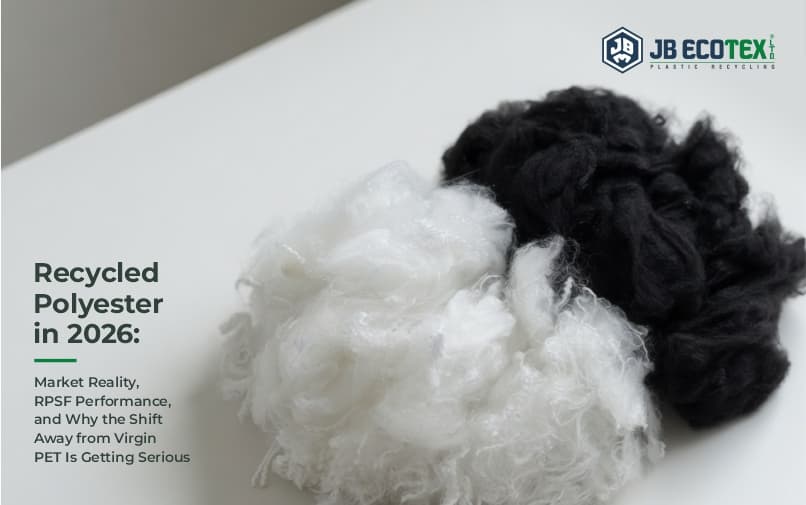
Recycled polyester is a type of polyester manufactured using recycled polyethylene terephthalate (PET) as its primary raw material instead of virgin petrochemical feedstock. Depending on the manufacturing process and the intended application, recycled PET can be converted into fibres, yarns, fabrics, nonwoven materials, and other polyester-based products.
Recycled polyester is used across a range of applications, including textiles, nonwovens, automotive components, home furnishings, and industrial products. The material may be produced from different sources of recycled PET, subject to feedstock availability, processing technology, and applicable quality requirements.
When businesses source recycled polyester, the conversation often goes beyond the material itself. Questions around feedstock, processing methods, fibre quality, and application suitability all play a role in selecting the right product.
At J B Ecotex, we believe that understanding these fundamentals helps businesses make more informed sourcing decisions. While recycled polyester is available in different forms and grades, the choice ultimately depends on the requirements of the end application and the quality of the recycled raw material used in the manufacturing process.
This guide explains what recycled polyester is, how it is produced, the different forms in which it is available, and the factors that businesses may consider when evaluating it for their manufacturing requirements.
What Recycled Polyester Really Means in the Current Market
At its core, recycled polyester is polyester made from recovered PET feedstock rather than fresh fossil-based inputs.
It means the recycled polyester supply chain depends heavily on collection systems, bale quality, contamination control, sorting efficiency, flake washing, and polymer recovery. It also means fibre producers are competing for the same recovered material that packaging producers need for rPET food packaging and other regulated applications. As more countries tighten recycled-content rules for packaging, this competition becomes sharper.
So when someone says “recycled polyester is growing,” that is only partly true. The better way to say it is this: recycled polyester capacity and demand are expanding, but access to high-quality feedstock is becoming more strategic, more regulated, and more contested.
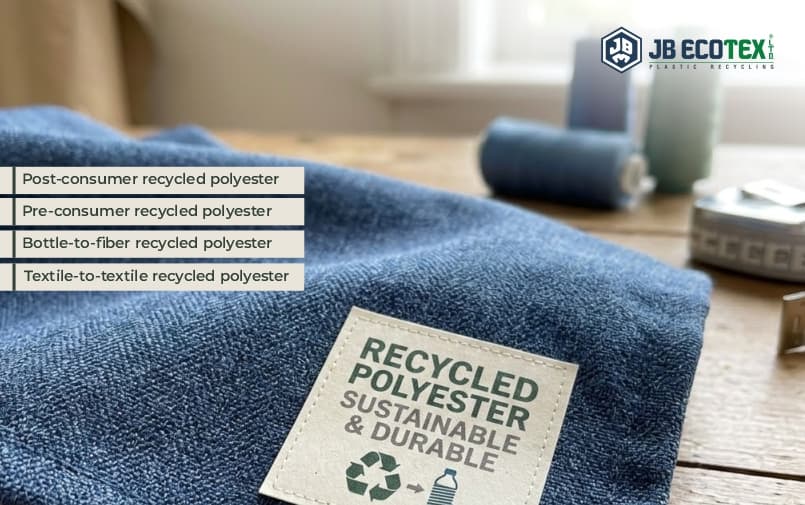
Not all recycled polyester is the same, and this is where many sourcing decisions go wrong.
Understanding the type of recycled input helps you choose the right material for your application.
1. Post-consumer recycled polyester
This comes from used products like polyester bottles and packaging waste.
- Most common source for rPET polyester
- Higher sustainability value
- Requires strong sorting and cleaning processes
2. Pre-consumer recycled polyester
Generated from industrial waste during manufacturing.
- Cleaner input material
- Lower contamination risk
- Less impact compared to post-consumer recycling
3. Bottle-to-fiber recycled polyester
This is a widely used route today.
- Converts PET flakes into recycled polyester fiber
- Highly scalable for RPSF production
- Dominates current global supply
4. Textile-to-textile recycled polyester
Still emerging at scale.
- Converts old garments into new fibre
- Expected to grow with circular economy push
- Currently limited in availability
For most industrial buyers, post consumer recycled polyester from bottle streams remains a practical and commercially viable option today.
Why the World Still Depends So Heavily on Virgin Polyester
There are three main reasons.
First, polyester is everywhere. Textile Exchange’s 2025 report says polyester made up 59% of global fibre output in 2024.. That is an enormous base. Even when recycled polyester volumes rise, virgin polyester can still outgrow it simply because total demand is so large.
Second, virgin synthetics remain structurally tied to the fossil economy. The IEA has long warned that petrochemicals are set to become one of the biggest drivers of oil demand growth globally. Polyester and PET sit inside that larger petrochemical system, which gives virgin material scale, infrastructure, and price advantages that recycling chains still struggle to match consistently.
Third, textile-to-textile recycling is not yet supplying the market at meaningful scale. Recycled polyester is still mostly bottle-to-fibre, not fibre-to-fibre. UNEP and related global circularity discussions continue to highlight how much textile waste the world generates, but the industry has not yet built enough sorting, chemical processing, and reverse logistics capacity to turn that waste into mainstream polyester feedstock. UNEP says the world generates around 92 million tonnes of textile waste annually, while only a small share of textile fibres come from recycled sources.
That is the market contradiction. The waste exists. The need exists. The demand exists. But circular textile feedstock is still underdeveloped, so the industry keeps leaning on bottles and virgin raw material.
Where RPSF Fits Into the Recycled Polyester Story
This is where recycled polyester fiber becomes commercially important.
RPSF converts recovered PET into staple fibre that can be processed across multiple downstream sectors. Unlike some sustainability narratives that stay abstract, RPSF is very tangible. Buyers assess it through denier, cut length, tensile behavior, elongation, crimp, colour, cleanliness, moisture, finish, opening performance, and end-use compatibility. In other words, it is bought on specifications and machine performance, not just on claims.
In practical manufacturing terms, the fibre production route often looks like this:
post-consumer PET bottles or industrial PET waste → sorting and decontamination → washed PET flakes → melt processing and filtration → fibre formation → crimping, cutting, drying, baling.
That feedstock stage matters a lot. Consistent PET flakes and controlled washing quality influence melt stability, contamination levels, colour outcome, and final fibre performance. Poor input quality shows up later as black specks, gel issues, inconsistent denier, weak physicals, and processing interruptions. That is why experienced buyers often review the full chain, not just the fibre spec sheet.
Recycled Polyester Performance: Is It Only a Sustainability Choice?
No. That is outdated thinking.
The right recycled polyester grade can perform very well in industrial applications, particularly where the supplier has strong control over feedstock sorting, flake washing, extrusion, filtration, and fibre engineering. Performance should not be judged by the word “recycled” alone. It should be judged by the intended application.
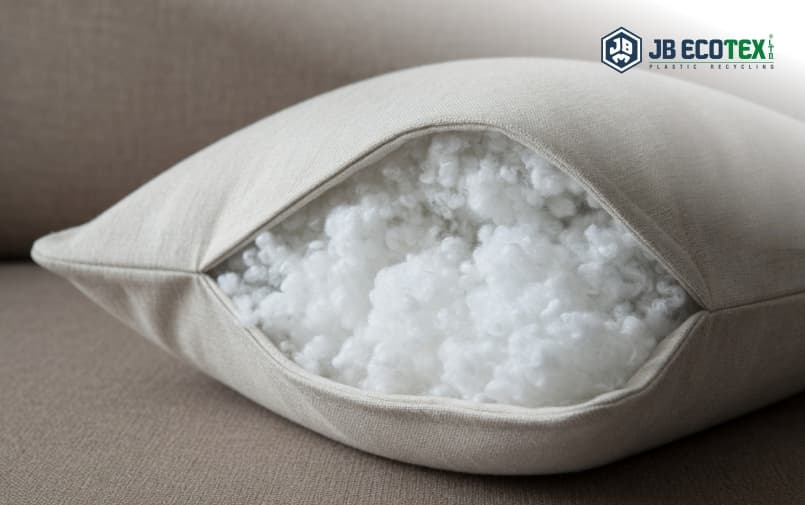
For example, in filling and cushioning applications, the buyer may care more about loft, resilience, hand feel, bulk retention, and recovery.
This is the important shift in buyer mindset: recycled polyester is not one thing. It is a material family with a quality range. A well-produced RPSF can be highly usable and commercially efficient. A poorly processed one creates waste, downtime, and complaints. The difference is not “virgin vs recycled.” The difference is process discipline, feedstock quality, and application matching.
There is also a climate case for using it. Textile Exchange’s recycled polyester challenge materials cite that mechanically recycled polyester can deliver more than 70% lower greenhouse gas emissions per kilogram compared with virgin polyester, based on referenced industry LCA work. That does not automatically solve every environmental issue, but it does show why recycled polyester remains strategically important even when the market is messy.
Current Global Market Situation For Recycled Polyester
The latest official market reading is quite revealing.
Textile Exchange reports recycled polyester fibre production increased from around 8.9 million tonnes in 2023 to around 9.3 million tonnes in 2024. That sounds positive. But its market share still declined from 12.5% to 12.0% because virgin polyester rose faster. So the global market is not moving away from virgin quickly enough.
That tells buyers four useful things:
1. Demand for recycled polyester is real, but it is not winning by default
Brands, exporters, and manufacturers may ask for recycled content, but virgin material still benefits from scale and price. When oil-linked inputs soften, recycled material can face stronger commercial pressure.
2. Feedstock competition is intensifying
Since most recycled polyester still comes from bottles, any policy or brand shift toward food-grade rPET food packaging can tighten the availability of premium bottle-grade feedstock for fibre. Europe and India are both moving in ways that strengthen demand for compliant recycled PET in packaging.
3. Circularity claims are being tested harder
It is becoming less acceptable to simply say “made from recycled plastic” without discussing source, traceability, post-consumer share, quality control, and application suitability. Regulatory scrutiny and customer audits are making documentation more important.
4. RPSF remains one of the most scalable recycled polyester formats
Because staple fibre serves many industrial applications, it remains a strong outlet for post-consumer recycled polyester, especially where buyers need performance plus responsible material positioning.
The Packaging Effect: Why PET Packaging Material Now Influences Fibre Sourcing
One of the biggest changes in the market is that packaging regulation is now shaping polyester sourcing.
The European Commission’s new packaging regime pushes packaging toward recyclability and greater recycled content, with application beginning from mid-2026 under the new PPWR framework. The broader direction is clear: reduce virgin material use and increase recycled plastic in packaging.
India is also moving decisively. In March 2025, FSSAI amended packaging regulations to allow recycled PET in food-contact uses under notified standards and guidelines, and in May 2025 it issued guidelines for acceptance of recycled PET as food contact material. Those guidelines require process control, accredited testing, and conformance to specified standards. FSSAI also lists approved rPET manufacturers for food-contact use.
For the recycled polyester market, this has two major implications.
First, bottle-grade recovered PET is becoming even more valuable. Second, fibre producers need stronger sourcing discipline because higher-end packaging applications can absorb premium feedstock. Over time, this could push the fibre industry toward better use of lower-grade streams, stronger washing and decontamination systems, and eventually more textile-to-textile recycling routes.
Recycled Polyester and RPSF Applications That Matter Commercially
A lot of recycled content writing stays too generic here, so let’s make this practical.
RPSF is relevant where buyers need functional bulk material with repeatable behaviour. Common downstream uses include home textile fillings, pillows, cushions, quilts, mattresses, sofas, nonwoven fabrics, thermal insulation, acoustic insulation, automotive interiors, geotextiles, construction textiles, filtration media, and industrial padding.
The reason this matters is that RPSF helps convert waste into production-grade raw material without requiring every buyer to completely redesign their product. In many cases, the switching logic is commercial and operational:
- access to post consumer recycled polyester
- ability to respond to recycled-content requirements from customers
- reduced dependence on virgin polymer markets
- better positioning for sustainability reporting and procurementcompatibility with existing product categories when the fibre is engineered correctly
That does not mean every RPSF grade fits every use. Hollow conjugated fibre for filling is a different buying decision from solid fibre for nonwovens or technical blends. But the broader point stands: recycled polyester is now part of production planning, not just ESG storytelling.
What Buyers Should Actually Evaluate Before Sourcing Recycled Polyester Fiber
If you are sourcing RPSF, the serious questions are not “Is it recycled?” but “How dependable is the material?"
Buyers should review feedstock source, whether the chain is bottle-based or mixed input, the washing and contamination control process, flake cleanliness, melt filtration strength, fibre consistency, denier tolerance, cut length accuracy, colour stability, physical performance, and batch-to-batch repeatability. For export-facing businesses, traceability and documentation are increasingly important as well. This is especially true when customers ask whether the content is post-consumer, pre-consumer, or mixed.
Also remember that recycled polyester does not operate in isolation. Its quality often begins upstream with PET flakes and washed PET flakes. A supplier with stronger control over PET recovery is usually in a better position to deliver fibre consistency.
Quick Checklist Before You Source Recycled Polyester Fiber
Before finalizing your supplier, check:
- Is the material truly post consumer recycled polyester?
- What is the quality of washed PET flakes used?
- Is fibre consistent across batches?
- Does the supplier control upstream processing?
- Is the material suitable for your exact application?
- Can they scale supply as your demand grows?
This checklist alone can save you from production issues later.
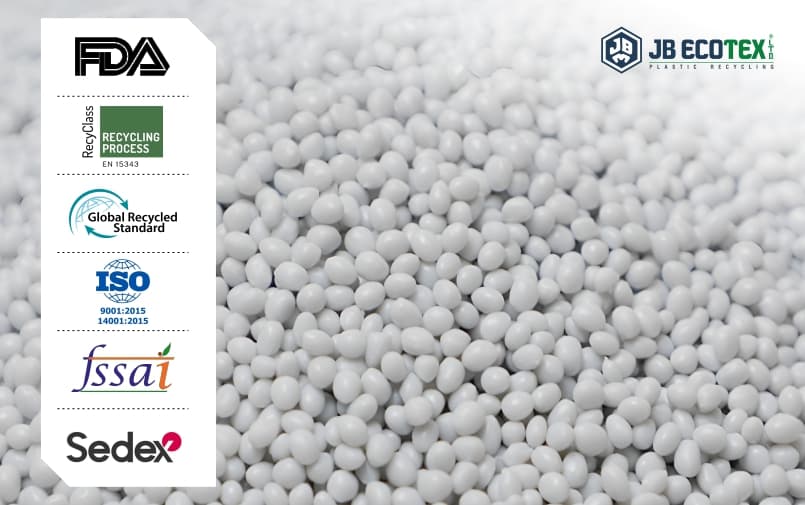
Virgin and Recycled PET Resin: Why The Market Is Still Hybrid
A common point of discussion in PET manufacturing is the distinction between virgin & recycled PET resin. Both are forms of polyethylene terephthalate (PET), with the primary difference being the source of the raw material. Virgin PET resin is manufactured using virgin feedstock, while recycled PET resin is produced using recycled PET.
Understanding these two material streams helps provide context for how PET is processed into a variety of end products.
Why Buyers Are Choosing J B Ecotex for Recycled Polyester and RPSF
When you are sourcing recycled polyester fiber, consistency matters more than claims.
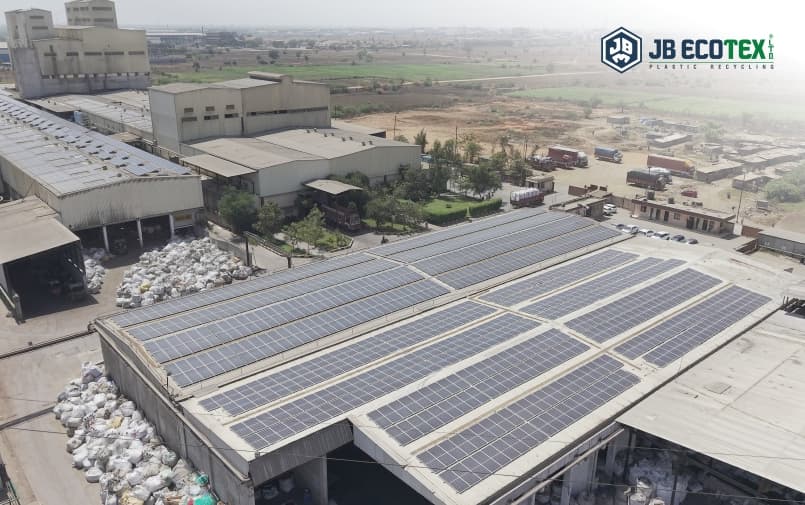
At J B Ecotex, the focus is not just on producing RPSF, but on controlling the entire value chain that influences quality. From sourcing and processing post consumer recycled polyester to producing high-quality washed PET flakes and converting them into fibre, the approach is built around process stability and repeatability.
What this means for buyers is simple. You are not dealing with fragmented sourcing or inconsistent batches. You are working with a system designed to deliver material that performs the same way every time it enters your production line.
What sets J B Ecotex apart
- Integrated recycling ecosystem
Strong control over PET flakes, washing processes, and fibre production ensures better input quality and fewer processing issues downstream.
- Application-focused RPSF production
Whether the requirement is for filling, nonwovens, or industrial use, fibre is developed keeping end-use performance in mind, not just basic specifications.
- Stable quality across batches
Reduced contamination, controlled IV, and consistent fibre parameters help minimize downtime and material rejection.
- Aligned with global material shifts
As demand for rPET polyester and recycled inputs grows across packaging and textile sectors, J B Ecotex is positioned to support buyers looking to reduce dependence on virgin materials without compromising performance.
If you are evaluating a shift toward 100 recycled polyester, the real question is not just availability. It is whether your supplier can deliver consistency at scale. That is where J B Ecotex fits in.
The Future of Recycled Polyester
The future of recycled polyester will not be defined by one trend. It will be defined by four.
The first is regulation. Recycled content rules and packaging standards will keep shaping material flows.
The second is feedstock competition. As packaging pulls more food-grade rPET, the textile and fibre industries will need stronger investment in collection, sorting, washing, and alternative feedstock recovery.
The third is traceability. Buyers will increasingly need proof around recycled content source, quality systems, and compliance.
The fourth is circularity maturity. The industry cannot rely forever on turning bottles into fibre while textile waste keeps piling up. UNEP’s textile waste numbers make that impossible to ignore. Over time, more value will have to come from true fibre-to-fibre and textile-to-textile systems.
Where Recycled Polyester Is Headed Next
The shift toward recycled polyester is not slowing down, but it is evolving.
More pressure from packaging regulations
Demand for rPET food packaging is increasing, tightening supply for fibre applications.
Stronger push toward circular textiles
Textile-to-textile recycling will move from concept to scale over the next few years.
Better quality expectations
Buyers are no longer accepting recycled material as a compromise. Performance is expected to match production needs.
Greater demand for 100% recycled solutions
More brands and manufacturers are actively moving toward 100 recycled polyester in their supply chains.
Integration over fragmentation
Suppliers with control over PET packaging material → flakes → fibre will have a clear advantage.
For buyers, this means one thing. Early alignment with the right supply partner will matter more than price fluctuations.
The Shift to Recycled Polyester Is Already Happening. The Question Is How You Adapt
Recycled polyester has moved past the stage where it can be treated as a simple substitute material. It now sits inside a much bigger global shift involving carbon pressure, petrochemical dependence, packaging regulation, recycling infrastructure, and customer expectations.
For businesses using RPSF, this creates a real opening.
The market is growing, but so is the pressure on supply. Virgin polyester still dominates. Recycled share is improving in volume, but not fast enough in market terms. Packaging is competing for the same PET stream. And buyers who understand this early will make better sourcing decisions than those who treat recycled polyester as just another trend.
In 2026, the real question is not whether recycled polyester matters. It does.
The real question is who is building the quality, traceability, and process discipline to use it properly.
Recycled Polyester FAQs
1. What is recycled polyester and how is it made?
Recycled polyester is a synthetic fibre made by processing used PET materials such as polyester bottles and packaging waste into new raw material.
The process typically includes:
- Collection and sorting of PET waste
- Cleaning and conversion into washed PET flakes
- Melting and filtration
- Conversion into recycled polyester fiber or filament
Most recycled polyester today is produced through bottle-to-fiber recycling, making it one of the most scalable forms of circular material use.
2. What is recycled polyester staple fiber (RPSF)?
Recycled polyester staple fiber (RPSF) is a type of recycled polyester fiber made from b and used in nonwoven, filling, and industrial applications.
It is commonly used in:
- Cushions and pillows
- Quilts and mattresses
- Automotive interiors
- Geotextiles and insulation
- Nonwoven fabrics
- RPSF is preferred because it offers a balance of performance, cost-efficiency, and sustainability when produced with consistent quality
3. Is recycled polyester as strong as virgin polyester?
Yes, recycled polyester can perform at par with virgin polyester when processed correctly.
The final performance depends on:
- Quality of PET flakes used
- Washing and contamination control
- Melt filtration and fibre processing
High-quality rPET polyester can deliver comparable strength, durability, and usability across multiple industrial and textile applications.
4. What is the difference between virgin and recycled PET resin?
Virgin PET resin is made from petrochemical raw materials, while recycled PET resin is produced from post-consumer or post-industrial waste such as bottles and packaging.
Key differences:
- Virgin PET depends on fossil resources
- Recycled PET reduces waste and resource consumption
- Performance can be similar when processed under controlled conditions
Today, many industries are moving toward virgin & recycled PET resin combinations to balance performance and sustainability.
5. Why is most recycled polyester made from plastic bottles?
Most recycled polyester comes from polyester bottles because they are:
- Easier to collect at scale
- More uniform in material composition
- Suitable for conversion into high-quality PET flakes
Globally, bottle-to-fiber recycling remains the dominant route, while textile-to-textile recycling is still developing.
6. What are the main uses of recycled polyester fiber?
Recycled polyester fiber is used across multiple industries, including:
- Home textiles and filling products
- Nonwoven and industrial fabrics
- Automotive components
- Construction and insulation materials
- Packaging-related applications
Its versatility makes it one of the most widely used recycled materials globally.
7. What is post-consumer recycled polyester?
Post consumer recycled polyester is made from products that have been used and discarded by consumers, such as bottles and packaging.
It is considered more sustainable because:
- It diverts waste from landfills
- It reduces dependence on virgin materials
- It supports circular material use
Most rPET polyester in the market today comes from post-consumer sources.
8. Why is demand for recycled polyester increasing globally?
Demand for recycled polyester is rising due to:
- Sustainability commitments by brands
- Government regulations on plastic and packaging
- Increasing awareness around waste management
- Pressure to reduce carbon footprint
At the same time, industries are actively looking to reduce reliance on virgin materials.
9. Is virgin PET becoming harder to rely on in the current global market?
Yes, reliance on virgin PET is becoming more challenging due to multiple global factors.
- Rising pressure on fossil-based raw materials
- Increasing regulations on plastic usage and emissions
- Volatility in petrochemical supply chains
- Growing demand from packaging and textile industries
At the same time, demand for PET packaging material and rPET food packaging is increasing, which is also impacting overall material availability.
This combination is pushing industries to adopt recycled polyester as a more stable and future-ready alternative.
10. What should buyers check before sourcing recycled polyester fiber?
Before sourcing recycled polyester fiber, buyers should evaluate:
- Source of raw material (post-consumer or industrial)
- Quality of washed PET flakes
- Consistency across batches
- Contamination levels
- Suitability for specific applications
Choosing the right supplier ensures performance reliability and reduces production risks.