
Recycled Polyester Staple Fibre for Spun Yarn That Runs Clean on Ring, OE, and Vortex Lines
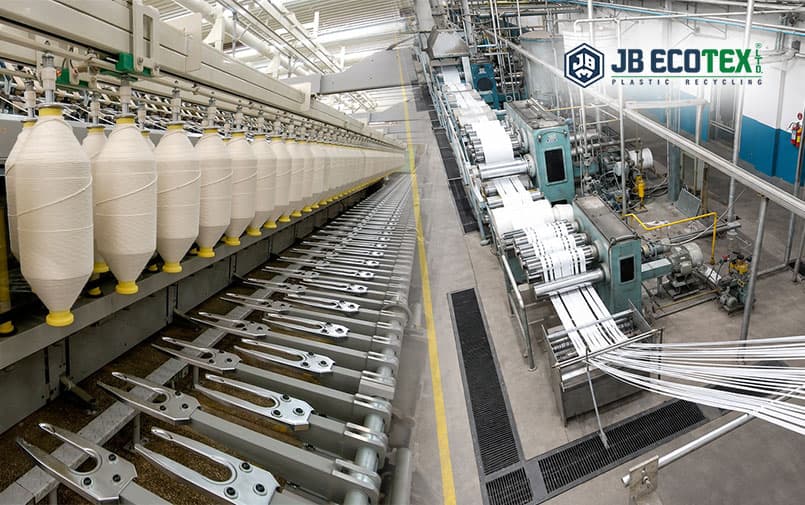
Spinning mills sourcing recycled polyester staple fibre for spun yarn production need two things above all else: fibre that runs clean through their lines and a supplier who can deliver on spec, every shipment. Both of those start here.
J B Ecotex manufactures rPSF for spinning mills across ring, open-end, and vortex systems. Our fibre is produced from post-consumer PET bottles through a controlled recycling process that maintains denier stability, consistent tenacity, and the surface finish your spinning equipment demands.
rPSF That Runs on Your Existing Line Without Adjustment
Spinning is an unforgiving application. Denier variation, inconsistent crimp, or finish imbalance will show up in yarn count, breakage rates, and fabric quality further down the line. Our recycled polyester staple fibre for spun yarn is manufactured to tight specification tolerances so it performs across your existing carding, drawing, and spinning setup without adjustment.
The standard spinning grade runs at 1.4D, 38mm cut length, which is the benchmark for ring spun yarn and open-end yarn production. We also supply custom denier and cut length configurations for mills running vortex systems or blended yarn programmes.
What spinning mills receive from our fibre:
- Stable denier and cut length across every batch, verified through in-process quality checks
- Spin finish (OPU) calibrated to your spinning system, whether ring frame, open-end, or vortex
- Consistent crimp count and elasticity for reliable drafting behaviour through carding and drawing
- High tenacity options available for finer count yarns requiring greater tensile strength
- Low fibre-to-metal friction for reduced nep formation and fewer end breaks on high-speed frames
GRS Certified Recycled Polyester Fibre for Yarn. Traceable from Source
If your mill supplies fabric or yarn to brands with recycled content requirements, your raw material chain needs to hold up to audit. Our rPSF for spinning mills carries GRS (Global Recycled Standard) certification, which provides independently verified traceability from post-consumer PET input through to finished fibre.
GRS recycled polyester fibre for yarn gives procurement teams and sustainability managers the documentation trail they need when responding to brand questionnaires, EPD requests, or compliance frameworks.
Beyond GRS, our fibre is produced under ISO-certified processes, and our facility operates with zero liquid discharge and renewable energy inputs. The recycled content percentage and chain-of-custody records are available for every shipment.
Polyester Fibre Specifications for Ring, Open-End, and Vortex Spinning
Different spinning systems place different demands on staple fibre. Ring spun yarn demands precise fibre length and crimp uniformity. Open-end spinning requires clean fibre with low trash content and controlled fibre-to-fibre cohesion. Vortex systems need consistent fibre orientation and surface finish that allows air-jet drafting without wrapping.
Our recycled PSF for cotton blend yarn programmes and mono-component yarn lines is available in the following standard configurations:
Standard Spinning Grades:
- Denier range: 1.2D to 1.5D for fine to medium count yarns
- Cut length: 32mm, 38mm, and 44mm depending on system and blend requirement
- Tenacity: Medium tenacity (MT), high tenacity (HT), and super high tenacity (SHT) available
- Finish: Spin finish formulated for ring spun yarn, PSF for open end mills, and fibre compatible with vortex spinning systems
- Colour: Optical white grades for dyeing and GRS black (dope-dyed) for solution-dyed yarn programmee
For mills running polyester staple fibre 1.4D 38mm spinning, this is our most dispatched configuration. For those running cotton blends, viscose blends, or acrylic blends, our technical team will recommend the finish, crimp, and tenacity combination that works with your existing line setup.
PSF for Cotton Blend Yarn: The Right Fibre Matters More Than You Think
Cotton-polyester blends are among the most technically demanding applications for recycled staple fibre. The fibre needs to blend uniformly with cotton, maintain sufficient cohesion through the drawing stage, and produce a yarn with the hand feel and evenness your downstream customers expect.
Our rPSF for spinning mills running cotton blend programmes is specifically finish-treated for blending behaviour. Mills producing PSF for cotton blend yarn report good lap formation, reduced draw frame breakage, and consistent yarn count across shifts.
The cotton-like KotLyke variant from our portfolio also gives mills the option of producing cotton-blend aesthetics from a 100% recycled polyester input, useful when brands want the look and feel of cotton blends with a higher recycled content percentage for sustainability reporting.
RPSF for Ring Spinning, Open-End, and Vortex Lines
Across spinning technologies, the raw material behaviour differs. Here is how our recycled fibre performs across the three primary systems:
RPSF for ring spinning mills requires fibre with accurate crimp frequency, appropriate elongation, and a surface finish that allows controlled drafting through roving and ring frames. Our standard 1.4D 38mm grade is a direct-fit for ring frame operations running Ne 20s to Ne 40s.
RPSF for open end mills demands low trash, low short fibre content, and fibre that does not wrap the rotor. Our OE-grade rPSF is processed through additional cleaning stages to reduce contamination below 50 ppm, which keeps your rotors clean and your ends-down rate stable.
Fibre compatible with vortex spinning has tighter tolerances on fibre length distribution and surface uniformity. Our vortex-compatible grades are finished and crimped to specification to support stable air-jet drafting behaviour on MVS systems.
If your mill runs more than one spinning technology, our technical sales team will map your requirement across grades and advise on whether a single fibre specification or separate grades serve your programme better.
What This Fibre Produces Downstream
Spinning mills buy fibre. Their customers buy yarn, fabric, and finished goods. The fibre decisions you make today show up in what your downstream customers receive six months from now. This matters when you are running programmes for brands with recycled content targets or quality thresholds.
Our recycled polyester staple fibre for spun yarn supports the following end-use categories:
Apparel yarns — ring spun and vortex-spun yarns for knitwear, wovens, activewear, and workwear fabrics where recycled content is a sourcing requirement from brand procurement teams.
Home textile yarns — medium to coarser count yarns for bedding, curtains, upholstery fabrics, and towelling blends where fibre bulk and yarn evenness drive buyer acceptance.
Industrial and technical yarns — high-tenacity configurations for yarns going into geotextile fabrics, automotive interiors, and filtration-adjacent woven structures.
Cotton blend yarns — blended programmes running polyester-cotton, polyester-viscose, and polyester-acrylic where the recycled PSF component needs to carry GRS certification through to the finished yarn stage.
If your mill runs multiple count programmes across different end-use categories, our technical sales team will specify per programme rather than providing a single grade recommendation.
Why Spinning Mills Source From J B Ecotex
There are multiple rPSF suppliers. The reason mills return is operational: fibre that runs consistently across shifts, documentation that holds up in brand audits, and a supplier with the production scale to support growing annual volumes.
J B Ecotex has operated in the PET recycling and staple fibre space for over a decade. Our facility processes millions of post-consumer PET bottles daily through multi-stage sorting, washing, and controlled fibre extrusion.
What sets our spinning-grade rPSF apart in practice:
- Batch-to-batch consistency maintained through in-line denier and finish monitoring across production runs
- Contamination control below 50 ppm across all spinning grades, critical for open-end and vortex rotor cleanliness
- GRS chain-of-custody documentation issued per shipment, compatible with standard brand audit formats
- Technical sales team with spinning-line knowledge, able to specify fibre against your machine model and count range
- Export capability to various countries and major spinning hubs, with established freight and documentation processes
Our facility holds GRS, ISO, and OEKO-TEX certifications. For mills supplying brands running ZDHC or restricted substance compliance programmes, our fibre comes with the chemical compliance documentation those programmes require.
Certifications Your Supply Chain Requires
Procurement teams at global brands increasingly require raw material certification at every tier. Fibre-level certification is the starting point.
Our spinning-grade rPSF carries the following:
- GRS (Global Recycled Standard) — verified recycled content and chain-of-custody from post-consumer PET input to finished fibre
- ISO 9001 — quality management system certification covering our manufacturing processes
- OEKO-TEX — material safety certification confirming the fibre meets restricted substance requirements
- ZDHC-aligned chemistry — our manufacturing chemistry is aligned with ZDHC MRSL requirements, supporting mills supplying brands with chemical compliance obligations
Transaction certificates, scope certificates, and test reports are available on request and can be formatted to match your brand partner's audit requirements. If your programme requires additional certification support, speak to our technical sales team before placing an order.
rPET Polyester: What You Are Actually Buying
rPET polyester is a term buyers encounter across supplier conversations, but the quality range it describes is wide. Post-consumer rPET sourced from PET bottle streams varies significantly depending on input quality, sorting rigour, washing process, and extrusion control.
At J B Ecotex, our input material goes through multi-stage hot-washing, optical sorting, and contamination removal before entering the fibre extrusion line. Contamination is controlled to below 50 ppm. IV consistency is maintained to prevent batch-to-batch variation in fibre tenacity and elongation.
The result is an rPSF that behaves like virgin polyester on your spinning line, with the sustainability credentials and certification trail that the recycled route provides.
Who Buys This Fibre
Our recycled polyester staple fibre for spun yarn supplies:
- Spinning mills running ring, open-end, and vortex systems across India, Bangladesh, Turkey, Vietnam, and other manufacturing hubs
- Yarn traders and converters sourcing GRS-certified recycled fibre for brand supply programmess
- Integrated textile manufacturers building recycled content into their fabric and garment output
- Procurement teams at brands whose supply chain compliance requires verified recycled raw material at the fibre level
If your programme requires a specific GRS chain-of-custody document format, recycled content percentage, or annual volume commitment, we will work with your procurement team on the supply and documentation structure.
Frequently Asked Questions
What denier and cut length is standard for ring spun yarn production?
1.4D at 38mm is the most common configuration for ring spun yarn in Ne 20s to Ne 40s count range. For finer counts below Ne 40s, 1.2D at 32mm or 38mm is frequently used. We supply both and can confirm the recommended specification against your count programme.
Is your fibre GRS certified for all spinning grades?
Yes. GRS certification covers our standard white spinning grades and our dope-dyed black grades. Chain-of-custody documentation is provided with each shipment. We can also supply transaction certificates as required by your brand audit process.
Can your rPSF run on open-end rotor systems without modification?
Our OE-grade rPSF is specifically processed to reduce trash and short fibre content for rotor performance. Mills running our fibre on OE systems report stable rotor cleanliness without modification to existing machine settings. That said, we recommend running trials on your specific machine configuration before full commercial adoption.
Do you supply fibre compatible with vortex spinning systems?
Yes. Our vortex-grade rPSF is finished and crimped to the surface and length tolerances that MVS systems require. Contact our technical team with your machine model and programme details for the recommended specification.
What is the minimum order volume for spinning grade rPSF?
Minimum order quantities vary by grade and destination. Contact our technical sales team for current MOQ and lead time information specific to your location and volume requirement.
Can you supply PSF for cotton blend yarn programmes?
Yes. Our standard spinning grade rPSF is finish-treated for blending behaviour with cotton. We will advise on the crimp, finish, and denier combination based on your blend ratio and count target.