
rPET Resin Colour Testing Explained: L*, a*, b* Values and Why Yellowing Matters
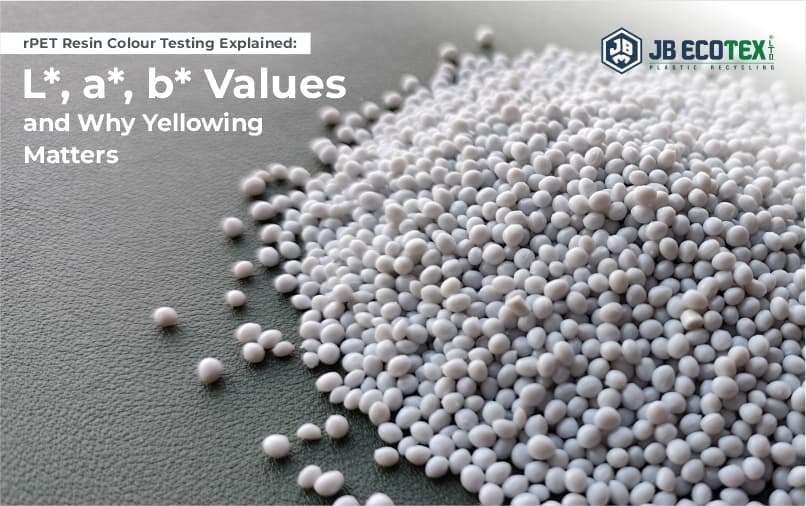
A shopper lifts a bottle from the shelf, turns it against the light, and forms a judgement in under a second. Clear reads as clean. Any tint reads as doubt. That split-second verdict begins months earlier, deep in the colour profile of the resin the bottle was blown from. This is why rPET resin colour testing sits at the core of our quality system at J B Ecotex. For each bag of food-grade rPET resin we produce, and at each stage of production behind it, we record three readings: L*, a* and b*. Colour consistency and quality consistency are the same discipline wearing different names.
What Is CIE Lab Colour Testing?
Developed as an international standard, CIE Lab quantifies the optical properties of a material in plain numbers. Industries from food packaging to pharmaceuticals rely on it for one reason: it turns colour into numbers. Two inspectors can disagree about a faint tint. Two spectrometers reading the same sample will agree, and their numbers can travel in an email, sit in a specification sheet, and settle a dispute months later. A visual check depends on the inspector's eye and the lighting around them. CIE Lab colour values replace that variability with a precise, instrument-based reading across three independent colour dimensions: L*, a* and b*.
For recycled PET resin, those three numbers describe how the material will behave in a clear bottle. They tell a buyer how bright the material will look, how neutral its tone will stay, and how close it will come to the market-ready clarity brands specify. At J B Ecotex, all three values are measured on a colour spectrometer, on every bag of final product and at every intermediate stage of production.
L*, a* and b*: The Three Numbers That Describe Resin Colour
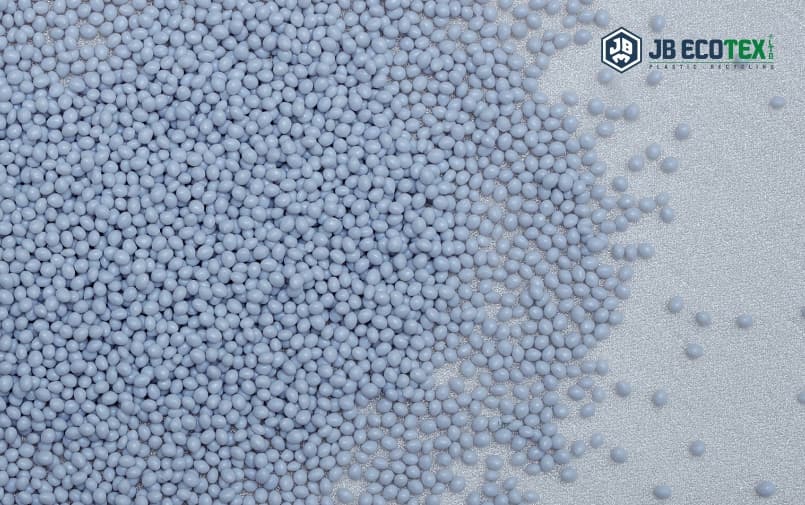
Each of the three CIE Lab dimensions answers a different question about your material. Read together, they form a complete colour fingerprint for a batch of rPET resin.
L* measures lightness
L* runs on a scale from 0 to 100. Zero is pure black. One hundred is pure white, which in resin terms reads as clear. Bottle grade material earns a high L* value: bright, clean and commercially ready. A low L* value acts as a warning sign that points towards contamination, degradation or a processing problem upstream.
a* tracks the red to green axis
A positive a* reading means the resin carries a reddish tint. A negative reading means the tint leans green. Clear bottle applications call for readings close to zero, where the tone stays neutral and unbiased in either direction.
b* tracks the yellow to blue axis
Positive b* values indicate yellowness. Negative values indicate a bluish cast. A low b* value means the tone is clean and neutral. Commercially, this is the number buyers watch hardest, because yellowing shows up more often than any other colour defect in recycled PET.
The Colour Standards We Hold Every Batch To
Numbers make promises testable. These are the colour limits we hold ourselves to on each batch of bottle grade rPET resin:
- L* for lightness: above 70
- a* for the red to green axis: between -1 and -2
- b* for the yellow to blue axis: between 0 and -3.5
A benchmark on paper is worth exactly as much as the testing behind it. The more useful question for any buyer is where the measurements happen and how often. Here is our answer.
Where Colour Testing Happens in Our Process
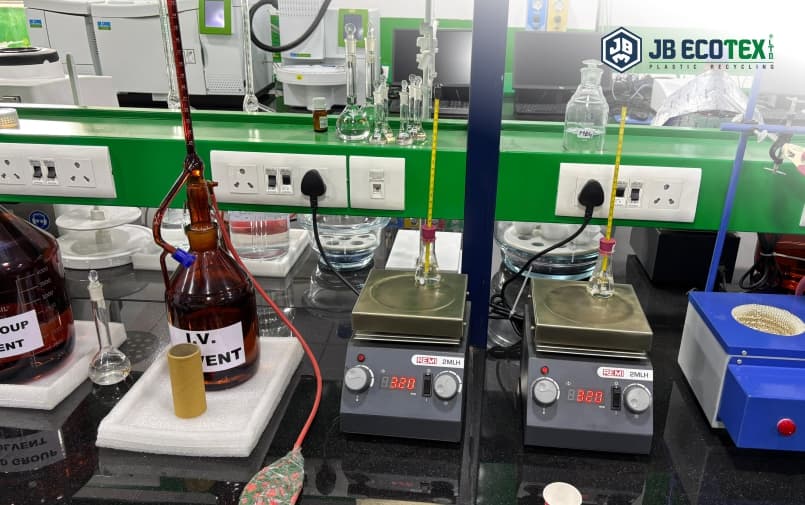
Colour testing at J B Ecotex works as a continuous, multi-stage monitoring system built into our standard operating procedure. It follows the material through the whole recycling journey, from incoming feedstock to the sealed bag. There are four fixed measurement points.
- Stage 1, flakes: testing begins with the feedstock itself. Incoming PET flakes are checked against our colour standards before they enter production. Poor colour at this stage signals contamination, and material that fails here is rejected at the gate.
- Stage 2, amorphous material: as flakes heat up and soften into a plastic state, the material is measured a second time. This catches any colour movement that appears during the first melt and the pre-processing steps.
- Stage 3, intermediate process: semi-processed material is measured as it moves through solid-state polymerisation (SSP) and the other process stages. A developing colour shift gets caught here, ahead of pelletisation and packing.
- Stage 4, final resin: every bag of finished pellets, the material many buyers know as rPET chips, receives an individual L*, a*, b* reading ahead of dispatch approval. Coverage is complete. Each bag is tested and certified.
Beyond the four fixed stages, random colour spot checks run throughout the day on our colour spectrometer. The unscheduled timing is the point. Scheduled tests confirm the plan works. Unscheduled ones confirm reality matches the plan in between. These confirm that equipment performance, feedstock consistency and ambient conditions all hold steady between scheduled tests. Drift has very few places to hide when the instrument keeps coming back at unscheduled moments.
Why rPET Yellowing Deserves Its Own Conversation
Yellowing is where colour chemistry and commercial risk meet, which is why the b* value carries so much weight in purchasing decisions.
The b* value in recycled PET works as an early warning system. A rising reading points to thermal degradation: somewhere in processing, the polymer took on more heat than it should have. Chains break, acetaldehyde is generated, mechanical strength drops, and the intrinsic viscosity of the resin may slip below specification. Our guide to rPET IV grades explains what those viscosity numbers mean for bottle applications.
The practical lesson for buyers is simple. A yellow tint is rarely just a tint. It usually appears as the visible symptom of heat damage that has already changed the material underneath. Checking the b* value on a certificate of analysis tells you about the colour and, indirectly, about the thermal history of the batch.
What Colour Consistency Means for Your Bottling Line
For B2B buyers of recycled PET resin for bottles, colour operates as a commercial requirement and an operational one, with consequences that flow well downstream. Colour consistency in recycled PET shows up in four places on your balance sheet.
Retail shelf appearance comes first. Shoppers read clarity as purity. Bottles blown from consistently colourless resin, high in L* and low in b*, carry a premium look on the shelf. One off-colour bottle standing among fifty clear ones tells the shopper a quality story you would rather they missed.
Brand owner specifications come second. Major FMCG brands set CIE Lab colour limits for their bottle suppliers. Resin that arrives inside those values keeps incoming lots clearing your quality gate the first time and keeps production runs on schedule. Resin that arrives outside specification forces a choice between rejecting the lot and spending hours adjusting equipment to compensate.
Production efficiency comes third. Colour consistency in your resin translates into colour consistency in your bottles, run to run and shift to shift. Stable inputs let you standardise production parameters and spare your line corrective colour additives and the downtime that comes with them. Consistency matters across deliveries too. Bottles moulded from slightly different colour lots look fine one at a time, and the mismatch shows up the moment they sit together on a pallet or a store display. Brand owners design their packaging and their labels around a single colour reference point. When resin drifts away from that point, converters end up sorting, blending or rejecting stock just to keep a shipment looking uniform.
Food safety comes fourth. Stable, neutral colour values double as an indirect signal that a resin has been decontaminated thoroughly and has stayed thermally stable through processing, which supports food-contact compliance under the FSSAI, FDA and EFSA frameworks. Colour data is one of several signals buyers use when they assess safe food packaging credentials in a supplier.
What Poor Colour Values Reveal About a Resin
Colour readings work like a diagnostic panel. Each type of deviation points to a specific failure earlier in the process.
A low L* value usually traces back to contaminated feedstock. Coloured bottles, non-PET fragments or poorly sorted input have made their way into the recycling stream, and that puts both purity and food-contact safety in doubt. A significant a* deviation towards red or green indicates colour contamination: coloured PET fragments or dye that the sorting and washing steps of mechanical recycling should have removed. A high b* value, as covered above, points to thermal degradation and overheating.
Batch-to-batch variation deserves special attention. When colour values wander between orders, it suggests the supplier lacks a consistent testing and correction system, and the next delivery becomes a guess. A question worth putting to any resin supplier: at which stages is colour measured, on what instrument, and can the readings for a specific bag be produced on request? Suppliers with a genuine system answer quickly. A buyer holding two different-looking lots from the same supplier is holding evidence about that supplier's process control.
Our answer to all four risks is the same: measure early, measure often, measure everything. Flakes. Amorphous material. Intermediate process. Final resin. Random spot checks between them. Our food-grade bottle-to-bottle recycled PET resins (Food Grade B2B rPET Resins) carry documented L*, a*, b* readings because that documentation is what turns a colour promise into a colour record.
Common Questions About rPET Resin Colour Testing
What are L*, a* and b* values in rPET resin?
L*, a* and b* are the three CIE Lab colour dimensions used to measure resin optically. L* records lightness from 0 (black) to 100 (white or clear). The a* value tracks red to green tint and b* tracks yellow to blue.
What is a good L* value for bottle grade rPET resin?
At J B Ecotex, bottle grade rPET resin must show an L* value above 70 on every batch. A high reading signals bright, clear material that meets commercial expectations. A low reading points towards contamination, degradation or processing problems upstream.
Why does recycled PET turn yellow?
Yellowing in recycled PET indicates thermal degradation. Overheating during processing breaks polymer chains, generates acetaldehyde, reduces mechanical strength and can pull intrinsic viscosity below specification. The damage appears on a colour report as a rising b* value.
What b* value should bottle grade rPET resin have?
We maintain a b* value between 0 and -3.5 on every batch of bottle grade resin. A low b* means a clean, neutral tone. Positive b* readings indicate yellowness, the most common colour defect in recycled PET.
How is colour measured in rPET resin?
Colour is measured on a colour spectrometer using CIE Lab values. At J B Ecotex readings are taken at four stages: incoming flakes, amorphous material, the intermediate process around SSP, and every bag of final resin, plus random spot checks daily.
Why does colour consistency matter in recycled PET?
Consistent colour lets converters meet the CIE Lab limits brand owners specify, keep bottles uniform run to run, and hold a premium look on the shelf. Stable colour values also act as an indirect marker of thorough decontamination.
Three Numbers That Turn Colour Into a Contract
Colour talk stays vague until somebody writes the values down. For us those written values are an L* reading above 70, an a* reading between -1 and -2, and a b* reading between 0 and -3.5, measured on a spectrometer at every stage and logged for every batch. Written values are what allow a buyer to specify colour and verify it, order after order. They sit at the heart of how we make Food Grade B2B rPET Resins and how we prove each delivery matches the one before it. For detailed colour certification documents and technical specifications for your application, our sales team is one message away.