Textile Industry Certifications That Cover Every Link in Your Supply Chain
Buyers in apparel, home textiles, automotive, and nonwovens face a question before a purchase order is placed: can you prove it? Auditors want to trace the raw material. Brand compliance teams screen for restricted substances. Retailers require chain-of-custody documents at the style level. The certifications attached to your input fibre contribute toward whether you get your fabric through the gate.
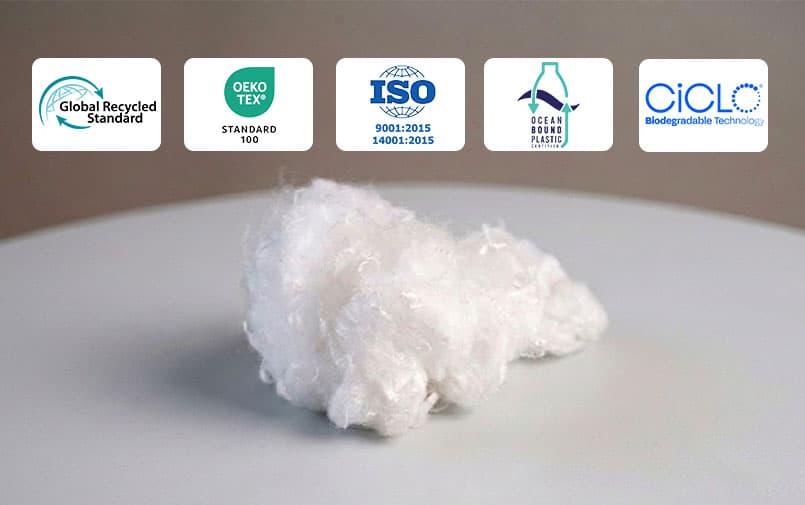
J B Ecotex manufactures recycled polyester staple fibre (rPSF) under five certifications. This page covers what each certification requires, what it allows you to claim, and why it matters to the buyers you are selling to.
GRS Certification: Recycled Content You Can Verify at Every Stage
The Global Recycled Standard (GRS), administered by Textile Exchange, is the most widely required certification for recycled content claims in global textile supply chains. It does two things that a data sheet cannot: it audits every facility in the supply chain separately, and it issues transaction certificates that travel with the material from one stage to the next.
The audit covers the entire chain. That means the collector who gathers post-consumer PET bottles, the recycler who converts those bottles into flakes, the fiber manufacturer who spins flakes into staple fiber, and every downstream processor before yarn or fabric stage. Each facility must hold its own valid GRS scope certificate before a recycled content claim is permitted on a product, hang tag, or sustainability report.
What GRS means for your purchasing decision
When you buy GRS-certified rPSF, you receive transaction certificates that can be passed forward through your supply chain. Those certificates are what allow your yarn mill or fabric unit to apply for its own GRS certification on finished goods. Without an audited chain of custody running back to the fiber stage, your recycled content claim rests on a supplier declaration. Brands, particularly those selling into EU, US, and Japanese markets, treat those two categories of evidence differently.
A recycled content percentage printed on a data sheet is a claim. A GRS transaction certificate is third-party verified documentation. That distinction is what brand compliance auditors and programs such as the Higg Materials Sustainability Index are designed to check.
→ Low vs high denier recycled polyester staple fiber – fiber selection guide
Why Certification Stacking Matters More Than Single-Standard Compliance
Generally, rPSF suppliers hold one certification. Some hold two. The gap between one certification and a full certification stack is larger than it appears on a supplier questionnaire.
Here is why that gap matters in practice. GRS confirms your recycled content claim is verified. But GRS alone tells a brand auditor nothing about whether the fiber is safe for skin contact. OEKO-TEX Standard 100 fills that gap. OEKO-TEX alone tells a compliance team the product passed substance testing, but gives them no information about whether the manufacturing facility manages its own environmental footprint in an auditable way. ISO 14001 fills that gap. OBP and CiCLO address specific market requirements around marine impact and microplastics that neither GRS nor OEKO-TEX covers.
When a brand runs a supplier qualification process, these questions arrive in the same questionnaire. A supplier with a single certification answers one section fully and leaves the rest as self-declarations. A supplier with a full stack answers the entire questionnaire with third-party verified documentation.
The commercial effect is straightforward:
- Faster supplier approval because fewer sections require follow-up
- Lower audit risk because more compliance requirements are met at the input stage
- Stronger downstream claims because the documentation chain is unbroken from raw material to finished fiber
- Reduced cost of compliance for your own certification applications because the foundational evidence already exists
This is the practical difference between sourcing certified fiber and sourcing fiber from a certified manufacturer. Both sound similar. The outcomes are different.
OEKO-TEX Standard 100: Chemical Safety Tested on the Finished Fiber
OEKO-TEX Standard 100 tests textile products against over 100 harmful and regulated substances including heavy metals, formaldehyde, pesticides, phthalates, and aromatic amines from azo dyes. The test is run on the finished article, which means the fiber itself is tested rather than the raw material inputs alone.
The standard is divided into four product classes based on the level of skin contact expected in the final produt:
- Product Class I: Articles for babies and toddlers under 36 months. Strictest limits across all parameters.
- Product Class II: Articles worn directly against skin such as underwear and T-shirts.
- Product Class III: Articles with limited skin contact such as outer garments and linings.
- Product Class IV: Decoration materials with minimal skin contact such as curtains and upholstery.
J B Ecotex rPSF is certified under OEKO-TEX Standard 100 at Product Class I for some products from our range.
A Closer Look at Product Class I
Class I is the most stringent product class within OEKO-TEX Standard 100. It is set for articles intended for prolonged contact with the skin of infants and toddlers under 36 months, a population whose physiological sensitivity to chemical exposure is highest. Substance limits for formaldehyde, pH, heavy metals, and colorants are set lower at Class I than at any other class.
For a recycled polyester staple fiber to clear Class I from a rPET route, the input material must be clean, the melt-spinning process must use only permitted additives, and the finished fiber must pass batch-level laboratory testing. The OEKO-TEX certificate number is linked to the specific product and facility and can be verified directly on the OEKO-TEX website.
If you are a yarn spinner or fabric manufacturer supplying to babywear or childrenswear brands, your input fiber's certification status is reviewed at the brand compliance stage. Class I certified input fiber means your OEKO-TEX Standard 100 application for the finished yarn or fabric starts from the strongest possible base. If the input fiber has only passed Class II or Class IV testing, achieving Class I on a finished article requires substantially more work.
What OEKO-TEX Standard 100 Does Not Cover
It is worth being precise about scope. OEKO-TEX Standard 100 tests the product for harmful substance residues. It does not verify recycled content percentage, it does not audit the supply chain for traceability, and it does not evaluate the manufacturing facility's broader environmental management practices. Those functions belong to GRS and ISO 14001 respectively. Holding all three at the same manufacturing facility is what allows the full compliance picture to be assembled from a single source supplier.
OEKO-TEX Standard 100 versus OEKO-TEX MADE IN GREEN
These two certifications are related but cover different ground. Standard 100 certifies the product against harmful substance limits. MADE IN GREEN combines Standard 100 substance testing with a facility-level audit of chemical input management and working conditions. J B Ecotex holds Standard 100. If your brand requires MADE IN GREEN on the finished fabric or garment, your downstream converter would require that certificate. The input fibre certification from J B Ecotex satisfies the Standard 100 product component requirement.
→ Why choose recycled polyester staple fibre from J B Ecotex
ISO 14001:2015: Audited Environmental Management at the Facility Level
ISO 14001 is an internationally recognised environmental management system standard. Where GRS and OEKO-TEX are product-level certifications, ISO 14001 audits the manufacturing facility itself: its systems for managing waste generation, water use, energy consumption, chemical handling, and environmental emissions. A certificate confirms that an independent registrar has reviewed documented processes, performance targets, and the internal audit trail across the facility's operations.
For a purchasing manager sourcing polyester staple fibre, ISO 14001 answers a different question than GRS does. GRS answers: is the recycled content verified? ISO 14001 answers: is the facility managing its own environmental footprint in a structured and auditable way?
Apparel brands running supplier qualification programs typically require fiber and yarn suppliers to disclose their environmental management systems. ISO 14001 satisfies that disclosure with a third-party audited credential rather than a self-assessment questionnaire. For mills supplying to EU brands navigating the Corporate Sustainability Due Diligence Directive, a tier-2 raw material supplier with ISO 14001 certification provides documented evidence of environmental due diligence at a deeper level of the supply chain.
Ocean Bound Plastic Certification: A Verified Marine-Impact Claim
Ocean Bound Plastic refers to post-consumer plastic waste collected from areas within approximately 50 km of coastlines and waterways where inadequate waste management infrastructure puts the material at high risk of entering the ocean. Certified OBP material differs from standard recycled PET in one specific and documentable way: the geographic origin of the input waste is independently verified.
J B Ecotex's AquaLoop fiber grades are manufactured from certified OBP PET. The OBP certification program, developed in collaboration with Control Union, requires documentation at the point of collection, verified chain of custody through processing, and batch-level traceability from collected coastal plastic through to finished fiber.
What OBP certification allows you to claim
When you purchase OBP-certified rPSF and process it under a GRS transaction certificate chain, your downstream product can carry a verified marine-impact material claim. This matters to brands selling into markets where ocean plastic origin is a commercial differentiator. The certification provides the documentation layer that separates a verified claim from a marketing statement. Sportswear, lifestyle, and sustainability-focused retailers have used OBP-origin fiber for product marketing for several years, and the claims that hold up under retailer scrutiny are those backed by certification documentation rather than supplier copy.
CiCLO Technology: End-of-Life Biodegradability Built Into the Fiber
CiCLO is a licensed additive technology incorporated at the fiber manufacturing stage that enables synthetic microfibers to biodegrade in biologically active environments including seawater, soil, landfill, and wastewater treatment conditions. The additive is introduced via a CiCLO masterbatch during melt spinning and becomes a permanent part of the fiber structure rather than a surface treatment that degrades or washes off over time.
J B Ecotex produces a CiCLO-enabled rPSF grade from post-consumer PET bottles. Each production batch is accompanied by documentation confirming CiCLO masterbatch incorporation. The fiber performs identically to conventional recycled polyester through the garment's service life. The biodegradation pathway activates when shed microfibers reach environments with suitable microbial conditions.
Microplastic pollution from synthetic textiles has moved from environmental science discussion into active regulation. Several markets have tabled requirements around microfiber filtration or reduction at the manufacturing stage. Brands evaluating fiber-level responses to this issue treat CiCLO-enabled fiber as a raw material solution that addresses the microfiber end-of-life problem before the garment is ever worn or washed.
Additional Certifications and Standards
Low BPA documentation
Certain rPSF grades at J B Ecotex are produced with BPA (Bisphenol A) levels below 1.0 ppm, verified by third-party laboratory testing on a batch basis. BPA is recognized as a potential endocrine disruptor, and global apparel brands are tightening Restricted Substance Lists to reduce it from textile inputs, particularly for skin-contact and babywear applications.
BPA test reports are available for qualifying production batches on request. The fiber is described as batch-tested BPA below 1.0 ppm with documented third-party laboratory results. It is not described as BPA-free, because trace contamination from recycled PET stream inputs is possible. That distinction matters for brand compliance teams that understand the difference between a blanket claim and a batch-verified measurement.
GRS Textile Exchange version.
GRS is administered by Textile Exchange, the industry body that also manages the Responsible Wool Standard, the Responsible Down Standard, and the Organic Content Standard. J B Ecotex is certified under GRS 4.0, the current version administered by Textile Exchange. This is the version accepted by all global apparel and home textile brands running responsible sourcing programs.
→ Low vs high denier recycled polyester staple fiber
How These Certifications Protect You as a Raw Material Buyer
Certification frameworks protect buyers in three ways that go beyond marketing language.
They reduce audit failure risk
Brands audit their supply chains. When an audit identifies a raw material supplier without documentation for recycled content or chemical safety, the manufacturer sourcing that material absorbs the cost of remediation or re-certification. Purchasing fiber that already carries GRS transaction certificates and OEKO-TEX documentation shifts the verification burden away from your facility and onto a process that has already been completed upstream.
They create defensible claims
Sustainability marketing claims for recycled content or ocean plastic origin face increasing regulatory scrutiny in the EU, US, and UK. The EU Green Claims Directive requires that environmental product claims be substantiated by recognized third-party certification. If you are producing fabric or garments carrying recycled content claims, your fiber origin documentation is part of the substantiation chain. GRS transaction certificates and OBP certification are accepted forms of that substantiation.
They accelerate qualification with new buyers
A yarn mill or converter entering a new buyer relationship with an apparel brand will face a supplier qualification questionnaire. The sections covering environmental certifications, restricted substance controls, and recycled material verification are long and document-heavy. Sourcing from an rPSF supplier that holds GRS, OEKO-TEX, and ISO 14001 means many of those sections can be answered with certificate numbers and audit reports rather than self-assessments.
What to Ask Any rPSF Supplier Before Placing an Order
If you are evaluating rPSF suppliers and comparing certification claims, the following is a practical checklist of what to request and verify before committing to a supply relationship.
For GRS:
- Ask for the supplier's current GRS scope certificate, which lists the certified products and the certification body that issued it
- Verify the certificate on the Textile Exchange public database at textileexchange.org
- Confirm that the specific fiber grade you are ordering falls within the certified scope, because a facility can hold GRS for some grades and produce others outside the certified scope
- Ask how transaction certificates are issued on orders, and confirm the process before your first shipment
For OEKO-TEX Standard 100:
- Ask for the certificate number and the product class it covers
- Verify the certificate directly at oeko-tex.com using the certificate number
- Confirm that the specific fiber grade you are ordering is listed under the certificate, because a certificate may cover a subset of a manufacturer's product range
- Check the certificate expiry date, as OEKO-TEX Standard 100 requires annual renewal
For ISO 14001:
- Ask for the current ISO 14001 certificate and the name of the registrar that issued it
- Confirm the certificate covers the manufacturing facility where your fiber is produced, not a holding company or group entity
- Check the validity date and the scope statement
For OBP:
- Ask for the OBP scope certificate and the chain-of-custody documentation for the specific batch
- Confirm the certification body and verify independently if required
For Low BPA claims:
- Ask specifically whether the claim is a blanket declaration or a batch-tested result with third-party laboratory reports
- Request a sample test report to confirm the testing methodology and threshold
A supplier that holds genuine certifications will provide all of this documentation without friction. Delays or vague responses to certificate verification requests are worth noting before a supply relationship begins
Frequently Asked Questions About Textile Industry Certifications
What is GRS certification in textiles?
GRS stands for Global Recycled Standard. It is an international certification administered by Textile Exchange that verifies the recycled content percentage in a textile product and audits the chain of custody across every facility that handles the material from raw waste collection through fiber production and downstream processing. A GRS transaction certificate issued at the fiber stage can be carried forward by yarn mills and fabric manufacturers as they apply for their own GRS certification on finished goods. Without an audited chain of custody, a recycled content percentage on a data sheet is a supplier declaration rather than a verified claim.
What is OEKO-TEX Standard 100 certification for textile manufacturers?
OEKO-TEX Standard 100 is a product-testing certification that evaluates finished textile articles against over 100 harmful substances including heavy metals, pesticides, formaldehyde, certain dyes, and phthalates. The test applies to the article itself, which means a fiber manufacturer is tested on the finished fiber rather than on raw material inputs alone. There are four product classes. Class I covers products for infants under 36 months and carries the strictest substance limits. A yarn spinner purchasing Class I certified input fiber starts from a demanding test level, which simplifies the path to Class I certification on finished yarn or fabric.
What does GRS Textile Exchange certified mean?
Textile Exchange is the nonprofit organization that administers the Global Recycled Standard. When a fiber or product claims to be GRS Textile Exchange certified, the recycled content has been audited and verified under the GRS framework as managed by Textile Exchange. Certification is issued by accredited third-party certification bodies rather than by Textile Exchange directly. The Textile Exchange website maintains a public database of certified facilities and their scope documents, which buyers can use to verify claims independently.
What is eco textile certification and why does it matter for manufacturers?
Eco textile certification is a general term covering any third-party verified standard that evaluates environmental performance in textile raw materials, processes, or products. A widely required frameworks in global textile supply chains are GRS for recycled content, OEKO-TEX Standard 100 for chemical safety, and ISO 14001 for facility-level environmental management. Manufacturers buying certified fiber can pass forward the certification documentation to brand customers as part of supplier qualification and compliance programs. Sourcing from a certified supplier reduces the documentation burden during brand audits and speeds up approval for new supply relationships.
What is Ocean Bound Plastic certification in textiles?
Ocean Bound Plastic certification verifies that plastic raw material was collected from coastal or inland areas within approximately 50 km of a shoreline where inadequate waste infrastructure creates a high risk of the plastic entering the ocean. The certification is issued by independent bodies under structured verification programs. In textile fiber, OBP-certified rPSF means the PET input was sourced from certified collection zones with documented chain of custody. This allows yarn and fabric manufacturers to make marine-impact material claims backed by third-party verification.
What is recycled manufacturing certification for polyester fiber?
Recycled manufacturing certification for polyester fiber typically refers to GRS, which verifies that the fiber is produced from genuine post-consumer or post-industrial recycled PET and that the recycled content percentage is accurate. The certification audits the recycler and the fiber manufacturer separately. A recycled polyester staple fiber with GRS certification comes with transaction certificates documenting the audited recycled content from collection through fiber production. This is the standard required by most global apparel brands when specifying recycled polyester as a material input.
How do certifications for recycled plastic products manufacturers work?
For a manufacturer producing goods from recycled plastic inputs, the certification process works in layers. The first layer is input material certification: GRS covering the recycled PET source and the fiber manufacturer's production process. The second layer is product safety certification: OEKO-TEX Standard 100 testing the finished fiber against substance limits appropriate to the end use. The third layer is facility-level environmental certification: ISO 14001 documenting that the manufacturing site manages its environmental impact through audited processes. When a yarn or fabric manufacturer purchases certified rPSF, the first layer is already in place and the own certification process begins from a verified foundation.
What is the difference between Oeko-Tex textiles and Oeko-Tex 100 certified?
OEKO-TEX is a brand that covers a family of certification programs for textiles and leather. OEKO-TEX Standard 100 is the specific product-testing program within that family that certifies textile articles for harmful substance limits. When a fiber or fabric is described as OEKO-TEX 100 certified, it means it has been tested under the OEKO-TEX Standard 100 framework and carries a certificate specifying the product class and tested parameters. Other programs under the OEKO-TEX umbrella such as MADE IN GREEN and LEATHER STANDARD cover different aspects of the supply chain and are separate certifications with separate requirements.