
India's 40% Recycled-Content Requirement for 2026-27: A Packaging Buyer's Guide to Food-Grade rPET Sourcing
For the 2026-27 financial year, India's recycled content mandate sets a 40% minimum for recycled plastic in rigid plastic packaging. For anyone who buys PET bottles, jars or trays, planning 40% recycled content PET packaging is now part of every budget and every supplier conversation. Food and beverage packaging adds a second set of requirements, because recycled PET that touches food follows its own route under the Food Safety and Standards Authority of India (FSSAI).
We manufacture food-grade bottle-to-bottle rPET resin at our facility near Surat. The brand owners and converters we speak with ask practical questions. How should a buyer judge a supplier? What should a specification include? Which records will an auditor want to see? We answer each below.
For a clause-by-clause breakdown of the rules themselves, see our explainer on the Plastic Waste Management Rules April 2026 update. The sections here focus on sourcing.
The Targets at a Glance
The Ministry of Environment, Forest and Climate Change notified the Plastic Waste Management (Amendment) Rules, 2026, through notification G.S.R. 237(E) dated 31 March 2026. The amendment introduced mandatory recycled content targets for producers, importers and brand owners, set by packaging category. For Category I, which covers rigid plastic packaging such as bottles, jars and containers, the targets are:
- 2025-26: 30% recycled plastic content
- 2026-27: 40% recycled plastic content
- 2027-28: 50% recycled plastic content
- 2028-29 onwards: 60% recycled plastic content
Source: Plastic Waste Management (Amendment) Rules, 2026, G.S.R. 237(E), 31 March 2026.
Two points shape every sourcing plan. The 40% figure applies to a single financial year, and the target moves to 50% in 2027-28, so a supply agreement sized for this year will need revisiting within twelve months. The target also applies to rigid plastic packaging as a whole, and PET is one of several polymers in that category, so each brand owner's PET requirement depends on its full packaging mix.
The obligation sits with producers, importers and brand owners, who report their recycled content use through the Central Pollution Control Board's centralised portal. Converters and resin suppliers feel the rule through their customers, as brand owners write recycled content into purchase specifications.
Where Food-Contact Packaging Fits
Food packaging is where the recycled content rules meet FSSAI's rules, and buyers need both in view.
The 2026 amendment provides an exemption where law or a mandatory Indian Standard prohibits recycled plastic, with FSSAI among the named bodies, and a brand claiming it declares the relevant law in its annual return. For food-contact packaging, the amendment also allows a shortfall against the 2025-26 target to be carried forward across the following three years, provided at least one-third of the carried-forward amount is cleared each year.
FSSAI's own rules on recycled PET changed in 2025. The Food Safety and Standards (Packaging) First Amendment Regulations, 2025, published on 28 March 2025, permit products made of recycled PET for packaging, storing, carrying or dispensing food, subject to the standards and guidelines notified by the Food Authority. FSSAI then issued Guidelines for Acceptance of Recycled PET as Food Contact Material in May 2025. Those guidelines cover the recycling of post-consumer PET that was used for food applications, and they apply to recycling technologies approved by FSSAI.
For a buyer, the practical reading is simple. Recycled PET can enter food packaging when it meets FSSAI's requirements, so the supplier's standing with FSSAI becomes a central part of qualification. How the exemption and carry-forward provisions apply to a particular pack is a question for each brand owner and its compliance advisers, and it is worth settling in writing before a sourcing plan is finalised. We explain what FSSAI approved rPET means for packaging lines in a separate article.
Labelling also needs attention. Recycled plastic packaging has to conform to IS 14534:2023 and carry the resin identification code, and food-contact packaging must also meet FSSAI's marking and labelling requirements.
What a Buyer Needs From Food-Grade Recycled PET
Food-grade recycled PET has to do two jobs at once. It has to run on a converter's machines like the PET it replaces, and it has to meet food-contact safety requirements.
Processing performance depends largely on intrinsic viscosity (IV). IV influences how resin behaves during preform moulding, stretch blow moulding, sheet extrusion and thermoforming. Different packaging formats call for different IV levels, so buyers usually specify a grade for each application.
Safety depends on decontamination. Post-consumer bottles can carry residues and substances absorbed during their first use. A food-grade process has to remove these to the levels regulators accept, and the resulting resin is tested batch by batch.
Appearance and taste also matter. Colour values, black specks, moisture and acetaldehyde all affect how a finished bottle looks, how its contents taste, and how smoothly the resin runs on a line. A good specification covers each of these points in measurable terms.
How We Make Food-Grade rPET Resin
Our food-grade rPET resin is made from post-consumer PET bottles through advanced EREMA VACUNITE® high-vacuum extrusion technology or EREMA VACUREMA® technology, together with Solid State Polycondensation (SSP) technology from Polymetrix. Incoming loads are checked at our gate, with bales sampled from different positions in each truck, as described in our walkthrough of how our PET recycling systems handle traceability and food-grade safety.
The bottles are segregated and inspected to remove non-PET materials and visible contaminants. They are sorted by polymer type and colour, and labels and caps are removed before crushing into flakes of uniform size. The flakes go through hot washing, friction cleaning and drying to remove dirt, label residue, adhesives, oils and moisture.
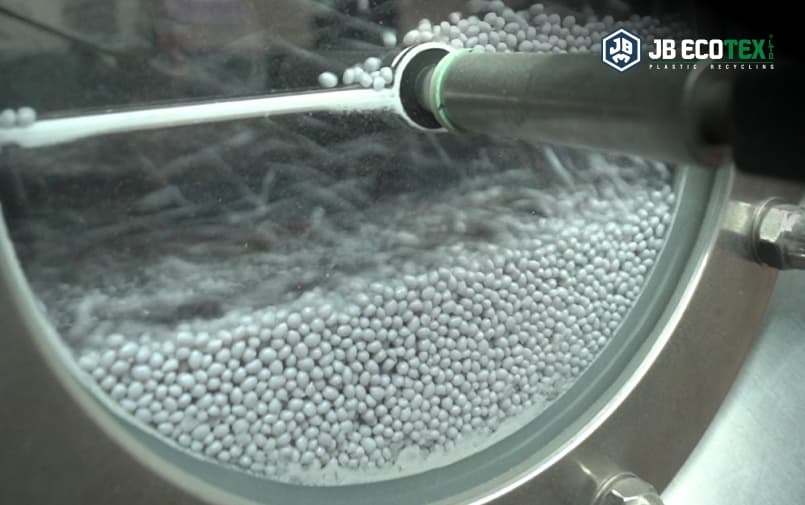
The clean flakes then move into the food-grade stage. They are pre-treated at high temperature under high vacuum to remove moisture, volatile organic compounds and organic contaminants.
They are melted in an EREMA extrusion system with continuous melt filtration and vacuum degassing, and the purified melt is formed into uniform pellets through underwater pelletising.
The pellets are crystallised under controlled conditions to improve thermal stability and prevent them sticking together. The last stage is vacuum-based solid state polycondensation (SSP) in a nitrogen environment, which restores intrinsic viscosity and reduces acetaldehyde and residual contaminants. Our explainer on the mechanical recycling process of PET covers the wider process.
Our food-grade rPET resin is available in multiple IV grades ranging from 0.76 to 0.86, along with customised grades for specific processing and packaging requirements. Each product is evaluated for intrinsic viscosity, moisture content, colour (L*, a* and b* values), bulk density, melting point, black specks and visual impurities, heavy metal and other contamination levels, acetaldehyde and volatile organic compounds.
The resin complies with the applicable standards prescribed by FSSAI and the US Food and Drug Administration, is covered by a US FDA No Objection Letter, and is certified under the Global Recycled Standard (GRS). Its uses include bottles for packaged drinking water, carbonated soft drinks, juices, milk and other ready-to-drink beverages, along with PET jars, straps, BoPET films, thermoformed food trays, ready-to-eat meal containers, fresh produce and confectionery packaging.
What Converters and Preform Makers Should Prepare For
Brand owners carry the legal obligation, though converters and preform makers handle much of the practical work. When a customer raises its recycled content requirement from 30% to 40%, the change reaches the factory floor as a new blend ratio, new trials and new records.
Blending comes first. Many converters run recycled resin alongside virgin PET, and the recycled share in each pack rises as brand targets climb. Each increase deserves its own trial, since a blend that runs smoothly at one ratio can behave differently at a higher one.
Drying comes next. PET resin, recycled or virgin, is dried before melt processing to protect its intrinsic viscosity. Converters adding recycled resin should confirm dryer settings for the grade they receive and check moisture before the resin enters the machine.
Appearance follows. Colour values and black speck limits on the technical data sheet help a converter predict how a finished bottle or tray will look. Agreeing these limits with the brand owner in advance avoids disputes after production.
Record keeping completes the picture. A converter supplying several brands may need to show each customer how much recycled resin went into its packs. Linking batch numbers, certificates of analysis and transaction certificates to each customer order makes that straightforward.
Lead times deserve a mention too. Qualification of a new resin grade usually involves samples, trials, documentation review and sign-off from the brand owner, and each step takes time. Starting that process well before the recycled content requirement changes gives the converter room to solve any processing issues without pressure.
Early conversations between the brand owner, the converter and the resin supplier save time for all three, particularly in a year when the target is rising.
Questions to Settle Before Approaching Suppliers
Supplier conversations go faster when a buyer has done some groundwork internally. Four questions are worth answering first.
Which packs fall into Category I? A full inventory of rigid packaging, grouped by format and polymer, shows how much of the recycled content requirement PET has to carry. A brand that also uses rigid packaging in other polymers may be able to meet part of its target there, which changes the PET volume it needs.
Which packs are in food contact? Food-contact packs call for food-grade resin and the FSSAI documentation that comes with it. Packs for personal care, household or other non-food products may have different requirements, and separating the two groups early keeps the specification clear.
Which packs are exported? Packaging bound for other markets may need additional documents, such as a US FDA No Objection Letter for the United States. Identifying these packs early avoids a second round of supplier qualification later.
Who owns the data? Recycled content reporting draws on purchase records, production records and sales records. Naming one team to collect these, and agreeing the format with procurement and finance, makes the annual return far easier to prepare.
With these answers in hand, a buyer can give suppliers a clear brief: the formats, the grades, the volumes for each year to 2028-29, and the documents required with each delivery. That brief is also a useful record in its own right, since it shows how the brand planned to meet each year's target.
An rPET Procurement Checklist for Packaging Buyers
A recycled content target becomes a purchase order only once the resin passes technical, regulatory and documentation checks. This rPET procurement checklist covers the areas buyers raise most often during supplier qualification.
- Food-contact standing. Ask for the supplier's FSSAI documentation and confirmation that its recycling technology is approved under FSSAI's recycled PET guidelines. For packaging bound for the United States, ask for the US FDA No Objection Letter.
- Chain of custody. Ask which certification supports recycled content claims, such as GRS, and whether transaction certificates are available for each shipment.
- Feedstock source. Confirm that the resin is made from post-consumer PET that was used for food applications, in line with FSSAI's guidelines, and ask how incoming bottles are checked.
- Technical data sheet. Compare IV grade and tolerance, acetaldehyde, moisture, colour values and black speck limits with your own line requirements.
- Batch documentation. Ask for a certificate of analysis with every batch and details of sample retention.
- Supporting declarations. Confirm that the supplier can provide the documentation your converters and food business need under FSSAI's guidelines.
- Processing trial. Run the resin on your own preform, blow moulding or thermoforming line before committing to volume.
- Supply planning. Discuss annual volumes, lead times and plans for the higher targets in 2027-28 and 2028-29
Planning Volumes Across the 2026-29 Targets
The move from 40% to 60% over three years changes how buyers should think about supply. A single-year agreement sized for this year's target will fall short next year.
Brand owners who share multi-year forecasts early give suppliers the most room to plan. Agreeing specifications ahead of production, running trials on each pack format, and identifying where a different IV grade would still suit the application all widen the range of usable material.
When shortlisting food grade rPET suppliers in India, look beyond price per tonne. Consistency between batches, speed of documentation and technical support during line trials often decide whether a recycled content plan works in practice. The carry-forward provision for food-contact packaging offers some flexibility, and it also creates a make-good obligation in later years, which makes forward planning more important.
Building sustainable PET packaging in India also means planning for the reuse obligations on rigid formats and the labelling requirements described above. Packaging, procurement and regulatory teams working from one shared plan will find these requirements easier to meet together.

Records to Keep Ready for Audits
Recycled content claims have to hold up on paper. The 2026 amendment allows compliance to be verified through a designated agency or a Registered Environment Auditor, so it pays to collect records from the first purchase order onwards.
Start with the supplier's regulatory documents: FSSAI documentation, confirmation of the approved recycling technology, and export-market documents such as the US FDA No Objection Letter. Keep the GRS scope certificate on file, along with the transaction certificate for each consignment.
Batch records come next. Certificates of analysis, test reports and sample retention details show that each delivery met the agreed specification.
Purchase and consumption records tie everything together. Quantities of recycled resin bought and used should match the packaging placed on the market and the figures reported on the CPCB portal. Where an exemption is claimed, keep a record of the law or standard relied upon, as declared in the annual return.
Frequently Asked Questions
What is India's 40% recycled content requirement?
The Plastic Waste Management (Amendment) Rules, 2026, set a 40% minimum recycled plastic content for Category I rigid plastic packaging in financial year 2026-27. The target was 30% in 2025-26 and rises to 50% in 2027-28 and 60% from 2028-29.
Does the recycled content mandate apply to food packaging?
Where FSSAI or another statutory body restricts recycled plastic, brands can claim an exemption in their annual return. Where recycled plastic is permitted in food contact, a 2025-26 shortfall can be carried forward across three years, with at least one-third cleared each year.
What does FSSAI approved rPET mean?
FSSAI's May 2025 guidelines apply to recycling technologies approved by FSSAI that convert post-consumer food-contact PET into resin for food packaging. Buyers should ask suppliers for their FSSAI documentation and confirmation that their recycling technology is approved under those guidelines.
What should an rPET procurement checklist include?
It should cover FSSAI documentation and approved technology, chain-of-custody certification such as GRS, feedstock source, the technical data sheet, batch certificates of analysis, supporting declarations, a trial on your own line, and supply planning for the rising targets through 2028-29.
Who is responsible for meeting the recycled content target?
Producers, importers and brand owners carry the obligation and report through the CPCB centralised portal. Converters and resin suppliers support them by providing compliant material and the records needed to show how much recycled content went into each pack.