
Low BPA Recycled Polyester Staple Fibre | Super-White Grade | BPA Below 1.0 ppm |RSL and MRSL Aligned
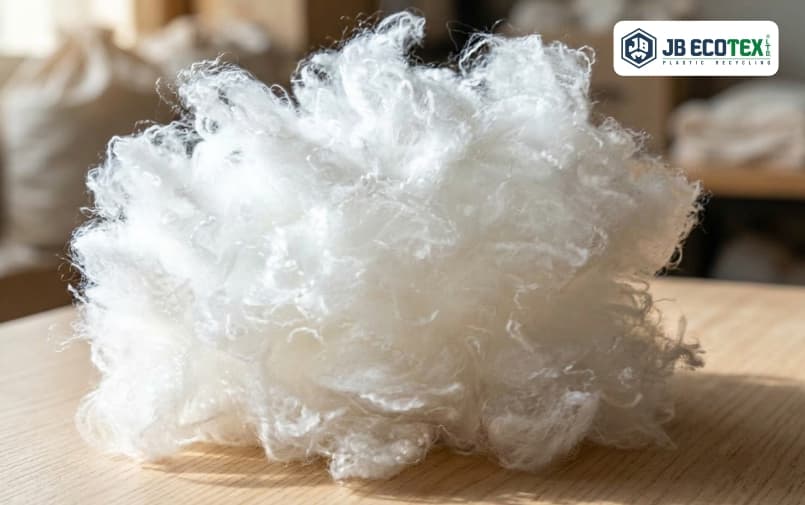
Sourcing recycled polyester for hygiene, baby, or skin-contact applications means your fibre needs to clear RSL audits, carry GRS documentation, and hold its BPA level across every production batch.
This is the grade built for that requirement.
J B Ecotex manufactures a super-white low BPA recycled polyester staple fibre from post-consumer PET, with BPA content below 1.0 ppm verified by accredited third-party laboratories. Available in 1.2D and 1.4D with cut lengths made to your requirement, with full compliance documentation for supplier qualification.
What BPA Is and Why It Matters in Recycled Polyester Fibre
BPA, or Bisphenol A, is an industrial chemical used in certain plastics and resins. PET itself does not intentionally contain BPA, but in the recycling process, trace BPA from mixed plastic inputs in the collection stream can carry through into finished fibre if melt filtration and processing controls are insufficient.
Recycled polyester staple fibre is used across all applications, from industrial nonwovens to apparel. For skin-contact, hygiene, and baby-product categories, brands and retailers now set BPA thresholds in the RSLs they impose on their supply chains, so the BPA level of the fibre becomes part of the specification.
The categories where low bisphenol A fibre is a specification requirement, not a preference:
- Baby and infant products, where OEKO-TEX Annex 6 Class 1 recycled polyester is the applicable standard
- Hygiene nonwovens including diapers, feminine care, and adult incontinence products
- Medical and pharmaceutical nonwovens supplied under RSL audit frameworks
- Wellness and athleisure apparel with next-to-skin layers
- Apparel brands supplying EU, US, and Japanese markets with active MRSL programmes
J B Ecotex builds BPA reduction into the melt filtration stage, producing a low BPA recycled polyester fibre at below 1.0 ppm, reproducibly, batch to batch.
Super-White Low BPA RPSF: Specifications
This is a super-white low BPA white rPET fibre with optical brightness and colour consistency that holds across production runs. The whiteness grade makes it suitable for applications where dyeability, colour layering, or bright final aesthetics are part of the product specification.
Grade 3002 holds BPA below 1.0 ppm, confirmed lot by lot at accredited third-party laboratories. For baby products and high-sensitivity hygiene programmes that need an even lower threshold, our recycled polyester staple fibre can be manufactured with BPA below 0.01 ppm. Share your target threshold with our technical sales team and we will confirm the grade that meets it.
Denier range: 1.2D and 1.4D
Cut length: customised to your requirement
BPA content: below 1.0 ppm, third-party laboratory verified
Colour: super-white
Fibre type: solid section
Process application: spun yarn across ring, vortex (MVS), open-end and air-jet systems
Compliance alignment: RSL compliant polyester staple fibre, MRSL compliant polyester fibre, OEKO-TEX Annex 6 Class 1 recycled polyester, GRS certified recycled content, ZDHC
Buyers requiring process documentation alongside test certificates can request the full compliance package through the J B Ecotex technical sales team. This includes GRS certification, lot-wise BPA test reports, and available test data for supplier qualification audits.
This fibre is catalogued internally as Grade 3002. Reference this when contacting us for samples or quotations.
How Low BPA Recycled Polyester Fibre Is Produced
The BPA level in recycled polyester fibre is a direct function of feedstock quality and processing control. It cannot be managed at the yarn or fabric stage. It has to be addressed at the fibre production level.
J B Ecotex processes rPET flakes and other processed PET waste, sourced from post-consumer PET bottle feedstock, through to finished RPSF in-house. BPA reduction works across two controlled stages.
The first is feedstock preparation. PET flakes go through intensive washing and drying before fibre production begins. Washing removes surface contamination and reduces BPA carry-in from the collected plastic. This is the stage where feedstock quality either creates or eliminates the BPA problem downstream.
The second is melt filtration during fibre production. The melted PET polymer passes through controlled filtration that removes residual BPA and other sub-threshold contaminants before extrusion into fibre. This is where the below 1.0 ppm level is achieved and maintained across batches, with each lot then confirmed by third-party testing.
The result is a fibre grade with BPA below 1.0 ppm, from a manufacturer producing recycled polyester staple fibre since October 2015.
For a full view of the recycled polyester staple fibre range, including dope-dyed, ocean-bound, flame-retardant, and biodegradable variants, see the complete product listing.
Where This Fibre Is Specified
Hygiene and Medical Nonwovens
Nonwoven producers supplying absorbent hygiene products work under some of the tightest RSL frameworks in the textile supply chain. Our low BPA recycled polyester staple fibre range is available for hygiene programmes where feedstock purity is a prerequisite, with BPA levels confirmed by laboratory testing. For producers who need an RSL compliant polyester staple fibre with verifiable BPA documentation, share your denier and BPA threshold and we will confirm the matching grade.
Baby and Infant Products
Babywear and skin-contact garments require clean certification trails and verifiable BPA control. This fibre at below 1.0 ppm, with lot-wise test reports, supports the thresholds that baby product brands specify in supplier quality requirements. The OEKO-TEX Annex 6 Class 1 recycled polyester alignment covers the most common certification requirement buyers in this category carry into their supply chains.
Skin-Contact Apparel and Wellness Textiles
As MRSL compliance requirements spread through apparel sourcing, brands buying recycled inputs for next-to-skin layers need fibre that passes chemical audit without substitution. This grade gives spinning mills an MRSL compliant polyester fibre option in the recycled category, with spinnability and yield characteristics that work across standard ring and open-end spinning setups.
Explore the complete polyester staple fibre range if your application falls outside these three clusters.
Compliance and Certifications
J B Ecotex's GRS-certified production framework covers the recycled content claim from feedstock through to finished fibre. The compliance alignment relevant to buyers in RSL and MRSL-governed supply chains is as follows.
GRS certification covers the recycled content claim and chain of custody from post-consumer PET bottle feedstock to finished RPSF. This is the certification most commonly required by brands running recycled content commitments under public sustainability targets.
RSL compliance covers the Bisphenol A compound family at below 1.0 ppm, with lot-wise third-party test reports your compliance team can file against each RSL audit.
MRSL compliance addresses substances used in the manufacturing process itself. J B Ecotex's process controls at the melt and filtration stage support MRSL programmes for BPA and related compounds, alongside ZDHC alignment.
OEKO-TEX Annex 6 Class 1 alignment makes this fibre suitable for buyers seeking OEKO-TEX certified end-products in the baby category. Buyers pursuing OEKO-TEX product certification should confirm testing through their own certification body.
J B Ecotex holds ISO certification and has operated in the recycled PET sector for over 10 years across domestic and export markets. Compliance documentation packages are available as part of the commercial qualification process.
Why Source from J B Ecotex
The claim of low BPA is only as reliable as the process behind it.
J B Ecotex is a manufacturer with in-house processing from rPET flake production through to finished RPSF. The BPA reduction happens at controlled process stages inside the manufacturing plant, with documentation available to buyers who need it for supplier audits.
The super-white grade is produced with batch-consistent optical brightness. For buyers in hygiene and baby categories where the final product aesthetics depend on fibre whiteness, this consistency matters across commercial volumes.
This low BPA white rPET fibre is available in the denier and cut length options that cover spun yarn applications without custom tooling. If your process runs 1.2D or 1.4D solid fibre, with cut length set to your spinning system, this grade fits as a direct-specification input.
Samples and compliance documentation are available before commercial order commitment. Contact the J B Ecotex technical sales team to begin qualification.
Related Grades in the RPSF Range
3002 is one grade within J B Ecotex’s full recycled polyester staple fibre range. If your application calls for a different optical, colour or performance specification, the following grades may be relevant:
3001 Super-White RPSF – Optimised for high optical brightness in spun yarn and home textile applications where shade consistency matters.
6002 Low BPA Dope-Dyed Black RPSF – Dope-dyed black with BPA below 1.0 ppm for babywear, innerwear and next-to-skin black fabric.
Biyo with CiCLO® Technology – Recycled polyester staple fibre with CiCLO® technology for brands with microfibre shedding commitments.
RPSF for Spun Yarn – Grades set up for clean running on ring, open-end and vortex spinning lines.
View the full RPSF product range
Request Samples or a Commercial Quotation
Our super-white low BPA recycled polyester staple fibre is available for sample dispatch and commercial quotation.
Contact the J B Ecotex technical sales team with your denier requirement, cut length, monthly volume, and any specific compliance documentation needed for supplier qualification. We supply to spun yarn mills, nonwoven manufacturers, hygiene product producers, and brand-facing converters across export markets.
Talk To Us (Interlink Fibre Form)
Frequently Asked Questions
What is low BPA recycled polyester staple fibre?
Low BPA recycled polyester staple fibre is RPSF produced from post-consumer PET with controlled melt processing that reduces Bisphenol A content to below specified thresholds. J B Ecotex's super-white grade holds BPA below 1.0 ppm, making it suitable for hygiene, baby, and skin-contact textile applications under RSL and MRSL frameworks.
What BPA level does super-white low BPA RPSF from J B Ecotex achieve?
J B Ecotex's super-white low BPA RPSF holds BPA content below 1.0 ppm through process-level control at the melt filtration stage, confirmed lot by lot at accredited third-party laboratories. Grades below 0.01 ppm are available for high-sensitivity programmes on request from the technical sales team.
Which applications require low bisphenol A fibre in recycled polyester?
Baby and infant products, hygiene nonwovens such as diapers and feminine care products, medical nonwovens, wellness apparel, and skin-contact textile layers all require low bisphenol A fibre. These categories operate under RSL and MRSL compliance frameworks that set BPA thresholds for recycled polyester inputs.
Is J B Ecotex's low BPA white rPET fibre OEKO-TEX Annex 6 Class 1 compliant?
J B Ecotex's low BPA white rPET fibre is aligned with OEKO-TEX Annex 6 Class 1 specification for recycled polyester. Class 1 is the most restrictive OEKO-TEX tier and applies to products with direct baby-skin contact. Buyers seeking OEKO-TEX certified end-product certification should confirm compliance testing through their designated certification body.
What deniers and cut lengths are available in low BPA recycled polyester fibre?
J B Ecotex's low BPA recycled polyester fibre Grade 3002 is available in 1.2D and 1.4D deniers, with cut lengths customised to your requirement. Contact technical sales with your processing specifications for confirmation.
What certifications cover this RSL compliant polyester staple fibre?
This RSL compliant polyester staple fibre is produced under GRS certification covering recycled content and chain of custody from post-consumer PET feedstock. J B Ecotex holds ISO certification and has over 10 years of production history in the recycled PET sector. Compliance documentation for RSL and MRSL supplier audits is available as part of the commercial qualification process.
How does J B Ecotex achieve less than 1 ppm BPA in recycled polyester fibre?
J B Ecotex achieves less than 1 ppm BPA through two process stages. The PET flakes pass through intensive washing and drying before fibre production to remove surface contamination. The melted polymer then passes through controlled melt filtration during extrusion, reducing residual BPA to below 1.0 ppm. Each lot is confirmed by accredited third-party laboratory testing.
Can this MRSL compliant polyester fibre be used in both spun yarn and nonwoven production?
This MRSL compliant polyester fibre is a solid-section super-white grade in 1.2D and 1.4D, built for ring, vortex, open-end and air-jet spinning. For nonwoven lines, low BPA grades are available across our RPSF range in other deniers. Share your process and we will confirm the grade, with full compliance documentation for supplier qualification.