
Recycled Polyester Staple Fibre Manufacturers
Recycled Polyester Staple Fibre Manufacturers
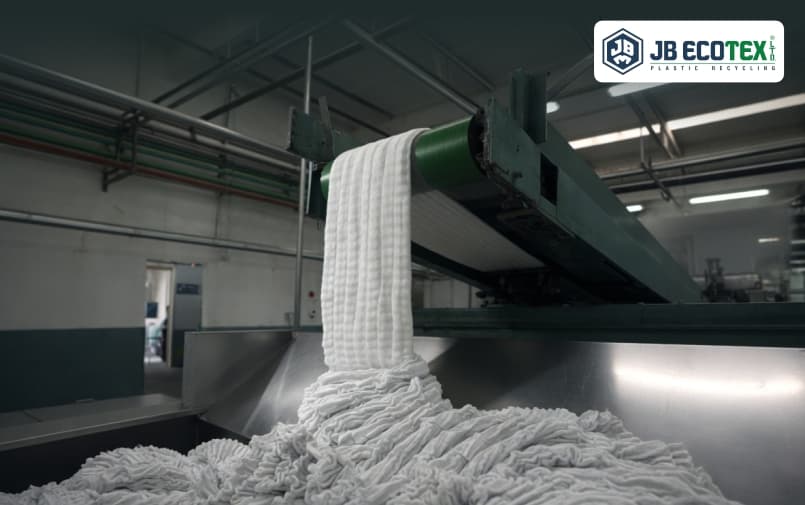
Post-consumerPET bottles go in. What comes out is a fibre that spins, bonds, insulates, filters, and fills, depending on what your plant is producing.
J B Ecotex manufactures recycled polyester staple fibre across a denier range of 0.8D to 100D, with grades developed for spun yarn spinning, nonwoven bonding, interlining production, flame-retardant applications, and cushion filling. Our grade ships with full batch traceability and certification documentation under GRS, OEKO-TEX Standard 100, and ISO 14001.
If you run a manufacturing unit and need a fibre supplier who can match specification to process rather than send a generic sample, this page covers what we produce and why application fit matters.
See thefull RPSF product range
Why So Many Industries Use Recycled Polyester Staple Fiber As A Raw Material
Recycled polyester staple fibre is a raw material that serves different manufacturing processes without requiring a fundamentally different material. That creates a supply challenge most manufacturers understand well: the fibre for a spun yarn line in Ludhiana and the fibre for a thermal-bonded automotive headliner in Pune have almost nothing in common in terms of what they demand from a producer.
Here are the possible segments that require rPSF of diverse specifications:
- Spun yarn manufacturers
- Nonwoven manufacturers
- Interlining producers
- Automotive textile suppliers
- Cushion and bedding manufacturers
- Brands with sustainability reporting requirements
We produce across all these segments because RPSF is genuinely useful across manufacturing sectors that share a common problem: they need a synthetic staple fibre with a verified recycled content claim and certification documentation that holds up to brand-level scrutiny.
See whymanufacturers choose recycled polyester staple fibre
RPSF Grades: 20 Variants Across Applications
Each grade below maps to a specific application requirement. The linked product pages carry full technical specifications, denier ranges, cut length options, and certification documentation.
White Grades for Spun Yarn
3001 Super-White RPSF | 1.2D and 1.4D | High optical reflectance | GRS + OEKO-TEX + ZDHC | Compatible with ring frame / vortex / open-end / air-jet
3002 Low BPA Super-White | Same optical performance as 3001 with BPA below 1.0 ppm | Third-party lab verified | Suited for RSL/MRSL-compliant supply chains
3011 Ultra-White High-Tenacity | 1.2D | Tenacity above 6.9 GPD | Engineered for sewing thread and high-strength yarn | Low shrinkage performance
Dope-Dyed Black Grades
Black 6001 | DDB rPET from 100% post-consumer PET bottles | Pigment at melt stage | Zero post-dyeing | Excellent light and rubbing fastness | GRS traceable
Black 6002 Low BPA | DDB performance with BPA below 1.0 ppm | OEKO-TEX Annex 6 Class 1 | Suited for skin-contact and babywear applications
Functional and Specialty Grades
Biyo | Recycled-route biodegradable fibre with CiCLO® technology | Breaks down in soil, seawater, landfill, and wastewater environments | 1.2D and 1.4D
EF-R Flame-Retardant | Inherent FR via phosphorus additive locked at melt stage | LOI above 35% | 1.5D and 2.0D | Available grey-white or DDB black
Ketonik Cationic Dyeable | Modified rPET with anionic sites for cationic dye compatibility | Lower dyeing temperature | Dual-tone fabric capability
KotLyke 5001 Cotton-Like | Matte finish with cotton-like drape and hand feel | 1.2D and 1.4D | Suited for cotton-blend yarns and woven casuals
Ocean Bound Plastic (OBP) Grades
2003 AquaLoop White | OBP-certified feedstock | Bright white | 1.2D and 1.4D | GRS + OEKO-TEX + ZDHC
6003 AquaLoop Black | DDB from OBP-certified feedstock | Deep black | Batch-consistent | Zero post-dyeing
Nonwoven and Filling Grades
LHAS Fiber | 0.8D to 15D | Low hot air shrinkage | Thermally stable for oven bonding | Cut lengths from 24mm to 120mm
MSF Micro Siliconised | 1.5D | Silicone finish | 32mm to 51mm | Designed for cushion filling and soft toy applications
BlackLoop | Textile-to-textile chemically recycled DDB black | Pre-consumer feedstock | Under development
View thecomplete RPSF product catalogue
Choosing Denier: 0.8D to 100D
Denier is the weight in grams of 9,000 metres of fibre. Lower denier produces finer fibre. Higher denier produces coarser, heavier fibre. Getting this selection wrong shows up directly in processing performance, whether through spinning line difficulties or nonwoven webs that fall outside target density.
Read theguide on low vs high denier RPSF selection
Textile
Certifications: What Each One Actually Checks
The certifications on a fibre supplier's qualification list are separate systems covering different parts of the supply chain. Here is what each one covers and why it matters to a manufacturer sourcing RPSF.
GRS (Global Recycled Standard) via Textile Exchange
GRS is a chain-of-custody standard that traces recycled content from the post-consumer waste source through each production step to the finished product. If your end brand requires a recycled content claim on a product label or sustainability report, GRS documentation from your fibre supplier is what backs that claim. A recycled content percentage without GRS documentation is an unsupported claim.
OEKO-TEX Standard 100
OEKO-TEX tests the finished product against a restricted substance list covering over 100 harmful substances including formaldehyde, heavy metals, pesticides, and pH limits. The certification applies at four product classes. Class I covers products withdirect skin contact including babywear. Class IV covers decorative materials/home textiles. Our 3001, 3002, 3011, and AquaLoop grades hold OEKO-TEX Standard 100 certification. The 3002 Low BPA and 3011 grades are certified under Annex 6, Class 1.
GRS and OEKO-TEX are separate certifications with separate scopes. GRS tells you where the material came from. OEKO-TEX tells you it is free from harmful substances above defined limits. Both matter for export-grade supply chains.
ISO 14001
ISO 14001 is an environmental management system standard covering how the manufacturing facility manages its environmental impact — waste, water, energy use. It is relevant for buyers who need to report on Scope 3 emissions or demonstrate responsible sourcing at the facility level.
OBP (Ocean Bound Plastic) Certification
OBP certification tracks PET waste collected from coastal zones within 50km of shorelines where inadequate waste collection infrastructure puts the material at risk of entering marine environments. The certification is issued by independent verifiers including Control Union. Our AquaLoop grades (2003 white and 6003 black) carry OBP certification, giving brands a documented marine-impact claim beyond general recycled content.
CiCLO Technology
CiCLO is a licensed additive incorporated during melt spinning that enables polyester microfibers to biodegrade in soil, seawater, landfill, and wastewater environments. It is relevant for brands targeting microplastic pollution reduction claims with documented third-party technology backing.
A practical note on eco textile certification as a search term: Buyers searching for "eco textile certification" or "textile industry certifications" are often looking for a supplier who holds all three primary layers: GRS at material traceability, OEKO-TEX at substance safety, and ISO 14001 at the facility level. A supplier holding all three covers every layer a procurement or compliance team will check.
What Controls Fibre Quality in RPSF Production
J B Ecotex produces RPSF from 100% post-consumer PET bottles through a controlled melt spinning process. Raw material quality is managed at intake, with bottle-grade rPET flakes going through decontamination and melt filtration before extrusion.
The quality parameters that matter for a spinning mill or nonwoven plant are tenacity, elongation, denier uniformity, cut length precision, and crimp consistency. Variation in any of these shows up directly in processing, as end breakage on a ring frame, uneven web formation in a nonwoven line, or GSM inconsistency in a bonded pad.
The facility in Surat, Gujarat operates under ISO 14001 environmental management certification with 70% of production energy sourced from renewable installations.
Manufacturing Units That Buy RPSF from J B Ecotex
Our buyers run spinning mills, nonwoven fabric plants, interlining manufacturers, automotive textile suppliers, cushion filling lines, and home textile production units. The reasons they source from us:
Wide grade availability across a single supplier relationship. A mill that produces both fine spun yarn and heavier nonwoven fabric benefits from sourcing both specifications from the same certified supplier. We cover 0.8D to 100D with certified grades in both standard and specialty variants.
Documentation that passes brand-level audits. When your end customer is a global apparel brand or a European retailer, the GRS scope certificate, OEKO-TEX certification reference number, and batch-level test reports need to be available on demand. We provide these as standard for every grade.
Supply consistency for export-grade production. Buyers exporting to Europe, the US, and Japan work with procurement requirements that include RSL compliance, BPA limits, and recycled content traceability as baseline requirements. Our certification documentation is current and our product specs are consistent across shipments.
Common Questions from Fibre Buyers
What is recycled polyester staple fibre and how is it manufactured?
Recycled polyester staple fibre (RPSF) is a short-cut synthetic fibre produced by melting and re-extruding post-consumer PET, typically from used plastic bottles. The bottles are collected, sorted, cleaned, and shredded into flakes. The flakes are melted, filtered, and extruded through spinnerets to form continuous filaments. These filaments are crimped, cut to a specified length (24mm to 120mm depending on the application), and baled for shipment. The resulting fibre is chemically identical to virgin polyester in structure and carries a verified recycled content claim documented through GRS chain-of-custody.
What is the difference between recycled polyester fibre and regenerated polyester staple fibre?
Both terms refer to polyester fibre produced from a non-virgin feedstock. Recycled polyester fibre typically refers to mechanical recycling routes, where post-consumer PET is melted and re-extruded without breaking the polymer down to monomer level. Regenerated polyester staple fibre is sometimes used for chemically recycled routes, where PET is depolymerised to monomers (PTA or BHET) and re-polymerised into virgin-equivalent resin before fibre production.
What certifications should I look for when sourcing recycled polyester staple fibre?
For most B2B procurement scenarios, three certifications cover the key requirements: GRS (chain-of-custody for recycled content claims), OEKO-TEX Standard 100 (substance safety for RSL/MRSL compliance), and ISO 14001 (environmental management at the production facility). If your end brand makes specific environmental claims about ocean plastic or microplastic reduction, OBP certification and CiCLO licensing are additional verification layers. GRS and OEKO-TEX are separate systems. GRS covers where the material came from. OEKO-TEX covers whether it is free from harmful substances at defined threshold levels.
What does GRS certification mean for a textile manufacturer sourcing RPSF?
GRS (Global Recycled Standard) is a chain-of-custody certification published by Textile Exchange. For a manufacturer sourcing RPSF, a GRS-certified supplier provides documented proof that the recycled content percentage on a product label or sustainability report is traceable to a verified post-consumer or post-industrial waste source. The certification covers each step of the supply chain from collection through processing and production. The GRS scope certificate issued to J B Ecotex covers our RPSF production and is available on request for qualified buyers.
What is OEKO-TEX Standard 100 certification and why does it matter for polyester fibre buyers?
OEKO-TEX Standard 100 is an independent testing and certification system for textile products. It tests the finished material against a list of over 100 restricted substances including formaldehyde, heavy metals, pH limits, and colour fastness requirements. For a polyester fibre buyer, it provides documented confirmation that the fibre is within defined harmful substance thresholds. This matters particularly for skin-contact applications — apparel, bedding, hygiene products — where downstream brands apply RSL (Restricted Substance Lists) to all material inputs. OEKO-TEX Annex 6 Class 1 covers products for direct skin contact including babywear. J B Ecotex's 3002 Low BPA and 3011 High-Tenacity grades carry Class 1 certification.
Can recycled polyester staple fibre be produced from feedstocks other than plastic bottles?
Post-consumer PET bottles are the primary feedstock for mechanical RPSF production because they are the most consistent and widely available form of post-consumer PET, producing clean polymer with predictable IV properties. Other feedstocks exist, including post-industrial PET waste, PET from mixed plastic streams, and pre-consumer textile cutting waste, but each introduces variability in polymer quality and certification scope. J B Ecotex's primary RPSF range uses 100% post-consumer PET bottles.
What denier range is available in recycled polyester staple fibre for nonwoven applications?
For nonwoven manufacturing, RPSF is available across a wide denier range depending on the bonding process and end product. Properties including hydrophilic treatment, FR performance, and LHAS (low hot air shrinkage) are available within the nonwoven range. Full nonwoven fibre specifications are on the nonwovenfibre product page.
What is dope-dyed black recycled polyester fibre and how does it differ from conventionally dyed fibre?
Dope-dyed fibre (also called solution-dyed) has colour pigment added directly into the polymer melt during the spinning stage. The pigment becomes part of the polymer structure rather than a surface application. The colour is permanent because the pigment is embedded rather than absorbed, producing light fastness and rubbing fastness. The dyeing step is eliminated, which means zero water use and zero chemical discharge at the dyehouse stage. J B Ecotex produces dope-dyed black RPSF in four grades: Black 6001, Black 6002 (low BPA), 6003 AquaLoop Black (OBP-certified), and BlackLoop (T2T, under development).
Does recycled polyester staple fibre perform like virgin polyester on spinning lines?
For well-processed RPSF, yes. The historical quality gap between recycled and virgin polyester came from IV (intrinsic viscosity) variability in recycled polymer, which shows up as end breakage on high-speed spinning systems. J B Ecotex processes RPSF using EREMA VACUNITE technology, which controls decontamination and melt filtration under vacuum conditions, delivering consistent IV across production batches. The 3001, 3002, and 3011 white grades are engineered for compatibility with ring frame, vortex (MVS), open-end, and air-jet systems. The 3011 super high-tenacity grade targets sewing thread production where strength uniformity and low shrinkage are critical.
What is Ocean Bound Plastic (OBP) recycled fibre and how is it certified?
Ocean Bound Plastic refers to PET waste collected from areas within approximately 50km of coastlines or waterways where inadequate waste collection infrastructure puts the material at risk of entering marine environments. OBP-certified fibre uses this feedstock, with chain-of-custody certification issued by independent verifiers. J B Ecotex works with Control Union for OBP verification on the AquaLoop grades. For brands making claims about ocean plastic diversion or marine impact reduction, OBP certification provides the documented traceability to support those claims. The AquaLoop 2003 (white) and 6003 (dope-dyed black) grades carry OBP certification.
How do I request technical data sheets and samples for recycled polyester staple fibre?
Contact the J B Ecotex technical sales team through the contact page or at connect@jbecotex.com. Sample requests for development and trial quantities are processed with full batch documentation: GRS scope certificate, OEKO-TEX certification reference, and the technical data sheet for the relevant grade. For volume enquiries, pricing is available on request with specifications confirmed against your processing requirements.
Request Specifications, Samples, or a Commercial Quote
If you know the denier, cut length, and application, send us those details and we will confirm which grade fits and what certification documentation is available. If you are still in specification development, the technical sales team can advise on fibre grade selection based on your process and end product requirements.