
Is Regenerated Polyester Staple Fiber as Good as Virgin? What Manufacturers Need to Know
The concern that slows down the switch from virgin to regenerated polyester staple fiber is rarely about sustainability intent. It is about production risk. Will it card the same way? Will whiteness hold across batches? Will tenacity hold up in a fine-count yarn? These are the questions that sit behind every trial order, and they deserve precise answers rather than reassurance.
The answer depends on the grade, the application, and critically, the supplier's process controls. Regenerated PSF from a well-run production line performs at levels consistent with mid-grade virgin polyester staple fiber across most standard textile, nonwoven, and filling applications. Where gaps exist, they are traceable to specific upstream variables, most of which a manufacturer can evaluate before placing an order. After more than a decade manufacturing recycledpolyester staple fibre, we have run enough production trials across enough applications to give you the specific answer rather than the general one.
What Regenerated Polyester Staple Fiber Is
Regenerated polyester staple fiber and recycled PSF (RPSF) refer to the same material. Both terms describe fibre produced from post-consumer PET waste, predominantly plastic bottles, rather than from virgin petrochemical feedstocks. In Asian markets the term "regenerated" is used interchangeably with "recycled" for this material. When evaluating a supplier, always request GRS certification rather than relying on the label alone.
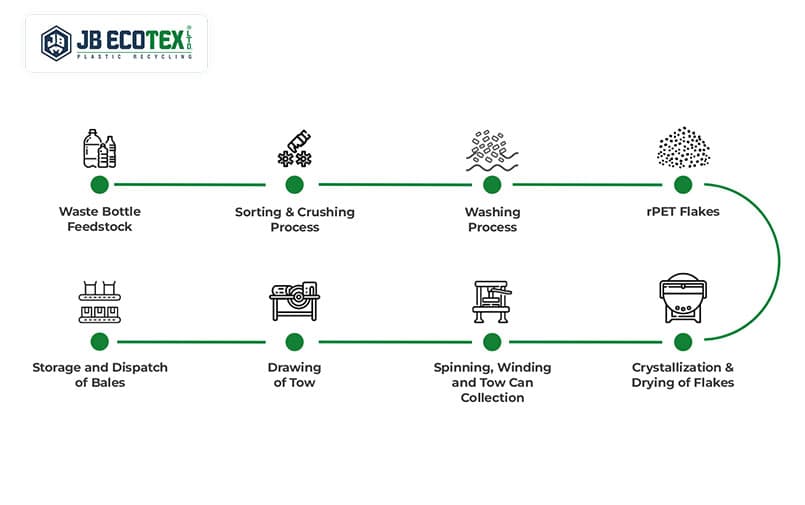
The source material is collected, sorted, hot-washed, and dried into clean rPET flake. That flake goes directly into an extruder where it is melted, filtered, and spun through a spinneret into continuous filament tow. The tow is drawn to develop fibre strength, crimped, heat-set, cut to staple length, and baled. This is a flake-to-fibre process with no intermediate resin or chip pelletising step, unlike food-grade rPET resin production which uses solid-state polycondensation for packaging applications. Understanding this distinction matters when reading a supplier's process description or evaluating quality claims, because the controls relevant to fibre production differ from those relevant to resin production. The full transformationfrom PET bottles into recycled polyester staple fiber is covered in detail separately.
Virgin polyester staple fiber starts from purified terephthalic acid (PTA) and monoethylene glycol (MEG), both petroleum-derived. These undergo polymerisation under heat and pressure to form PET polymer, which is then spun, drawn, crimped, cut, and baled through essentially the same downstream steps as regenerated fibre.
The polymer in the finished fibre, PET, is chemically the same in both routes. What differs is the feedstock origin, the upstream processing required to reach spinneret-ready melt, and the documentation chain attached to the material.
Where Regenerated and Virgin PSF Are Comparable
For the majority of standard applications, regenerated polyester staple fiber produced from well-controlled bottle-flake feedstock performs at levels consistent with mid-grade virginpolyester staple fiber. The parameters where parity is achievable include:
Tenacity. Regenerated fibre from a well-run production line delivers tenacity consistent with mid-grade virgin PSF across standard textile and nonwoven grades. Higher-tenacity grades for geotextile and technical nonwoven applications are achievable in regenerated grades with the right draw ratio and process control.
Elongation at break. The elongation range that covers most carding, spinning, and bonding applications is reachable in regenerated fibre. Elongation in regenerated PSF is governed by the draw step during production rather than by feedstock origin.
Crimp count and stability. Crimp is applied mechanically at the stuffer-box crimping stage and heat-set to stabilise it. This step is process-controlled regardless of whether the input is virgin or recycled polymer. A regenerated fibre producer with consistent melt feeding and controlled crimping parameters produces crimp geometry comparable to virgin PSF at equivalent specifications.
Moisture regain. PET polymer absorbs minimal moisture regardless of origin. Regenerated fibre maintains moisture regain at comparable levels to virgin polyester staple fiber. This affects processing stability in humid environments and wash durability in end products equally across both material types.
Recycled fiber fill applications. Hollow conjugated siliconised (HCS) grades in regenerated PSF are used in pillows, cushions, quilts, and furniture filling by manufacturers including major global home furnishing brands. The loft, resilience, and softness profile of HCS recycledfiber fill is determined primarily by crimp architecture, cross-section geometry, and siliconisation level, all of which are process-controlled rather than feedstock-dependent.
Where Differences Exist
Measured against virgin PSF, regenerated fibre has specific areas where variability is a real factor.
Whiteness and colour consistency. Virgin PSF starts from purified chemical feedstocks, so the base colour entering the spinneret is highly consistent. Regenerated PSF from bottle flake has a more variable baseline colour because post-consumer PET bottles differ in their prior additives and processing history. Optical sorting at the flake stage manages much of this variation, but lot-to-lot whiteness index variation in regenerated fibre is a genuine consideration for applications specifying a tight whiteness index, such as optical-white bedding, certain hygiene nonwovens, and export fabrics where buyers measure whiteness on arrival. For applications that will be dyed to medium or dark shades, this variation has little practical relevance.
Batch-to-batch consistency under poor process control. The gap between regenerated and virgin PSF is largely a function of upstream process control rather than an inherent property of the material. Flake contamination above threshold levels causes spinneret blockages, tow breaks during drawing, and fibre inconsistency within a production run. Inadequate moisture removal in the drying step causes hydrolytic degradation during melt processing, which reduces fibre strength. These are supplier process problems. A well-run regenerated PSF line with controlled contamination, moisture, and melt filtration produces fibre with consistency comparable to virgin grades.
Specific high-specification end uses. Certain filtration media, precision-specification nonwovens, or fabrics with unusually tight tolerance requirements have historically been produced with virgin-grade fibre. As regenerated fibre process technology has improved, this gap has narrowed. Evaluating against your specific specification, rather than assuming parity across all grades, is the practical approach.
The Environmental Footprint Difference: What the Data Shows
For manufacturers whose customers ask about carbon footprint and sustainability credentials, the environmental dimension of the regenerated versus virgin comparison is as relevant as the performance comparison.
The production of regeneratedpolyester staple fiber bypasses the most energy-intensive stages of virgin production: crude oil extraction, refining, and primary polymerisation from PTA and MEG. Life cycle assessments referenced by TextileExchange indicate that recycled polyester production generates lower greenhouse gas emissions per kilogram of fibre compared to virgin production, with the reduction attributed largely to avoiding the upstream petrochemical processing stages. The actual reduction varies depending on the LCA methodology, geographic context, energy grid mix at the recycling facility, and collection and transport distances for the feedstock. Figures vary across studies and should be treated as directional rather than fixed, and any specific carbon reduction claim made to a customer should reference the LCA methodology used.
From a procurement standpoint, what matters is that the carbon footprint difference is real, third-party verifiable through LCA, and increasingly a requirement in customer sustainability reporting frameworks rather than a voluntary disclosure.
Two additional environmental factors that come up in buyer conversations:
Petroleum displacement. Regenerated PSF uses post-consumer PET as feedstock, which means each tonne of recycled fibre produced displaces a corresponding requirement for virgin petroleum-derived polymer. For manufacturers supplying into brands with Scope 3 emissions reduction targets, this displacement is a quantifiable contribution to their supply chain emissions reduction.
Microplastics. This is an area where the picture is more complex. Both virgin and regenerated polyester shed microfibre during washing, and the environmental concern applies to the material category broadly, with the concern applying equally across recycled and virgin origins. Buyers asking about microplastic shedding should be directed to application-specific guidance rather than treated as a recycled-versus-virgin distinction.
How Regenerated Polyester Staple Fiber Serves Different Applications
The application range of regenerated polyester staple fiber has expanded considerably over the past decade, driven by improvements in recycled fibre quality and by buyer requirements for recycled content. Recycledpolyester staple fibre manufacturers now supply grades covering the full spectrum from fine-count spun yarn through to heavy industrial nonwoven applications.
Spun yarn production. Regenerated PSF is used in ring spinning and open-end spinning for polyester-cotton, polyester-viscose, and polyester-wool blends. Fine-count ring-spun applications require tighter fibre consistency than coarser open-end counts, which are generally more tolerant of variation. Cationic dyeable polyester (CDP) grades in regenerated form serve applications requiring vivid colour with low-temperature cationic dyes, including suiting, shirting, melange, and colour-separated fabrics.
Nonwovens. Regenerated PSF is used across spunlace, thermal-bond, and needlepunch processes for a wide range of end uses. Finer grades serve filtration and hygiene applications. Mid-weight grades go into interlinings, wadding, and synthetic leather substrates. Heavier grades serve geotextiles, automotive felt, and construction liners. Low hot air shrinkage (LHAS) grades are specified where dimensional stability through a thermal bonding process is required.
Filling applications. Hollow conjugated siliconised (HCS) grades in regenerated PSF are used for cushions, pillows, stuffed products, and furniture filling. Crimp architecture and siliconisation level govern the loft and softness profile. These parameters are specified at order and are independent of whether the base fibre is regenerated or virgin origin.
Dope-dyed black grades. DDB regenerated PSF is used in automotive trim, contract upholstery, protective workwear, and outdoor applications where colour fastness to washing, light, and rubbing is specified. The pigment is incorporated at the melt stage before spinning, giving fastness performance that aqueous dyeing of white fibre has difficulty matching. It also removes the process water and effluent load of conventional dyeing, relevant for buyers tracking chemical footprint or operating under ZDHC framework requirements.
Flame retardant grades. FR regenerated PSF uses flame retardant chemistry incorporated at the polymer stage, making it suitable for contract upholstery, transportation seating, public-space textiles, and industrial protective applications where ignition resistance is specified.
Ocean Bound Plastic route. OBP-route regenerated PSF uses PET collected from coastal and waterway-adjacent waste streams in areas with limited waste management infrastructure, verified under the Zero Plastic Oceans certification framework. The fibre production process is the same as standard bottle-flake-route PSF. What OBP adds is a traceable claim that the input material was diverted from a marine-proximate waste stream, relevant for brands with ocean plastic commitments in their sustainability reporting.
Textile-to-textile chemically recycled grades. A growing segment produces regenerated PSF from pre-consumer textile waste through chemical depolymerisation. This route is in early commercial development. Less than0.1% of polyester fibre globally is currently recycled into new textiles, though investment is accelerating as brands set textile-to-textile specific targets. J B Ecotex's sister entity JBrPET works on the upstream chemical recycling side for manufacturers tracking this development.
The Polyester Staple Fiber Price Question: What Drives the Difference
The polyester staple fiber price relationship between regenerated and virgin grades is variable. It shifts with geography, crude oil pricing, rPET feedstock availability, and grade. There are periods and markets where regenerated PSF prices at parity with virgin, and periods where a premium exists. Understanding what drives that premium is more useful for procurement planning than tracking a single price point.
Three cost components in regenerated PSF production have no direct equivalent in virgin production:
Feedstock collection and sorting. Post-consumer PET bottles require collection infrastructure, colour sorting, and baling before reaching a recycling facility. These costs are upstream of manufacturing and are embedded in the flake price.
Hot-washing and contamination removal. Achieving the contamination threshold required for fibre-grade spinning requires multiple washing stages, hot water systems, and optical sorting. Virgin PSF production starts from PTA and MEG, which arrive as purified chemical inputs without this upstream processing requirement.
Certification costs. GRS chain-of-custody certification requires annual third-party audits at every facility in the supply chain. OBP certification adds collection-point verification costs. These costs are embedded in certified regenerated fibre and are absent from uncertified material and from virgin PSF production.
The practical implication for procurement: the relevant comparison is the total cost of meeting a customer's documentation requirements, rather than the base fibre price in isolation. An uncertified recycled fibre at a lower price carries no value for a buyer whose customer requires a GRS certificate of transaction. For manufacturers whose customers are building polyester sustainable product ranges, the certification cost is the cost of being in that supply chain at all. The pricing decision is therefore less about regenerated versus virgin polyster staple fibre at face value, and more about what your end-customer's sourcing requirements actually demand.
What Flake Quality Controls in the Finished Fibre
Understanding the upstream variables that drive fibre quality helps explain why regenerated polyester staple fiber from different suppliers can perform very differently despite carrying the same label.
Contamination level. Flake above the acceptable contamination threshold for fibre-grade spinning causes spin-pack pressure buildup, spinneret hole blockages, and tow breaks during drawing. The downstream consequence is fibre inconsistency within a run and bale-to-bale variation in tenacity. Ask for the test method and measurement frequency, rather than just the stated threshold.
Moisture content of dried flake. PET is hygroscopic. Flake entering the extruder above target moisture levels undergoes hydrolytic degradation during melt processing, reducing fibre strength. Suppliers with properly controlled drying stages produce more consistent tenacity lot-to-lot.
Flake colour and particle size distribution. Colour consistency of sorted flake affects whiteness index in the finished polyster staple fibre. Particle size uniformity affects melt homogeneity. A wide distribution creates uneven melt temperature in the extruder, producing filaments with variable cross-section that shows up in carding efficiency or yarn evenness downstream.
Reading a Fibre Test Report: Parameters That Matter by Application
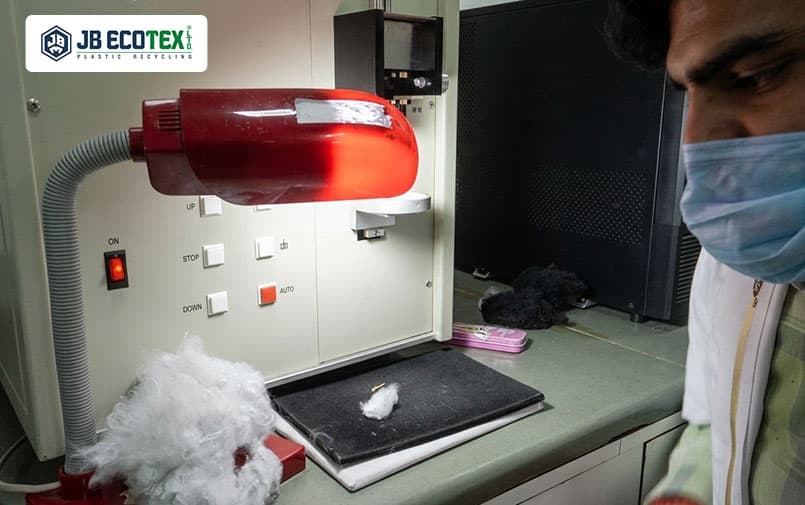
When a polyesterstaple fiber manufacturer provides a test report, the parameters worth examining depend on the end application.
Fibre fineness tolerance matters most in ring spinning, where it directly affects draft ratios, yarn count control, and evenness in the finished yarn. Needlepunch and thermal-bond nonwovens are generally more tolerant of wider variation.
Tenacity standard deviation across lots, rather than just the nominal value, indicates whether the production process is actually controlled. A single-certificate tenacity figure states the target. Lot-level standard deviation across multiple batches reflects what actually arrives.
Oil pick-up (spin finish level). This controls static, inter-fibre friction during carding, and surface feel in the finished product. The right finish level depends on the downstream process. A supplier offering a single finish formulation across all applications is working with a one-size-fits-all approach that may require adjustment on your line.
Whiteness index and yellowness index. Ask for both values and request lot-level data across multiple production runs rather than a single test certificate.
Certifications That Matter When Sourcing Regenerated PSF
When evaluating a regenerated polyester staple fiber supplier, certifications serve two distinct purposes: they verify what the material is made from, and they verify how it was produced. Understanding which certification covers which claim prevents buyers from treating all certificates as interchangeable.
GRS (Global Recycled Standard), administered by Textile Exchange, is the chain-of-custody certification that verifies recycled content. It covers the whole supply chain from feedstock to finished fibre. Every node in the chain carries obligations, beyond the fibre manufacturer alone.
At the feedstock level, GRS requires verification that the input is genuinely post-consumer or post-industrial waste, with documentation of source.
At the manufacturing level, GRS requires a mass balance audit tracing recycled input through production to finished fibre, alongside environmental, social, and chemical facility requirements. Annual third-party auditing is required.
At the downstream converter or spinner level, buying GRS-certified fibre allows inclusion in your own GRS chain of custody without running your own feedstock audit, provided the certificate-of-transaction linkage is maintained throughout.
A point worth confirming: certification at fibre level does constitute a product-level recycled content claim at retail only when the chain remains unbroken through every processing step to the brand. Confirm that your GRS scope certificate covers the specific grade being purchased. Certificates list products by scope, and a certificate for one grade applies to that grade only, even within the same facility.
OEKO-TEX Standard 100 addresses a different question entirely: whether the finished fibre contains harmful substances at levels that could affect human health. Where GRS verifies origin and chain of custody, OEKO-TEX Standard 100 verifies that the fibre has been tested against a defined list of regulated and non-regulated substances including heavy metals, pesticides, formaldehyde, and pH. For manufacturers supplying into apparel, babywear, home textiles, or any end use with skin contact, OEKO-TEX Standard 100 certification on the fibre is what supports the claim that the recycled input is safe for human use — something GRS certification alone does not cover.
ISO 9001:2015 certifies the supplier's quality management system rather than the product itself. It confirms that the manufacturing operation runs to a documented, audited, and continuously reviewed process framework. For a buyer evaluating whether a regenerated PSF supplier will deliver consistent fibre across batches over time, ISO 9001 is the evidence that process control is institutionalised rather than operator-dependent.
ISO 14001:2015 certifies the supplier's environmental management system. It confirms that the facility monitors and controls its environmental impact in a structured, audited way. For buyers whose customers require environmental due diligence documentation on their supply chain, ISO 14001 from a fibre supplier contributes to that audit trail.
In procurement terms: GRS answers the question of what the fibre is made from and whether the recycled content claim is verifiable. OEKO-TEX Standard 100 answers whether it is safe. ISO 9001 and ISO 14001 answer whether the manufacturing operation behind it is credible and controlled. A supplier holding all four gives buyers a complete documentation set that covers content, safety, process quality, and environmental responsibility in a single source.
Qualifying a Regenerated PSF Supplier
Based on over a decade in regeneratedPSF manufacturing, these are the supplier evaluation questions that separate reliable supply from variable supply, for manufacturers moving beyond the sustainability label and into production reality.
What is your flake contamination specification and how is it measured? Method and measurement frequency matter as much as the stated threshold.
Can you share lot-level standard deviation on tenacity, fibre consistency, and crimp count across recent production batches? Nominal values state the target. Standard deviation reveals the actual process.
What is your spinneret change frequency and melt filter specification? These determine long-run supply consistency and are questions a supplier with disciplined process control can answer directly.
Does your current GRS scope certificate cover the specific grade being purchased? Scope certificates are product-specific.
What is the moisture content of your dried flake at extruder entry? This is the upstream parameter most directly linked to batch-to-batch tenacity consistency.
For dope-dyed grades: what is your carbon black dispersion method and what fastness test data is available? Pigment dispersion quality is the primary variable differentiating consistent DDB fibre from fibre that shows speckling or uneven colour in production.
Frequently Asked Questions
Is regenerated polyester staple fiber the same as recycled PSF?
Yes. Both terms refer to the same material: fibre produced from post-consumer PET waste, predominantly plastic bottles, rather than from virgin petrochemical feedstocks. "Regenerated" is the term commonly used in Asian markets, while "recycled PSF" or RPSF is the internationally standard terminology. GRS certification verifies the recycled content regardless of the label used.
Can regenerated polyester staple fiber be used in ring spinning?
Yes.
Regenerated PSF is widely used in ring spinning for polyester-cotton,
polyester-viscose, and polyester-wool blends across apparel, home textiles, and
industrial yarn applications. Fine-count ring-spun applications require tighter
fibre consistency, which depends on the supplier's process controls rather than
on the recycled origin of the material.
Does regenerated PSF require different machine settings than virgin PSF?
Generally, the same production equipment handles both. Specific adjustments to carding settings, draw ratios, or spin finish formulations may be needed depending on the grade and the exact specifications of the regenerated fibre being introduced. Running a trial before full-scale conversion is standard practice when switching fibre sources.
What certifications should I ask for when buying regenerated PSF?
GRS verifies recycled content and chain of custody. OEKO-TEX Standard 100 confirms the fibre is free from harmful substances, essential for skin-contact end uses. ISO 9001 and ISO 14001 confirm quality and environmental management systems. For OBP-route fibre, Zero Plastic Oceans certification applies additionally.
Is regenerated polyester staple fiber price higher than virgin PSF?
The price relationship varies by market, grade, and timing. When a premium exists, it reflects upstream costs including feedstock collection, hot-washing, and certification that have no equivalent in virgin production. For buyers whose customers require GRS documentation, the comparison is total supply chain cost rather than base fibre price alone.
Can regenerated PSF deliver the same colour results as virgin in dyeing?
For medium to dark shade dyeing, regenerated PSF performs comparably to virgin grades. For applications requiring a tight optical-white or high whiteness index, baseline colour variation in regenerated fibre from bottle-flake feedstock is a real consideration. Dope-dyed grades in regenerated PSF remove the dyeing step entirely and deliver consistent colour with superior fastness.
J B Ecotex is a Surat-based manufacturer and exporter of regenerated polyester staple fiber, food-grade rPET resin, and hot-washed rPET flakes with over a decade in the recycling industry. Certifications include GRS, FSSAI (File No. STD/SP-20/T-RPET-07), FDA NOL, EFSA, and ISO standards.
Disclaimer: All data presented is on a consolidated basis for JB Ecotex Limited and its wholly owned subsidiary, JB RPET Industries Private Limited, as of 31 March 2026.