
PET Plastic Flakes Manufacturer: Why Clean Flakes Matter in Recycling
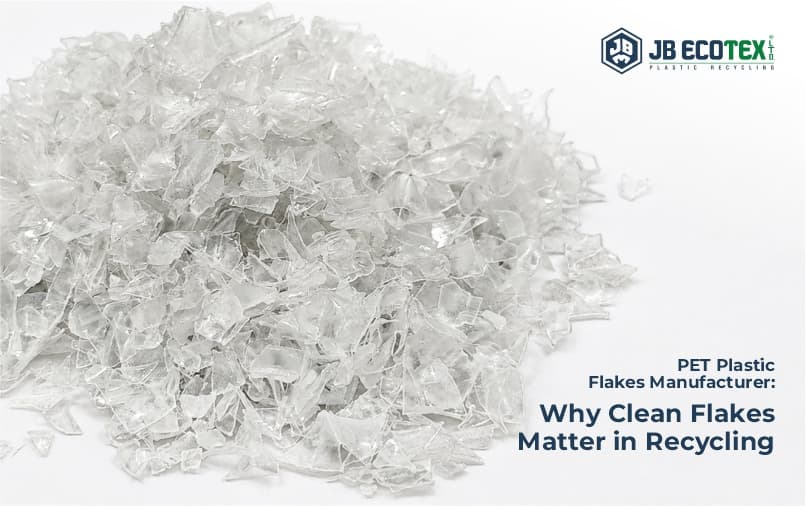
The recycling chain for post-consumer PET bottles depends on one specific intermediate: the flake. Before recycled polyester fibre gets spun, before food-grade rPET resin gets pelletised, a small irregular fragment of sorted and processed PET has to meet a set of specifications that determine whether everything downstream runs cleanly. That fragment is the PET plastic flake. It is the input that feeds spinning mills, resin converters, and strapping manufacturers worldwide. Its cleanliness, consistency, and traceability set a ceiling on what any downstream process can achieve.
At J B Ecotex, we have spent over a decade processing post-consumer PET bottles into hot-washed rPET flakes that serve fibre producers, resin converters, and packaging manufacturers across global markets. The perspective in this piece comes from that production experience: what actually happens when flake quality slips, what buyers should be asking suppliers, and where the industry is heading on traceability and process accountability.
What PET Plastic Flakes Are
PET, polyethylene terephthalate, is a thermoplastic polymer used in beverage packaging, food containers, textile fibre, and industrial films. When post-consumer PET bottles go through a processing facility, the output after granulating is a collection of fragments, typically 8 to 14 millimetres in their longest dimension. These are PET plastic flakes: the first usable form of recycled PET and the feedstock for multiple end markets.
Three categories of material are worth distinguishing clearly. Post-consumer bottle bales are the raw input, variable in contamination and unsuitable for direct manufacturing. Finished recycled fibre or rPET resin pellets are the processed output that manufacturers use on production lines. PET bottle flakes sit in between: they have been through sorting and washing but have yet to go through extrusion, melt processing, or spinning. Their commercial value rests entirely on consistency.
Procurement teams sourcing from a PET flakes manufacturer care about consistency because their equipment is calibrated around material specifications. Moisture variance above 1% causes die pressure fluctuations during extrusion. PVC contamination above 30 parts per million introduces black specks and thermal degradation in fibre and resin alike. Colour deviations within a batch force blending adjustments that add cost and complexity. Each deviation is a production variable the buyer absorbs, which is why cleanliness is a manufacturing input, not a marketing label.

How PET Plastic Flakes Are Made
Understanding the production sequence is the foundation for evaluating supplier capability. Every stage in the process is a point where contamination can be removed or where it can compound if controls are absent. The sequence below reflects how we run PET plastic waste recycling at our facility in Surat.
Feedstock Collection and Sorting
Post-consumer PET bottles arrive in bales with variable composition. Different bottle colours, polypropylene closures, polyolefin or paper labels, and occasional non-PET bottles travel together in collection streams. Early sorting involves manual removal of visible non-PET materials, followed by automated systems that separate by polymer type, colour, and density. Sorting quality at this stage is not a pre-processing courtesy. It determines what is achievable at every step that follows. A facility working with well-sorted feedstock reaches lower PVC levels and tighter colour consistency than one trying to compensate for contaminated input.
The rPET flake market in India has seen buyer attention to feedstock provenance because experienced procurement teams have learned that flake quality is partially determined before grinding begins.
Bottle Washing Before Size Reduction
Sorted bottles are washed before entering the granulator. This step removes mud, loose label fragments, and surface residues that would otherwise embed more deeply into the material during size reduction, where the increased surface area means contaminants have greater opportunity to interact with the polymer
Granulating into Flakes
Bottles pass through a granulator that reduces them to the target size range. Flake size is a controlled specification. Fragments below 4 millimetres generate fines that are difficult to dry uniformly and cause bridging in pneumatic conveying systems at converters' facilities. Fragments above 14 millimetres reduce wash contact efficiency because there is less surface area per unit weight in the wash solution. The 8 to 14 millimetre range is a function of downstream process requirements, not an arbitrary standard.
Hot Wash Processing
This is where hot wash PET flakes separate from material rinsed only with ambient-temperature water. Hot washing operates at 80 to 95 degrees Celsius using caustic soda at controlled concentrations combined with surfactants. The alkaline bath at temperature saponifies fats and oils absorbed into the PET surface, dissolves adhesive residues from labels, and removes organic contamination embedded in the polymer matrix. Cold washing removes surface dirt. Hot washing addresses contamination that has penetrated the material.
At J B Ecotex, hot caustic treatment is applied at two stages: at the bottle level before granulating and at the flake level after granulating. Applying the treatment at both stages means contamination that survives the first encounter faces a second treatment where the increased surface area per unit weight gives the wash solution better contact with every particle. After washing, multiple rinse stages remove caustic residue and dissolved contamination. Dewatering and thermal drying bring moisture to below 1% by weight before the material moves to sorting.
Quality Screening and Release Testing
After drying, flakes pass through optical sorters and metal separation equipment. Optical sorting removes residual non-PET particles and colour deviations. Metal separation systems address ferrous and non-ferrous fragments. Washing reduces contamination. Sorting confirms consistency. Batch-wise laboratory testing for PVC content, moisture, bulk density, and colour is the final gate before any material is released for shipment.

Why Clean PET Plastic Flakes Matter to Manufacturers
The case for clean PET plastic flakes is a production case. Contamination in the input material does not stay contained at the input stage. It propagates through the process and appears in the output.
Processing Efficiency
PVC contamination causes black specks and requires halting extrusion or adjusting process temperatures to manage degradation. Metal particles damage tooling and force unplanned maintenance. Moisture variation produces die pressure fluctuations that create inconsistent output across a run. None of these problems can be corrected at the converter's end after the material has arrived. The buyer absorbs the cost in lost production time, rejected output, and tooling wear.
Downstream Product Quality
In polyester fibre production, flake quality sets the physical properties of the finished fibre. A spinning mill running clean, consistent flakes can hold target tenacity and elongation values across a production run. Variable or contaminated input forces constant process adjustment, and the finished fibre reflects those adjustments in its mechanical properties. In food-grade rPET resin production, the requirements are more stringent. Regulatory authorities assess whether the processing steps applied to flakes are sufficient for food-contact use. Flake cleanliness before resin processing is a prerequisite for that assessment, not a secondary consideration.
Contamination Cascades
A single contaminated batch introduced into a clean line creates consequences beyond that batch. Cross-contamination from PVC or polyolefin fragments can affect multiple subsequent runs through residue left in the equipment. Buyers who experience this once tighten their source qualification criteria substantially. Specifying hot wash PET flakes with batch-wise documentation is how procurement teams reduce this risk structurally rather than managing it batch by batch.
Reliable Output Across Commercial Volumes
A supplier who produces a clean sample for qualification and variable material at commercial scale is a different category of supplier from one who maintains consistent specifications across volume. The distinction only becomes visible over time, which is why source traceability and process documentation matter: they are the evidence base buyers use to evaluate which type of supplier they are dealing with before the problem appears in production.
Closed-Loop Plastic Recycling and the Role of PET Flakes
Closed-loop plastic recycling describes a system in which a material at end of use becomes feedstock for the same or equivalent product category, rather than being downcycled into a lower-value application. PET has one of the more developed closed-loop systems among commodity plastics because its thermal properties and established collection infrastructure allow it to be reprocessed into food-contact applications under defined conditions.
In a closed-loop plastic recycling system for beverage bottles, the material flow is: post-consumer bottles collected and sorted, processed into clean flakes, converted into food-grade rPET resin, used to produce new beverage bottles or food packaging, and then collected again at end of use. The flake is the hinge point. It is where post-consumer waste becomes manufacturing-ready feedstock. Flake cleanliness determines whether the loop closes fully or whether contamination forces diversion into lower-value applications, breaking the loop at its most critical joint.
This matters to manufacturers and brand owners because regulators across multiple markets are developing or tightening requirements on recycled content verification. In the EU, regulations governing recycled PET in food-contact packaging require that the recycling process demonstrate sufficient decontamination. In India, FSSAI's framework for food-contact recycled PET sets comparable conditions domestically. In the US, the FDA's No Objection Letter process assesses recycling technologies against contamination benchmarks. In each of these frameworks, the flake is the input that determines whether the downstream process can satisfy the regulatory standard. A recycled content claim rests on the provenance and documented quality of the flake at source.
Certification programmes including the Global Recycled Standard and Recyclass auditing provide third-party verification that materials have been processed to defined quality levels. These certifications support recycled content claims in supply chains where brand owners need to demonstrate verified content to regulators and downstream buyers. The PET bottle recycling process that produces certified flakes is the foundation those claims rest on.
Applications of PET Flakes Across Manufacturing
PET flakes serve several distinct end markets. The grade, colour, and processing specification of the flake determines which of these markets it can reach. Matching flake specification to application requirement is something buyers should do at sourcing, since using a lower-grade flake in a higher-requirement application creates quality problems that surface downstream.
Polyester Fibre Production
Recycled polyester staple fibre is among the primary end uses for PET plastic flakes. Spinning mills use flakes as feedstock either directly or after pelletising into chips. The fibre produced serves apparel, home textiles, nonwoven fabrics, and technical applications including automotive upholstery and industrial fill. Clear flakes produce natural-colour fibre that can be dyed to specification. Dope-dyed black applications can work with mixed-colour flakes where the colourant masks input variation. The fibre market's requirements centre on moisture, PVC contamination, and bulk density, because these variables directly affect spinning efficiency and fibre consistency.
Food-Grade rPET Resin
Food-grade rPET resin production requires clear flakes documented to a standard sufficient for regulatory review. The resin produced is used for beverage bottles, food packaging, and thermoformed trays.
Industrial and Packaging Applications
Beyond fibre and food-grade resin, PET bottle flakes serve industrial applications including polyester strapping for logistics, PET sheet for thermoforming, and input for nonwoven fabric production used in geotextiles and filtration. These applications work with fibre-grade flakes where food-contact certification is outside the application specification. Colour tolerance is typically wider in these markets, and some applications can accommodate mixed-colour input where clear flakes carry a cost premium the end product value does not justify.

Quality Factors Buyers Should Evaluate When Sourcing PET Flakes
A sourcing checklist for a PET flakes manufacturer covers the parameters below. Each one corresponds to a production risk if the specification drifts. Buyers who evaluate these through documentation and process evidence rather than sample-based claims reduce the probability of problems appearing at commercial volumes.
PVC Content
PVC is the most damaging contaminant in PET processing. It degrades at PET processing temperatures and releases hydrochloric acid, which degrades the PET polymer and causes yellowing, black specks, and equipment corrosion over time. At J B Ecotex, our hot-washed rPET flakes are processed to below 30 ppm PVC. Buyers should request batch test reports and evaluate how a supplier generates those results, not only whether the stated specification meets the threshold.
Moisture Content
Moisture in PET flakes above 1% by weight causes intrinsic viscosity loss during melt processing, producing die pressure variation in extruders and surface defects in finished pellets, sheet, or fibre. Buyers should confirm whether a supplier measures moisture per batch or per production run and whether the drying stage is validated to consistently reach the target level.
Colour Consistency
For clear and natural-colour applications, colour consistency within and across batches determines whether the converter requires blending adjustments. Mixed-colour flakes sold as clear represent a contamination event from the buyer's perspective. Colour specification should be documented with quantitative limits such as yellowness index or b* value, stated in measurable terms rather than qualitative descriptors.
Source Traceability
In markets where recycled content claims are subject to audit, traceability from collection point through processing to shipment is a commercial requirement alongside a quality one. GRS certification and Recyclass auditing provide frameworks for this traceability. Buyers sourcing for regulated markets should confirm that supplier documentation covers the full chain from post-consumer bottle input to finished flake, covering the processing steps applied at each stage.
How J B Ecotex Approaches These Criteria
Reading a quality checklist and operating against one are different things. The following reflects how we run our process and what that means for buyers sourcing from us.
Two-Stage Hot Wash as a Process Decision
Most wash lines apply hot caustic treatment once, at the flake stage. We apply it twice: first at the bottle stage before granulating and again at the flake stage after granulating. The rationale is straightforward. Contamination that survives one caustic treatment encounters a second at a stage where the increased surface area per unit weight gives the wash solution better contact with every particle. This is a process design choice, not a specification claim. The result shows up in PVC levels consistently below 30 ppm across batches.
Certifications Held
J B Ecotex holds GRS, FSSAI, FDA NOL, ISO 9001:2015, ISO 14001:2015, OEKO-TEX Standard 100, and certifications. For the Recyclass-audited flakes grades (CLR100, CLR250, CLR500, GRNM10), external Recyclass auditing provides an additional layer of process verification. Each certification corresponds to a defined standard assessed by an external body. They are the documented evidence of process compliance, not a substitute for it.
Batch-Level Documentation
Every batch of rPET flakes is tested and documented before shipment. Buyers receive test reports covering PVC content, moisture, bulk density, and colour for each consignment. For regulated markets where recycled content claims are subject to audit, this documentation supports the chain of custody from our facility to the buyer's production line. Traceability is built into the production process, not assembled retrospectively when an audit requires it.
Clear, Green, and Mixed-Colour Grades
We produce three flake grades: Clear Hot-Washed, Green Hot-Washed, and Mixed-Colour Hot-Washed. Each grade is processed and documented separately. Buyers sourcing clear flakes for food-grade resin or natural-colour fibre receive material from a dedicated processing stream, not blended output. This separation matters because colour is a downstream production variable, and mixing grade streams to meet volume targets creates consistency problems that appear in the converter's output rather than in our quality report.
Why Input Quality Drives Manufacturing Outcomes
The relationship between flake quality and manufacturing output is direct. A spinning mill running clean, consistent PET plastic flakes from a qualified PET flakes manufacturer can calibrate its process to target specifications and hold output quality across production runs. A mill running variable input spends time adjusting process parameters, blending batches to average out variation, and managing higher rates of off-spec fibre. That cost accumulates.
For resin converters, the implications extend into regulatory documentation. A converter producing food-grade rPET resin needs to demonstrate to the relevant authority that the input flake meets decontamination standards. If the supplier cannot document input specifications and the processing steps applied, the converter's own certification process becomes harder to maintain. Input quality and documentation are part of the same requirement from a regulatory standpoint.
Stable supply has its own value independent of quality. Buyers who qualify a reliable source and can depend on consistent specifications across commercial volumes reduce the procurement overhead of managing multiple sources or running repeated qualification trials. A PET flakes manufacturer with documented capacity, defined process controls, and maintained certifications creates a lower total cost of sourcing than a cheaper supplier whose specifications require continuous monitoring.
It is worth noting what types of plastic waste that can be recycled into functional manufacturing inputs. The answer is narrower than collection programmes suggest. Post-consumer PET bottles from sorted collection streams are among the more reliable feedstocks because the polymer type is relatively uniform and the supply chain from collection to processing is relatively developed. Even within PET, feedstock from regions with robust collection infrastructure produces more consistent flakes than material from mixed or poorly sorted streams. Understanding feedstock geography is part of understanding why supplier location and sourcing relationships affect the quality of the output.

Why Flake Quality Is a Production Decision, Not a Sustainability Label
Here is the practical reality of sourcing PET plastic flakes at commercial scale. A lower-priced flake that forces a converter to run slower, produce more off-spec output, or repeat qualification cycles costs more than the price difference by the time those effects compound. The economics of recycled input are downstream economics. The flake price is a starting point; the total cost of using that flake across a production run is the number that matters.
Clean PET bottle flakes allow manufacturers to treat recycled input as a stable raw material rather than a variable they manage around. That is the operational shift that changes recycled content from a procurement risk to a procurement advantage. It requires a supplier whose process controls are documented, whose specifications are maintained across commercial volumes, and whose certifications reflect external verification rather than self-assessment.
At J B Ecotex, the process decisions we have made, including two-stage hot washing, optical sorting, batch-level testing, and grade separation across clear, green, and mixed-colour streams, are responses to exactly this buyer requirement. We believe manufacturers using our flakes know what they are getting before the material reaches their line, and they have the documentation to demonstrate it when their own customers or regulators ask. To discuss specifications or request batch documentation, visit our hot-washed rPET flakes product page.
Frequently Asked Questions
What are PET plastic flakes and how do they differ from rPET resin?
PET plastic flakes are fragments of post-consumer PET bottles that have been sorted, washed, and sized, typically between 8 and 14 millimetres. They are the intermediate material between post-consumer bottle bales and finished rPET resin or recycled fibre. rPET resin is produced by melting and processing clean flakes through an extrusion and pelletising stage. Flakes are the input to that process; resin is the output.
What is the difference between hot wash PET flakes and cold-washed PET flakes?
Hot wash PET flakes are processed at 80 to 95 degrees Celsius using an alkaline solution, which removes adhesive residues, saponifies oils absorbed into the polymer surface, and addresses contamination embedded in the material rather than sitting on it. Cold-washed flakes are rinsed at ambient temperature and remove surface dirt but do not address embedded contamination. For food-grade resin production and regulated end-use applications, hot washing is the process standard because of the decontamination level it achieves.
What PVC contamination level is acceptable in PET flakes for fibre and resin production?
For food-grade rPET resin production, PVC content in the input flake should be below 30 parts per million. PVC degrades at PET processing temperatures, releasing hydrochloric acid that causes polymer degradation, yellowing, and black specks in the finished product. For fibre-grade applications, tolerance may be wider depending on the end use, but contamination levels above 35 ppm are associated with quality problems across both fibre and resin processing. J B Ecotex targets below 30 ppm PVC across all flake grades.
What types of plastic waste can be recycled into PET flakes?
PET flakes are produced from post-consumer PET bottles, which carry the resin identification code 1. Bottles used for beverages, water, and some food products are the primary feedstock. Other plastics, including HDPE, polypropylene, PVC, and multilayer packaging, are separated during sorting and do not feed into PET flake production. Mixed plastic waste streams require more extensive sorting before PET can be extracted at a specification suitable for manufacturing use.
What certifications should a PET flakes manufacturer hold for food-grade applications?
For food-grade applications, buyers should look for FSSAI certification (for India), FDA No Objection Letter (for the US market), and EFSA opinion compliance (for the EU). These certifications require the recycling process to demonstrate decontamination to defined thresholds assessed by the relevant regulatory authority. GRS certification provides traceability verification for the recycled content claim. At J B Ecotex, our food-grade rPET resin production is supported by FSSAI, FDA NOL & certifications, and our flake production carries GRS certification alongside Recyclass auditing for the relevant grades.