The Hidden Competition for PET Waste Supply: Why Bottles, Packaging and Textiles Compete for the Same Material
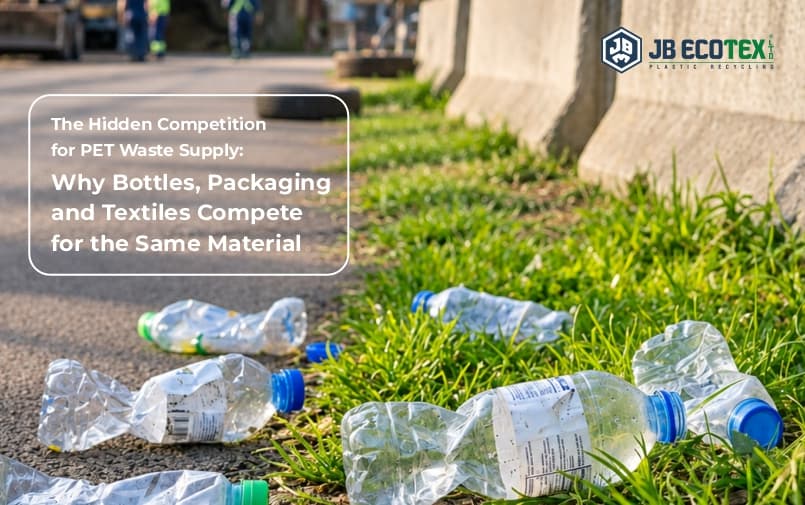
PET waste supply is the starting point for every recycled polyester product. A used PET bottle can return as food-grade resin for new bottles, as sheet or strapping for other packaging, or as recycled polyester staple fibre for a spinning mill. These are three different industries with different buyers and different rules. All three draw on the same stream of collected PET.
We have produced recycled polyester staple fibre since 2015, washed rPET flakes since 2020 and food-grade bottle-to-bottle rPET resin since 2024. Running fibre and resin production side by side means we see this overlap every day. It shows up in how bales are graded, how suppliers are chosen and how each product line plans its material.
Below, we set out how the overlap works, what the regulations say, and what buyers and suppliers can do with that knowledge.
What PET Waste Supply Covers
For a recycler, supply means three things together: how much material is available, how clean it is, and how reliably it arrives. A large volume has limited use if contamination changes from one truck to the next. A clean source has limited use if it arrives only occasionally.
Post-consumer bottles are the most familiar source. They reach recyclers through a chain of waste pickers, scrap dealers, aggregators, material recovery facilities and balers. Recyclers also work with post-industrial polyester waste, fibre waste, sheet trimmings and other PET-based scrap. Each source has its own contamination profile, and each suits some end uses better than others.
Colour adds another layer. Clear and light blue bottles usually go towards applications where appearance forms part of the specification. Coloured PET can go into products where a darker or dope-dyed finish is acceptable, such as black fibre.
PET waste supply is therefore a set of grades. The overlap between industries happens grade by grade, and it is sharpest where several end uses want the same grade.
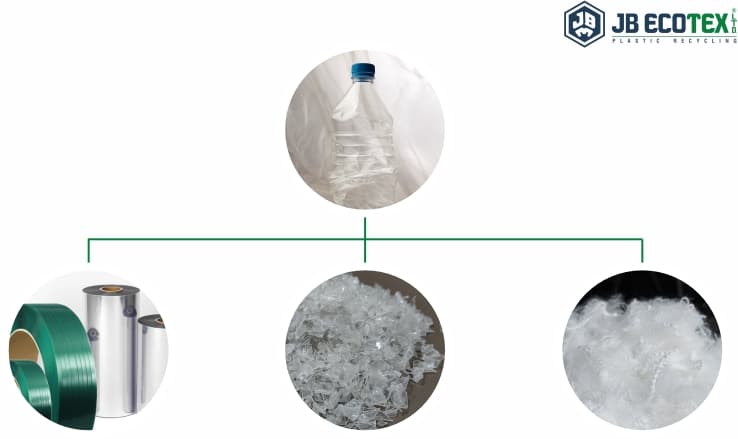
Three Streams That Draw on the Same Material
Bottle-to-Bottle Food-Grade Resin
Food contact sets the highest bar. In India, the Food Safety and Standards Authority of India (FSSAI) published the Food Safety and Standards (Packaging) First Amendment Regulations, 2025, on 28 March 2025. The amendment permits products made of recycled PET for packaging, storing, carrying or dispensing food, subject to the standards and guidelines notified by the Food Authority.
FSSAI then issued its Guidelines for Acceptance of Recycled PET as Food Contact Material in May 2025. Those guidelines cover the recycling of post-consumer PET that was used for food applications, and they apply to recycling technologies approved by FSSAI.
The guidelines also set documentation duties across the chain, from resin manufacturers and converters to bottlers and food businesses, and they require food packaging made with recycled PET to say so on the label. For a brand, that means the recycled content has to be traceable on paper as well as in the product.
That scope matters for supply. The food-grade route draws on a specific slice of PET waste: containers that previously held food or beverages, collected and sorted well enough to meet the acceptance criteria. Our food-grade resin is produced under an FSSAI licence, and for the United States it is covered by a US FDA No Objection Letter. We have written separately about how bottle-to-bottle recycling is changing packaging in India.
Sheet, Film, Strapping and Other Packaging
Packaging beyond bottles also uses recycled PET. Thermoformed trays, sheet, film and strapping each carry their own requirements for colour and cleanliness, and many of these applications sit outside the food-contact rules. Washed flakes are a traded input for converters in these segments, and our PET bottle flakes are made for that kind of buyer.
Recycled Polyester Staple Fibre for Textiles
Spinning mills, non-woven producers, interlining makers and fiberfill manufacturers all use recycled polyester staple fibre. Each application sets its own requirements for denier and tenacity. Textile brands that make recycled content claims often ask for chain-of-custody verification through standards such as the Global Recycled Standard (GRS), published by Textile Exchange.
Our recycled polyester staple fibre range covers spun yarn, non-woven, interlining and other textile uses. Fibre lines can use bottle grades as well as several other PET and polyester waste streams, which gives them more flexibility on input than the food-grade route.
Our fibre range shows how grade and product connect. Dope-dyed black grades such as our Black 6001 fibre have added colour during production, which gives more room to use coloured PET. We also have Sedex and the Ocean Bound Plastic certification. Each grade places a different demand on the supply base.
What the Regulations Ask of Brands
Recycled PET demand comes largely from obligations and commitments placed on the brands that buy packaging and textiles. Two frameworks are worth knowing.
In India, the Ministry of Environment, Forest and Climate Change notified the Plastic Waste Management (Amendment) Rules, 2022, on 16 February 2022. The amendment set out Guidelines on Extended Producer Responsibility (EPR) for plastic packaging. The guidelines group plastic packaging into categories, with rigid plastic packaging in Category I, and they cover reuse, recycling, use of recycled plastic content and end-of-life disposal. The obligations apply to producers, importers and brand owners. The framework has been amended since 2022, so brand owners should check current targets on the Central Pollution Control Board's EPR portal.
In the European Union, Article 6(5) of Directive (EU) 2019/904 on single-use plastics sets minimum recycled content levels for PET beverage bottles. Indian suppliers whose customers sell into the EU see those requirements reflected in their specifications.
These rules explain why recycled plastic demand now reaches recyclers from more than one direction. A beverage brand working towards EPR recycled content obligations needs food-grade resin. An apparel brand with a recycled content claim needs verified recycled fibre. Both depend on the same collection system upstream.
Is There a PET Feedstock Shortage?
We would frame this question by grade, since the answer differs for each one.
The regulations above point to where the overlap is strongest. The food-grade route needs post-consumer PET that was used for food applications, sorted and cleaned to meet FSSAI's acceptance criteria. Fibre and other packaging can also use that same material, along with a wider range of inputs. The overlap therefore concentrates on clean, well-sorted bottle grades from food and beverage use.
We avoid describing the situation as a PET feedstock shortage in absolute terms. Availability varies with region, season, local collection activity, freight and price, and a grade that is hard to find in one quarter can ease in the next. For procurement teams, the practical questions are which grades matter for their product, where those grades come from, and how their suppliers manage changes in availability.
Those questions are best answered with your own suppliers and your own purchase data. Published market commentary can help with context, though it rarely reflects the grade and region you actually buy.
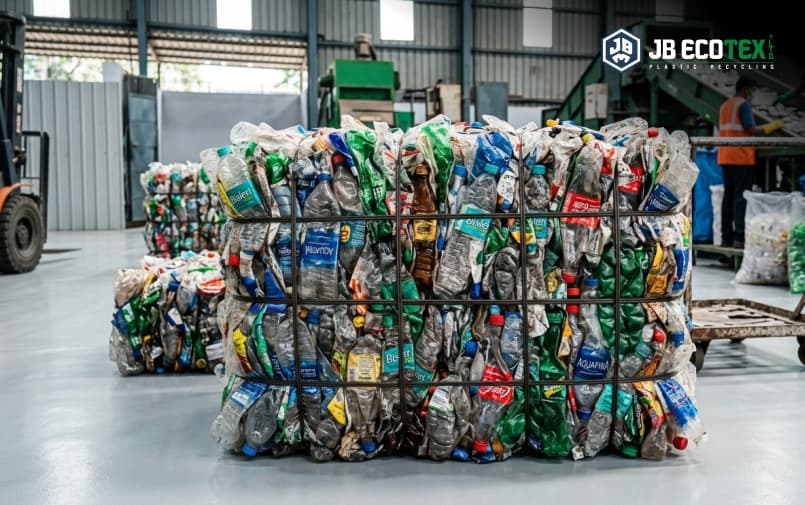
How Grading Decides Where Each Bale Goes
Much of the overlap between industries plays out inside a single facility, at the point where incoming material is graded.
When feedstock trucks reach our gate, quality checks begin straight away. Material that meets the thresholds for food-grade use continues into that stream. Material that misses those thresholds can be diverted to applications such as fibre or strapping. The full sequence is explained in our walkthrough of how our PET recycling systems handle traceability and food-grade safety.
This cascade is where the three streams meet. A food-grade line and a fibre line in the same group are, in effect, two customers for the same bale. Grading sends each bale to the stream it suits, and it keeps material that falls short of food-contact requirements in productive use.
The processing route matters as well. Mechanical recycling, the route we use, relies on sorting, washing and controlled reprocessing. Our explainer on the mechanical recycling process of PET covers each stage.
Supplying PET Bottle Waste: What Recyclers Look For
Every recycled product depends on PET waste collection working well upstream. The quality of PET bottle waste is largely set before it reaches a recycler, and suppliers who prepare material carefully make it usable for more end uses. These are the points we look at when assessing a load.
- Polymer segregation. PET bottles kept apart from other plastics reduce sorting losses at the recycler.
- Colour sorting. Clear, light blue and coloured bottles go to different applications, so separating them at source widens the options for each lot.
- Caps and labels. Caps and labels are usually made of other polymers, and heavy label or cap content adds processing load.
- Moisture and residues. Dry bales with limited food or liquid residue are easier to wash and grade.
- Consistency between loads. Predictable quality from one truck to the next helps a recycler plan which stream the material can enter.
Relationships matter here as much as price. Suppliers want predictable offtake and fair grading. Recyclers want consistent bales. Where both sides agree the specification in advance, the whole chain works better. A good first step for any new supplier is to share a representative sample and a clear description of the source, such as the collection area and the type of containers in the lot. That helps a recycler judge which stream the material can enter before the first full load moves. If you collect or bale PET bottle waste and would like to supply us, please reach our procurement team through the contact page on our website.
Recycled Polyester Feedstock Beyond Bottles
Bottles get most of the attention, though recycled polyester feedstock covers more ground. Fibre producers can work with post-industrial polyester waste, fibre waste and other PET-based scrap alongside bottles. Using these streams eases the demand a fibre line places on bottle grades that packaging buyers also want.
We also produce fibres through an Ocean Bound Plastic (OBP) route. The OBP certification framework covers how the material is collected and documented.
Within our group, a separate chemical recycling operation works with PET that mechanical routes find difficult, such as mixed or coloured material. With mechanical recycling, chemical recycling and several feedstock types in use, a wider share of collected PET can find a productive application.
How We Plan Our Own rPET Supply Chain
We make recycled polyester staple fibre, washed rPET flakes and food-grade bottle-to-bottle rPET resin at our facility in Gujarat. Because these product lines can draw on overlapping grades, our planning looks at fibre, flakes and resin together.
Three habits shape how we manage our rPET supply chain. We source from a broad base of suppliers across bottle and other waste streams, which gives us more options when a particular grade tightens. We grade every load at the gate, so each stream receives material suited to it. We document the chain of custody through the certifications our customers ask for, including GRS, ISCC, RecyClass and OBP.
Supply planning also depends on the customer side. A resin customer and a fibre customer may both rely on bottles collected from the same regions, so forecasts from both help us secure the right grades at the right time.
What Brands Can Do When Setting Recycled Content Targets
Brands often set recycled content targets at a corporate level, and procurement teams then turn those targets into purchase orders. The overlap in feedstock described above affects how smoothly that happens.
A target for food-contact packaging depends on clean food-grade PET waste and on suppliers holding the right regulatory approvals. A target for apparel or home textiles depends on fibre suppliers who can document recycled content through a recognised standard. Both targets rely on the same collection system.
Planning early helps. Sharing forecasts with suppliers, agreeing specifications well ahead of production, and allowing flexibility on colour or grade where the application permits all give a supplier more room to secure material. Longer-term arrangements also give recyclers the confidence to invest in collection partnerships and processing.
A brand that uses recycled PET in both packaging and textiles can also look at the whole portfolio. Each category may be able to use a different grade, which spreads the brand's demand across the supply base.
Questions to Ask PET Recycling Companies About Their Supply
If you buy recycled PET in any form, your supplier's feedstock position affects your own continuity. These questions give a clearer picture than a price sheet alone.
- Where does your feedstock come from? Ask about the number of suppliers, the mix of bottle and other waste, and how long the main suppliers have worked with them.
- How do you grade incoming material? Ask what happens at the gate and where material that misses a threshold goes.
- Which certifications cover traceability? GRS, ISCC and RecyClass each address different parts of the recycled content picture.
- Which approvals apply to food-contact grades? For India, ask about the FSSAI licence and the approved recycling technology. For the United States, ask about a US FDA No Objection Letter.
- How do you plan for changes in availability? A supplier with a wide sourcing base and more than one feedstock route has more room to respond.
Frequently Asked Questions
What is PET waste supply?
PET waste supply is the flow of used PET available to recyclers, mainly post-consumer bottles plus post-industrial polyester and PET scrap. It covers volume, cleanliness and reliability together, because recyclers need consistent grades to produce food-grade resin, flakes or fibre.
Why do bottles and textiles compete for PET waste?
Both industries use recycled PET from the same collection system. Food-grade resin needs clean post-consumer PET from food and beverage use, and recycled polyester fibre can use that same material. EPR obligations and brand recycled content claims bring both buyers to it.
Is there a PET feedstock shortage in India?
The answer depends on grade and region. Clean, well-sorted bottle grades from food and beverage use attract interest from several end uses at once. Availability also varies with season, collection activity, freight and price, so buyers should track the specific grades they use.
What rules allow recycled PET in food packaging in India?
The FSS (Packaging) First Amendment Regulations, 2025, published on 28 March 2025, permit recycled PET for food packaging subject to FSSAI standards. FSSAI's May 2025 guidelines then set acceptance criteria and apply to recycling technologies approved by FSSAI.
How do PET recycling companies secure feedstock?
Most build a wide network of collectors, aggregators and balers. They grade incoming bales carefully, use more than one feedstock type, and keep long-term supplier relationships so they can respond when a particular grade becomes harder to source in their region.