
From Recycled PET Bottles to Geotextile Fibre: The Role of RPSF in Circular Infrastructure
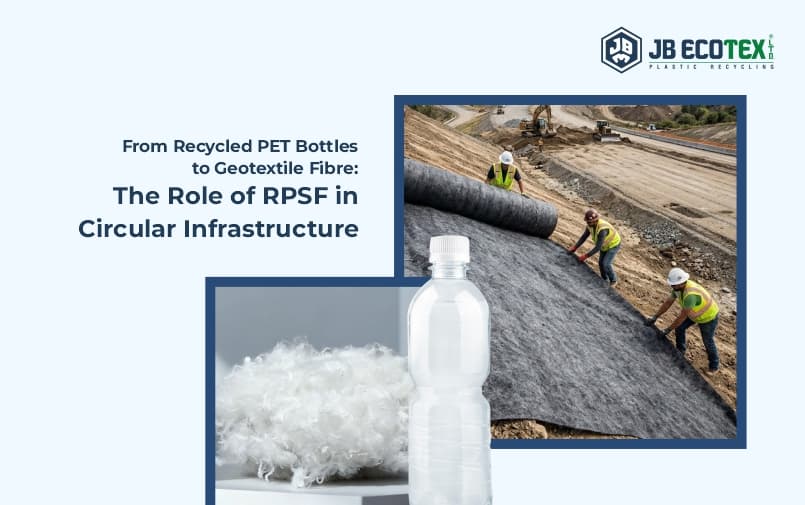
The path from recycled PET bottles to geotextiles passes through a material most people never see: recycled polyester staple fibre, or RPSF. A used bottle can become clean flakes, then fibre, and then part of a nonwoven fabric made by a textile manufacturer.
We manufacture RPSF. Our part of the chain ends when a bale of fibre leaves our facility, and the fabric that follows is designed, made and tested by the manufacturers who buy it. Below, we explain what geotextiles are, how RPSF is made, how nonwoven producers use it in further manufacturing, and what changes when a manufacturer uses recycled polyester fibre as an alternative to virgin polyester fibre.
What Geotextiles Are
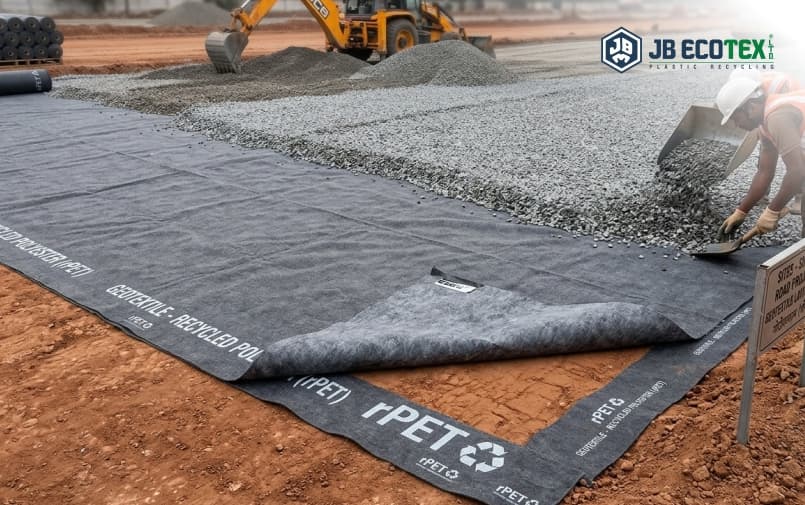
Geotextiles are textiles used in civil engineering and construction work. They form part of a wider group of materials known as geosynthetics.
The Indian Roads Congress, in its guidelines on geosynthetics (IRC:SP:59), describes two broad types of geotextile by how they are made. Woven geotextiles are made by weaving weft threads through warp threads. Nonwoven geotextiles are produced from randomly distributed continuous filaments or staple fibres, bonded together chemically, thermally or mechanically.
That second description is the link to our work. Staple fibres are short, cut lengths of fibre, and RPSF is a staple fibre. When a nonwoven manufacturer chooses to make fabric from staple fibre, recycled polyester staple fibre is one of the raw materials it can use.
The properties a geotextile needs, and the tests it must pass, are set by the fabric manufacturer, the project designer and the applicable specifications. Those questions sit outside the scope of a fibre supplier, so this article stays with the fibre and how it is used.
What Recycled Polyester Staple Fibre Is
Recycled polyester staple fibre is a synthetic fibre made by recycling PET materials. Our RPSF is produced mainly from post-consumer PET bottles, along with other processed PET waste.
RPSF is used as an alternative to virgin polyester staple fibre. It is designed to offer properties such as tensile strength, resilience and durability, along with resistance to wrinkles, shrinking and abrasion. These characteristics make it useful across textile and non-textile manufacturing.
The word "staple" describes the form of the fibre. Staple fibres are cut to set lengths, measured in millimetres, and packed in bales. Manufacturers then open the bales and process the fibre on their own lines, whether they are spinning yarn, making fibrefill or producing nonwoven fabric.
You can see our full range on our recycled polyester staple fibre product page.
How Recycled PET Bottles Become RPSF
Every bale of RPSF starts as collected PET. Our process moves through these stages.
- Bottle feedstock. Post-consumer PET bottles are collected, segregated and inspected to remove non-PET materials and contaminants.
- Sorting and crushing. Bottles are sorted by polymer type and colour, caps and labels are removed, and the bottles are crushed into flakes of uniform size.
- Washing and drying. The flakes go through intensive washing and drying to remove dirt, adhesives, labels, oils and moisture.
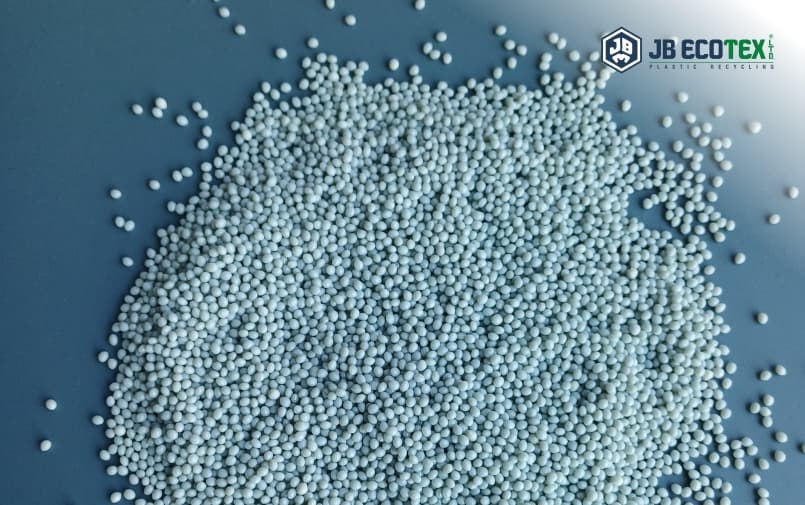
- rPET flakes. Clean, dry flakes of consistent size become the main raw material for fibre production. We also supply washed PET bottle flakes as a product in their own right.
- Additional PET feedstock. Other processed PET waste is fed into the RPSF line along with the flakes, with checks to keep the product within its specification.
- Crystallisation and drying. The feedstock is crystallised and dried under controlled conditions to improve thermal stability and reduce moisture before melt spinning.
- Spinning and collection. The molten polymer is extruded through spinnerets into continuous filaments, which are cooled and collected as tow in tow cans.
- Drawing. The tow is stretched under controlled conditions to align the polymer molecules, which improves tensile strength and dimensional stability.
- Crimping, drying and cutting. The drawn tow is mechanically crimped, heat-set, dried and cut into staple lengths, giving the fibre its bulk and resilience.
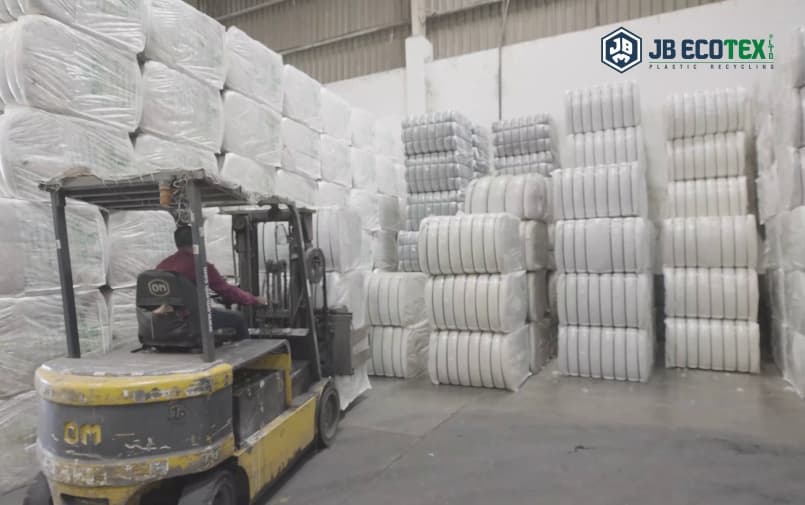
- Baling. The finished fibre is packed in bales of approximately 350 kg each and stacked in our godowns for dispatch.
Each stage prepares the material for the next. Washing prepares flakes for melting. Crystallisation and drying prepare the feedstock for spinning. Drawing and crimping give the fibre the characteristics a downstream manufacturer needs.
How RPSF Is Used in Further Manufacturing
Once a bale reaches a customer, the fibre enters a second manufacturing process. The route depends on the product the customer makes, and three routes account for most of the uses we see.
For nonwoven fabric, including the nonwoven geotextiles described above, the fibre is usually opened, carded and laid into a web. The web is then bonded. IRC:SP:59 names three bonding routes for nonwoven geotextiles: mechanical, thermal and chemical. Mechanical bonding, such as needle punching, entangles the fibres. Thermal bonding uses heat. Chemical bonding uses a binder.
For yarn, spinning mills open and card the fibre, then draw and spin it into yarn. RPSF is often blended with natural fibres such as cotton for apparel yarns.
For fibrefill, the fibre is opened and used as filling in products such as pillows, cushions, quilts and soft toys.
In each case, the downstream manufacturer controls its own process and its own product quality. The fibre supplier's job is to deliver fibre that behaves consistently, so the manufacturer's line runs predictably.
On nonwoven lines in particular, fibre behaviour shows up quickly. Excess fines or broken fibres can build up in carding machines and disturb web formation, and fibres can wrap around rollers during carding. Clean, consistent fibre helps keep these issues in check. We cover these line-level questions in more depth in our overview of polyester fibre for non woven manufacturers, and the fabric side in our piece on non woven polyester fabric.
What Happens to a Bale After Dispatch
The handover from fibre supplier to manufacturer is a practical moment, and a little care at this stage helps the rest of the process.
Each bale carries identification that links it to a production batch. Manufacturers usually record these details on receipt, so any later question about a roll of fabric or a lot of yarn can be traced back to the fibre that went into it.
Storage comes next. Bales are best kept dry, clean and protected from damage until they are used, since moisture and dirt can affect how fibre behaves on the line.
When production starts, many manufacturers draw fibre from several bales at once and blend it before carding. This practice evens out small differences between bales and helps the line run steadily.
Manufacturers also tend to run a quick check on incoming fibre before it goes into full production, particularly when a new batch or a new grade arrives. Comparing a sample against the agreed specification catches issues early, while they are still easy to resolve with the supplier.
Feedback closes the loop. When a manufacturer tells its fibre supplier how a batch performed on the line, the supplier can use that information to keep future deliveries consistent. Over time, this exchange is one of the most useful parts of a supply relationship, for virgin and recycled fibre alike.
Moving From Virgin Polyester to Recycled Polyester Fibre
Many manufacturers that use polyester staple fibre are considering recycled polyester fibre as an alternative input. For a nonwoven producer, including one making geotextiles, the move usually raises three kinds of questions.
The first is technical. Will the recycled fibre run on the existing line, and will the finished fabric still meet its own specification? The only reliable way to answer this is through trials on the manufacturer's own equipment, followed by testing of the finished product.
The second is commercial. How consistent is supply, how are specifications agreed, and how are changes handled? These questions are settled between the fibre supplier and the manufacturer before regular supply begins.
The third is documentation. A manufacturer that wants to describe its product as containing recycled content needs evidence for that claim. Standards such as the Global Recycled Standard (GRS) provide a framework for verifying recycled content through the supply chain, and our RPSF is supplied with the documentation our customers need for their records.
Using recycled polyester fibre also changes where the raw material comes from. The polymer in RPSF comes from collected PET bottles and other PET waste, which puts that material back into productive use. This is the basis of the circular idea behind recycled fibre, and it is why the source and traceability of the fibre matter to many buyers.
We explain more about how mills approach this decision in our article on why manufacturers choose recycled polyester staple fibre.
Fibre Specifications Manufacturers Agree With Their Supplier
Whatever the end product, a manufacturer switching to RPSF agrees a fibre specification with its supplier. The main parameters are familiar across polyester staple fibre.
Denier describes fibre fineness. Each manufacturer chooses a denier to suit its product and process.
Cut length is the length to which the fibre is cut. It affects how the fibre opens, cards and processes on a given line.
Crimp is the wavy structure given to the fibre during production. It helps fibres hold together during processing.
Tenacity describes fibre strength. Where a product calls for higher fibre strength, a higher-tenacity grade can be specified.
Colour and finish depend on the product. Some applications call for specific shades of white or black, and others need a particular surface finish.
Consistency ties these parameters together. A specification is only useful if each batch matches it, so manufacturers usually agree tolerances, testing and batch documentation along with the nominal values.
We produce RPSF in a wide range of deniers, cut lengths, colours and value-added finishes, including customised specifications developed with individual customers.
Our RPSF Range
Our fibre is available in various shades of white, including milky white, off white, non-optical white, optical white, polar white, vanilla white, ibis white and pearl white, along with blacks and customised shades.
Our value-added categories include Super High Tenacity (SHT) fibre, fire-retardant EF-R fibre, cationic dyeable Ketonik fibre, cotton-like KotLyke fibre, low-BPA fibre, hydrophilic fibre, low hot air shrinkage (LHAS) fibre and high-bulk fibre, along with other customised functional grades.
Some grades also extend the range of feedstock we use. AquaLoop fibre is produced through an Ocean Bound Plastic (OBP) route. BlackLoop and WhiteLoop fibres are produced through a textile-to-textile (T2T) route.
The right grade for any product depends on the manufacturer's process and specification, and we work through that choice with each customer. For a nonwoven producer, that conversation usually starts with the product it plans to make and the line it will run on. From there, colour, denier, cut length and any functional finish can be narrowed down together, and samples can be sent for trials before any commitment on volume. This keeps the choice grounded in how the fibre actually performs on the customer's equipment.
Where Else RPSF Is Used
Geotextiles are one of many uses for RPSF. In textiles, RPSF is used mainly for spun yarn, especially for apparel, and in carpets, quilts, curtains and nonwoven home furnishings.
Outside apparel and home textiles, RPSF is used in pillows, cushions, mattresses, sleeping bags, soft toys, wadding and filling materials, automotive interiors, tyres, industrial filters, filtration media, medical and hygiene products, geotextiles, acoustic and thermal insulation materials, furniture, sports goods, construction applications and other technical textile products.
This spread is why PET recycling for technical textiles has grown into a significant part of the fibre business. Many of these products are nonwovens, so the same attention to consistent fibre properties applies across them.
For a manufacturer serving several of these markets, working with one recycled polyester manufacturer across a range of grades can simplify specifications, documentation and quality management.
How a Fibre Supplier and a Manufacturer Develop a New Grade
A new fibre grade for a nonwoven product usually takes shape over several rounds of work.
It starts with a brief. The manufacturer describes the product it wants to make, the specification its product must meet, and the line it will run on.
Sampling comes next. The fibre supplier proposes one or more grades and sends samples with technical data. The manufacturer checks how the fibre opens, cards and bonds on its own equipment.
Trials follow. The manufacturer produces trial material, tests it against its own targets, and shares the results. If something falls short, the two sides adjust the fibre, the product design or the process, and run another trial.
Once the product meets its target, the grade moves towards regular supply. Both sides agree the fibre specification in writing, including tolerances, packing and the documents that accompany each consignment.
Records matter throughout. Batch documentation for the fibre, test reports for the finished product, and recycled content certificates together form the evidence a customer may ask for later.
Questions to Ask Before Switching to RPSF
Manufacturers considering recycled polyester fibre for nonwovens, including geotextiles, can avoid surprises by settling a few questions first.
- What does the finished product need to achieve? Confirm the product specification before choosing a fibre.
- Which fibre parameters matter most? Agree denier, cut length, crimp, tenacity, colour and finish with the supplier.
- How consistent is the fibre between batches? Ask for technical data and batch documentation, and check how variation is controlled.
- How will the fibre be trialled? Plan trials on your own line and test the finished product before committing to volume.
- How is recycled content documented? Ask which certification supports the recycled content claim and whether transaction certificates are available for each consignment.
Frequently Asked Questions
What are geotextiles?
Geotextiles are textiles used in civil engineering and construction, and they belong to the wider group called geosynthetics. They are commonly made as woven fabrics or as nonwoven fabrics produced from filaments or staple fibres bonded chemically, thermally or mechanically.
How are recycled PET bottles turned into geotextile fibre?
Bottles are sorted, crushed, washed and dried into flakes. The flakes are crystallised, dried, melted and spun into filaments, which are drawn, crimped and cut into staple fibre. Nonwoven manufacturers then use this fibre to make fabric.
What is RPSF used for?
RPSF is used in spun yarn, home furnishings, fibrefill products, automotive interiors, filtration media, insulation materials, geotextiles, construction applications and other technical textiles. The right grade depends on each manufacturer's product and process.
Can recycled polyester fibre replace virgin polyester fibre?
RPSF is used as an alternative to virgin polyester staple fibre in many applications. Whether it suits a particular product depends on trials on the manufacturer's own line and testing of the finished product against its specification.
How is recycled content in RPSF verified?
Recycled content can be verified through chain-of-custody standards such as the Global Recycled Standard (GRS). Manufacturers should ask their fibre supplier for the relevant certification and transaction certificates for each consignment.