
PET Resin Supplier | Recycled PET Granules and rPET Pellets
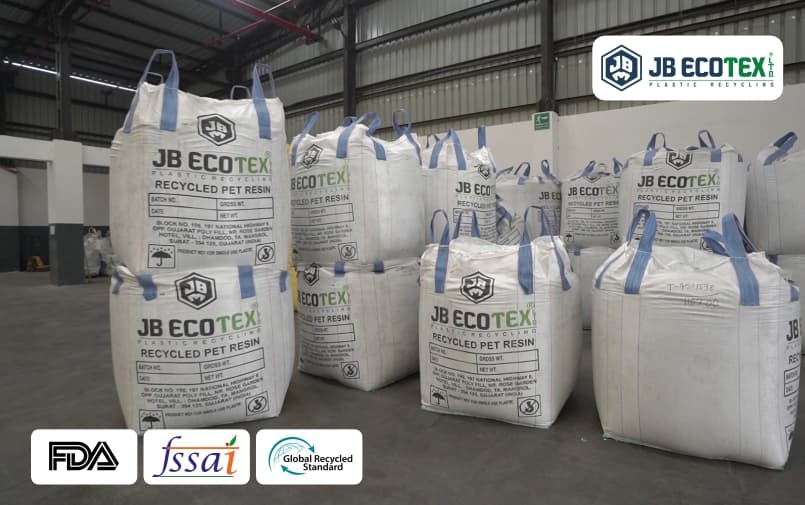
Recycled PET Resin for Packaging, Fiber and Industrial Manufacturing
Polyethylene terephthalate is one of the most widely used polymers in modern manufacturing. Packaging, beverage bottles, polyester fibers, thermoformed trays and industrial strapping are all produced using PET resin as a primary raw material.
As industries move toward circular material systems, recycled PET has become an important alternative to virgin resin.
JB Ecotex produces recycled PET resin in pellet and granule form, allowing recovered PET to re-enter manufacturing supply chains. The focus of the process is restoring polymer quality so that recycled material performs reliably in industrial production environments.
Our rPET pellets and recycled PET granules are supplied to manufacturers producing:
- rigid packaging
- beverage containers
- polyester fibers
- thermoformed PET sheets
- PET strapping and industrial products
The goal of recycled PET production is not simply waste management. The objective is to convert recovered PET into a polymer that can function again as a manufacturing raw material.
What Is PET Resin
PET resin is polyethylene terephthalate polymer supplied in pellet or granule form and used as a raw material in manufacturing.
The polymer can be produced through two routes:
- polymerization of PETrochemical feedstock to produce virgin PET
- recycling of recovered PET materials to produce recycled PET resin
Recycled PET resin, often referred to as rPET, is produced by processing recovered PET materials through recycling systems designed to remove contamination and stabilize the polymer structure.
Industries increasingly incorporate rPET into production to:
- reduce dependence on virgin plastic
- meet recycled content requirements
- move toward circular material systems
What Is rPET
rPET refers to recycled polyethylene terephthalate that has been recovered from used PET products such as bottles, packaging and industrial waste streams.
After collection and processing, PET is converted into pellets or granules that can be used again in manufacturing.
rPET is widely used in:
- packaging and beverage containers
- polyester fiber production
- thermoformed PET sheets
- industrial PET products
The use of recycled PET allows PET products to remain in the production cycle rather than becoming waste.
Recycled PET Resin Production at JB Ecotex
Producing recycled PET suitable for manufacturing requires a controlled recycling process.
Recovered PET often contains contaminants, degraded polymer chains and inconsistent molecular structure. These issues must be addressed during recycling to produce pellets that can be processed reliably.
JB Ecotex operates mechanical recycling infrastructure designed to restore PET polymer quality and maintain stable processing characteristics.
The recycling system includes:
- sorting and washing of PET feedstock
- controlled melt filtration to remove impurities
- vacuum-based decontamination
- polymer stabilization and pelletization These steps ensure that recycled PET is converted into uniform pellets with consistent intrinsic viscosity and predictable processing performance.
PET Recycling Process
Producing high quality recycled PET involves multiple processing stages designed to remove contaminants and stabilize the polymer.
Recovered PET is sorted and cleaned before being converted into flakes. These flakes are processed through controlled recycling systems where the polymer is filtered, decontaminated and pelletized.
Each stage of the recycling process influences the final quality of the recycled resin.
Bottle-to-Bottle Recycling
Bottle-to-bottle recycling refers to the process of converting used PET bottles into new PET resin that can again be used to manufacture bottles or food packaging.
JB Ecotex produces recycled PET resin from post-consumer PET bottles through a controlled recycling process designed to remove contaminants and rebuild polymer quality.
The resulting resin can be used in closed-loop packaging systems including:
- beverage bottles
- water bottles
- thermoformed food packaging
- rigid containers
Bottle-to-bottle recycling plays a critical role in reducing reliance on virgin plastic while maintaining the functional properties required for packaging.
Feedstock Source and Circular PET Recovery
The quality of recycled PET resin is closely linked to the quality of the feedstock used during recycling.
JB Ecotex sources PET primarily from post-consumer PET bottles and packaging streams, which are sorted and processed through controlled recovery systems before entering the recycling process.
Feedstock preparation includes:
- sorting to remove non-PET materials
- washing and contamination removal
- conversion into clean PET flakes
- preparation for polymer processing
Using recovered PET bottles as feedstock allows the polymer to be reintroduced into manufacturing systems through closed-loop recycling pathways.
This approach supports circular material flows where PET packaging can be recovered, recycled and reprocessed into new packaging or industrial products.
Advanced Recycling Systems
JB Ecotex incorporates Erema Vacunite recycling technology, a globally advanced mechanical recycling system for food-grade rPET resin production, which provides material purity and intrinsic viscosity for food-contact packaging applications.
The Vacunite system combines vacuum-assisted decontamination with nitrogen-protected crystallisation, ensuring material purity and intrinsic viscosity for food-contact packaging applications.
Key characteristics of this process include:
- removal of volatile contaminants
- restoration of polymer molecular structure
- stable intrinsic viscosity control
- consistent pellet production
These systems allow recycled PET to be processed into materials suitable for demanding manufacturing environments.
Mechanical and Chemical Recycling of PET
PET can be recycled using two different approaches.
Mechanical recycling processes recovered PET through cleaning, melting and pelletization to produce recycled PET resin.
Chemical recycling breaks PET down to its molecular building blocks and reconstructs the polymer.
Both approaches contribute to extending the usable life cycle of PET materials. Thus, making both chemical and mechanical recycling essential for PET bottle recycling practices.
PET Food Grade Resin
Food packaging applications require strict control of contamination and polymer quality.
JB Ecotex produces mechanically recycled PET resins suitable for food grade packaging applications using controlled recycling processes designed to remove impurities and stabilize the polymer.
These resins are used in:
- beverage bottle manufacturing
- food packaging sheets
- thermoformed food trays
- rigid packaging containers
As packaging regulations evolve globally, demand for reliable food grade recycled PET resin continues to increase.
rPET Pellets, PET Chips and Recycled PET Granules
JB Ecotex supplies recycled PET resin in chip, pellet, or granule form for industrial processing. These terms are commonly used interchangeably in the PET industry and all refer to the solid resin form produced after recycling and polymer processing.
rPET Chips / Pellets / Granules
Recycled PET resin supplied as chips, pellets, or granules is used across a wide range of manufacturing processes, including:
- extrusion
- injection molding
- fiber spinning
- PET sheet production
- thermoforming
- PET strap manufacturing
- polyester fiber production
Although the terminology may vary between industries or regions, chips, pellets, and granules all represent the same processed PET resin material used as feedstock for manufacturing.
Consistent particle size, controlled intrinsic viscosity, and high polymer purity help ensure stable processing performance across industrial applications.
Typical Resin Specifications
Recycled PET resins are supplied in multiple intrinsic viscosity grades depending on the intended application.
JB Ecotex produces food-grade rPET resins in IV grades commonly used in packaging and thermoforming.
Typical grades include:
| Parameter |
Typical Range |
| Intrinsic Viscosity |
0.76 – 0.84 dL/g |
| Pellet Shape |
Spherical |
| Feedstock |
Post-consumer PET bottles |
| Contaminant Level |
Controlled through melt filtration and
decontamination |
| Processing Technology |
Erema Vacunite high-vacuum extrusion |
IV grades such as 0.80 and 0.84 dL/g are commonly used in bottle manufacturing, thermoformed trays and rigid packaging applications.
Certifications and Regulatory Compliance
Manufacturers using recycled PET in packaging and consumer products must ensure that the resin meets regulatory and safety standards. Compliance is particularly important for applications involving food contact, beverage packaging, and personal care containers.
JB Ecotex supplies recycled PET resin supported by internationally recognised certifications and documentation.
FSSAI Certified Food-Grade rPET
JB Ecotex is listed by the Food Safety and Standards Authority of India (FSSAI) as a certified supplier of food-grade rPET resin. This approval confirms that the recycling process meets India’s regulatory standards for food contact materials.
FSSAI certification requires:
- validated decontamination processes
- migration testing and safety verification
- documented traceability of PET feedstock
- strict contamination control standards
FDA and Global Food-Contact Compliance
For companies exporting packaging or products internationally, compliance with global food safety frameworks is essential. JB Ecotex supports supply chains that require documentation aligned with international standards including US FDA process requirements for recycled plastics.
Global Recycled Standard (GRS)
GRS certification verifies recycled content and supply chain transparency. It provides assurance that recycled PET used in manufacturing originates from verified sources and is processed through controlled systems.
Traceability has become a critical requirement for manufacturers using recycled materials.
JB Ecotex supplies Global Recycled Standard PET, allowing manufacturers to verify recycled content and maintain transparency in their supply chains.
GRS certification confirms that:
- recycled inputs are verified
- production processes are traceable
- supply
Traceability and Batch Documentation
Traceability has become a core requirement in PET recycling systems and packaging supply chains, particularly when recycled materials are used in regulated applications.
At JB Ecotex, every batch of food-grade recycled PET resin is linked to documented records that track the origin of the feedstock, the recycling process, and quality verification results.
Each shipment can include documentation such as:
- batch-level test reports
- migration testing results
- compliance certificates
- material safety documentation
This level of documentation supports manufacturers during audits and regulatory approvals while ensuring transparency across the supply chain.
Industries Using Recycled PET Resin
PET resin is used across several manufacturing sectors.
Packaging and Bottles
PET is widely used in packaging due to its strength, clarity and barrier properties.
Applications include:
- beverage bottles
- food containers
- thermoformed trays
- packaging sheets
PET packaging material is one of the popular materials used in the packaging industry.
Polyester Fiber and Textile Manufacturing
Recycled PET resin is used to produce polyester fibers for textiles and technical applications.
These include:
- polyester staple fiber
- filament yarns
- nonwoven fabrics
Industrial Packaging
PET resin is also used in industrial packaging products including PET strapping used for load securing.
These applications require strong polymer structure and stable viscosity.
PET Resin Quality Parameters
Manufacturers evaluating PET resin suppliers often examine several technical parameters.
Intrinsic Viscosity
Intrinsic viscosity reflects the molecular weight of the polymer and influences processing behaviour during extrusion and fiber production.
Polymer Purity
Impurities in PET resin can affect product quality and machine performance. Melt filtration during recycling helps remove contaminants.
Moisture Control
PET is sensitive to moisture during processing. Proper drying and pellet handling prevent degradation.
Pellet Uniformity
Uniform pellet size improves feeding consistency in extrusion and injection moulding systems.
Maintaining stability across these parameters allows recycled PET resin to perform reliably in production environments.
Recycled PET Resin Supply from India
India has developed significant PET recycling capacity due to the scale of PET consumption and the availability of recoverable feedstock.
This environment has enabled large recycling operations capable of producing recycled PET resin for global supply chains.
JB Ecotex converts recovered PET into recycled resin that can be supplied to manufacturers worldwide.
How Manufacturers Evaluate PET Resin Suppliers
Selecting a PET resin supplier typically involves evaluating several operational factors.
Polymer consistency
Stable intrinsic viscosity and pellet quality ensure
predictable processing.
Feedstock traceability
Traceable recycled inputs are increasingly required to
meet sustainability targets.
Production infrastructure
Suppliers operating advanced recycling systems are
able to maintain consistent resin quality at scale.
Certification and compliance
Many manufacturers require recycled PET to comply with
standards such as Global Recycled Standard.
These factors determine whether recycled PET can integrate reliably into industrial manufacturing systems.
Production Capacity
Reliable supply is an important consideration when sourcing PET resin for industrial production.
JB Ecotex currently operates food-grade rPET resin production capacity of 21,600 metric tonnes per year, with expansion plans targeting 36,000 metric tonnes annually.
This scale allows the company to support packaging manufacturers and converters that require consistent raw material supply for large production runs.
Frequently Asked Questions
What is rPET?
rPET stands for recycled polyethylene terephthalate produced by recycling PET materials such as bottles and packaging.
What are rPET pellets used for?
rPET pellets are used in packaging production, polyester fiber manufacturing, PET sheet extrusion and industrial PET products.
Can recycled PET be used for food packaging?
Yes. Recycled PET can be used for food packaging when it is produced through controlled recycling systems designed to remove contamination and stabilize polymer quality.
What is Global Recycled Standard PET?
Global Recycled Standard PET refers to recycled PET produced in facilities certified under the Global Recycled Standard, verifying recycled content and traceability.
Who supplies recycled PET resin in India?
JB Ecotex produces recycled PET granules and rPET pellets used by packaging manufacturers, textile producers and industrial processors.
PET Resin Supplier for rPET Pellets and Recycled PET Granules
Manufacturers across packaging, textile and industrial sectors increasingly incorporate recycled PET into their material supply chains.
Recycled PET resin allows PET products to re-enter manufacturing systems rather than being discarded after a single use.
Through controlled recycling processes and advanced infrastructure, JB Ecotex converts recovered PET into recycled resin suitable for multiple manufacturing applications.
For companies sourcing rPET pellets, recycled PET granules and food grade recycled PET, consistent polymer quality and reliable supply remain critical factors.
JB Ecotex focuses on delivering both. Reach out to see how it works in your operations.