
Recycled Polyester Manufacturer: What Buyers Should Check Before Choosing a Supplier
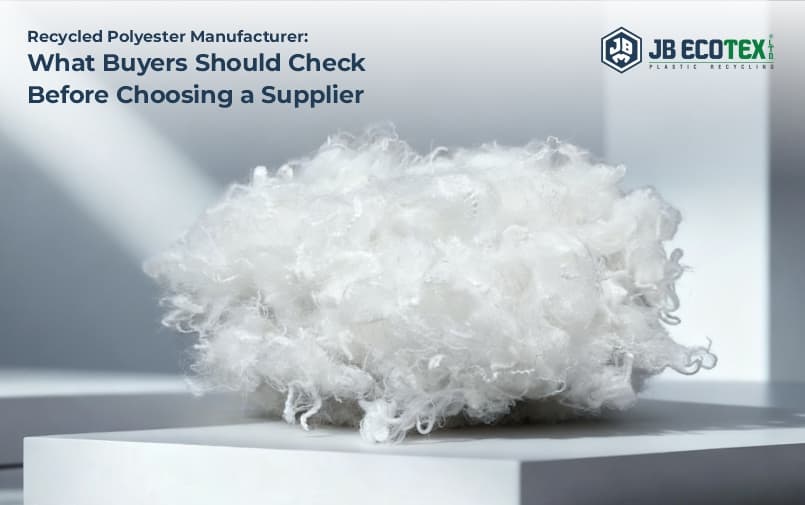
The recycling chain for post-consumer PET bottles depends on one specific intermediate: the flake. Before recycled polyester fibre gets spun, before food-grade rPET resin gets pelletised, a small irregular fragment of sorted and processed PET has to meet a set of specifications that determine whether everything downstream runs cleanly. That fragment is the PET plastic flake. It is the input that feeds spinning mills, resin converters, and strapping manufacturers worldwide. Its cleanliness, consistency, and traceability set a ceiling on what any downstream process can achieve.
At J B Ecotex, we have spent over a decade manufacturing recycled polyester staple fibre across dozens of grades for spinning mills, nonwoven converters, filling manufacturers, and brand supply chains. The enquiries we receive follow a pattern. In the early stages of a supplier search, buyers ask about price and denier. By the third or fourth conversation, they are asking about batch records, GRS certificate scope, and what happens when a quality issue surfaces six months after delivery.
That shift in questioning reflects what actually matters in a supply relationship. This article covers the factors that experienced procurement teams arrive at eventually. Starting with them is more efficient than discovering them after the first shipment.
What Recycled Polyester Staple Fibre Is
Recycled polyester staple fibre is a short-cut synthetic fibre manufactured from post-consumer PET waste, primarily plastic bottles. It processes through spinning and nonwoven equipment comparably to conventional polyester staple fibre. The functional difference lies upstream: the raw material is recovered, sorted, cleaned, and reprocessed PET rather than virgin petrochemical polymer.
This origin is where we at J B Ecotex place the sharpest attention. The position we hold, based on over a decade of processing post-consumer PET, is that finished fibre quality is determined at the feedstock stage more than at any other point in the manufacturing chain. A manufacturer sourcing from colour-separated, well-controlled post-consumer bottle bales will produce fibre with more predictable whiteness, tenacity, and denier uniformity than one sourcing from mixed or poorly sorted streams.
The specification sheet a buyer receives reflects what the manufacturer targets. The feedstock sourcing protocol determines whether it can be delivered consistently across every shipment.

How Recycled Polyester Is Manufactured: The PET Bottle to Polyester Fibre Journey
The PET bottle to polyester fibre conversion covers several stages. Each introduces variables that compound or cancel out in the finished fibre. Understanding ence helps procurement teams ask the questions that go beyond the datasheet.
Feedstock Collection and Sorting
Post-consumer PET bottles arrive in bales from municipal collection streams, deposit-return systems, or controlled collection programmes. At intake, contamination is the primary risk. Mixed-colour bales, non-PET plastics, caps, and label adhesives all compromise downstream flake quality.
At J B Ecotex, incoming bales are assessed against defined colour and contamination thresholds before they are accepted into the facility. Bales that fall outside those thresholds are rejected at intake. The logic is clear: contamination that enters the washing stage at high levels cannot be fully eliminated through washing alone. It transfers through to flake quality and, ultimately, into fibre quality. Accepting off-specification bales and compensating downstream is a false economy that produces unpredictable output.
Hot-Washing and Flaking
Sorted bottles are shredded into flakes and passed through a hot-washing process designed to remove adhesive residue, label fragments, and surface soil. Hot-washed flakes carry measurably lower contamination levels than cold-washed material. Flake quality is assessed at this stage for moisture content and residual contamination before the material advances to drying and extrusion.
Melt Extrusion and Fibre Conversion
Clean, dried flakes are melted and extruded through spinnerets into continuous filament. The drawing process determines tenacity. Crimp engineering affects bulk, fibre cohesion during carding, and bonding compatibility in nonwoven structures. Cut length is set to match the downstream process: ring spinning, open-end spinning, airlaid, needle-punch, or thermal bond.
Melt filtration at the extrusion stage removes undissolved particulates that would otherwise appear as black specks or surface defects in the finished fibre. The fineness of the filtration media and the frequency with which it is changed are parameters that separate consistent polyester fibre production operations from inconsistent ones. These details must be requested directly if they are not volunteered in supplier presentation.
Final Testing and Batch Release
Finished fibre is tested across denier, tenacity, elongation, whiteness index, and moisture content before release. At J B Ecotex, batch records are linked to specific production runs and retained. When a quality issue surfaces months after delivery, the originating production data is available for root cause investigation. This traceability within the manufacturing operation is part of what ISO 9001:2015 certification requires in practice, as distinct from on paper.
Key Quality Factors Buyers Should Evaluate
Fibre Denier and Cut Length
J B Ecotex supplies RPSF across deniers from 0.8 to 100, depending on application. The denier selection guide covers how denier affects application outcomes across spinning and nonwoven production specifically. Cut length must match the processing machinery: a 38 mm cut suits the majority of ring spinning operations, while longer cuts are specified for certain needle-punch and thermal-bonded nonwoven lines. A mismatch between cut length and machine configuration causes production inefficiencies regardless of how well the fibre performs on other parameters.
Batch-to-Batch Consistency
For polyester fibre properties, the critical test is whether the third and tenth shipments perform identically to the first. Consistency depends on upstream feedstock control. If raw material source quality varies in colour, viscosity, or contamination level across seasons or supply batches, output fibre will vary correspondingly.
Request inter-batch variation data covering denier coefficient of variation, whiteness index deviation, and tenacity range before committing to a supply relationship. A recycled polyester manufacturer must produce this data to structure its quality system to capture it. Capturing it is the only way to control it.
Tenacity and Elongation
Tenacity, expressed in grams per denier, determines how recycled psf behaves under stress during spinning, needling, or thermal bonding. Automotive nonwovens, geotextiles, and technical filtration media require higher tenacity grades capable of withstanding the mechanical loads imposed during processing and in service.
J B Ecotex offers medium, high, and super-high tenacity grades depending on the application requirement. A manufacturer offering graded tenacity options across its product range signals genuine process control. A manufacturer offering a single tenacity grade across all applications is operating with limited process differentiation.
Application Fitness
Recycled psf covers a wide range of variants beyond standard white staple fibre. Dope-dyed grades eliminate downstream dyeing. Flame-retardant grades meet fire resistance requirements for automotive and furniture applications. Siliconised grades offer improved friction coefficients for specific carding configurations. Low-BPA grades address contamination concerns for markets with restricted substance requirements. Hollow conjugated grades provide loft and thermal performance for filling applications. Ocean Bound Plastic grades carry documented feedstock provenance from coastal collection zones.
A competent recycled polyester manufacturer will raise application-fit questions during the enquiry stage. A supplier that accepts a specification and fulfils it without interrogating the end-use is one to scrutinise. Application mismatches cost more to resolve after a production run than before one.

Questions Spinning Mills and Nonwoven Producers Ask Us
Rather than listing what buyers should ask in the abstract, here are the questions procurement teams raise with J B Ecotex consistently during supplier qualification.
"Can you hold denier consistency across our monthly volumes?''
Denier variation within a batch creates uneven yarn count, which causes fabric weight variation and shade differences during dyeing in the finished textile. Mills running high-speed ring frames are acutely sensitive to this. Verbal assurance is insufficient here. The answer requires inter-batch coefficient of variation data from recent production runs at volumes comparable to the buyer's requirement.
"What is your whiteness index and does it stay stable across seasons?''
Feedstock quality can shift seasonally depending on collection patterns and bottle type composition in the input stream. At J B Ecotex, stable whiteness output across the year is maintained through incoming material qualification rather than compensated for in post-processing. A manufacturer without robust incoming material control will show batch-to-batch colour drift that creates shade inconsistency problems in optical white yarn production. Asking for whiteness index trend data across twelve months of production is a reasonable qualification request that any manufacturer with a functioning quality system should be able to answer.
"Does your GRS certificate cover the specific grade we are procuring?''
GRS scope varies by certificate. Buyers should confirm that the grade they are procuring falls within the certified scope of the specific certificate on record, and that the certificate number is independently verifiable through the Textile Exchange certification database. A certificate that cannot be cross-referenced to a live public record is inadequate for compliance documentation purposes.
"What does your low-BPA grade mean in practice, and what test data supports it?''
Low-BPA grades are produced through feedstock selection and process controls designed to reduce bisphenol A levels in the finished fibre. Buyers in skin-contact textile or food-adjacent applications should request quantified test data. The grade designation is a starting point. The test results behind it are the verification. At J B Ecotex, this data is available for buyer review on request.
These questions reflect what experienced procurement teams actually examine. A recycled polyester manufacturer that answers all of them with documented evidence rather than verbal assurance has built the operational infrastructure required for a serious supply relationship.
Sustainability, Traceability, and the 2026 Regulatory Context
Is Recycled Polyester Eco Friendly?
The question of whether recycled polyester is eco friendly requires a precise answer. The environmental case rests on measured outcomes documented in third-party life cycle assessment studies, including the Franklin Associates ISO 14040-compliant LCA and the Denkstatt study commissioned through the PET Recycling Team GmbH. Both are available through industry channels and provide figures that buyers can reference independently rather than accepting manufacturer claims at face value.
The measurable dimensions are reduced dependence on virgin PETrochemical feedstock, lower energy consumption per kilogram of fibre relative to virgin polyester production, and the diversion of post-consumer plastic bottle waste from landfill and waterway contamination pathways.
What the Regulatory Environment Requires in 2022
The procurement context for recycled psf has shifted materially over the past two years. Buyers sourcing into EU markets face a new layer of traceability documentation requirements driven by several converging regulations.
The EU's Empowering Consumers Directive, which came into force in March 2024 and is being transposed into national law by March 2026 with an effective start date of September 2026, restricts unsubstantiated environmental claims. Brands that reference recycled polyester content in product communications require supplier documentation that is independently verified rather than self-declared. The EU's Ecodesign for Sustainable Products Regulation (ESPR) entered into force in July 2024 with the first obligations, including a ban on destroying unsold textiles and footwear, taking effect on 19 July 2026. Recycled content is identified as a criteria area in the ESPR working plan for textiles, with delegated acts expected in 2027. The practical effect for procurement teams today is that supplier documentation gaps that were tolerable two years ago create compliance exposure now.
What this means for supplier selection: a recycled polyester manufacturer that holds GRS certification, maintains auditable batch records, and provides certificate numbers verifiable through the Textile Exchange database is supplying documentation that satisfies current regulatory expectations. A manufacturer relying on self-declared recycled content claims without third-party verification is supplying documentation that falls short.
J B Ecotex holds GRS, OEKO-TEX Standard 100, ISO 9001:2015, ISO 14001:2015, and Ocean Bound Plastic certification across its RPSF product range. Certificate numbers and audit bodies are available for buyer verification. The broader context of how India's recycled polyester supply chain fits into global sourcing strategies is covered in the analysis of India's role in the recycled polyester market.

Applications of Recycled Polyester Staple Fibre
Recycled polyester staple fibre serves a wide range of end-use categories. A manufacturer's depth of experience across multiple application segments is an indicator of genuine process range and technical depth.
Textile Yarns
Ring-spun and open-end spun yarns produced from recycled psf feed into apparel, home textiles, and furnishing fabric. Key procurement criteria are whiteness, dyeability, denier uniformity, and spinning performance across high-speed frames. J B Ecotex supplies spun yarn grades across deniers from 0.8 to 3, in medium, high, and super-high tenacity, across cut lengths from 24 mm to 102 mm.
Nonwoven Fabrics
Nonwoven production places different demands on fibre than spinning does. Crimp structure, thermal bonding compatibility, and surface finish carry more weight in nonwoven specifications than in spun yarn work. The full specification range for nonwoven applications and the processing considerations that accompany each grade are covered in the nonwoven fibre manufacturing section of the J B Ecotex site. J B Ecotex supplies nonwoven grades from 3 to 100 denier for hygiene products, medical textiles, automotive interiors, filtration media, and geotextiles.
Filling and Wadding
Hollow conjugated siliconised grades are used in cushion filling, pillow filling, and thermal wadding. Performance criteria here include loft retention, resilience under repeated compression, and fibre migration resistance. These properties are determined by crimp structure and siliconisation level, both of which are process-controlled parameters at the manufacturing stage.
Flame-Retardant and Specialist Grades
FR-treated grades serve furniture, automotive, and public transport upholstery markets where fire resistance standards apply. OBP-certified grades carry documented feedstock provenance from coastal and waterway-adjacent collection zones, which supports specific brand sustainability reporting under the traceability requirements described above.
The reasons why procurement teams consolidate supplier relationships across multiple application categories around a single qualified manufacturer are practical: single-source qualification, consistent documentation, and technical support across product lines without re-qualifying a new vendor for each grade.
Common Mistakes Buyers Make When a Recycled Polyester Manufacturer
Selecting on price alone.
A price that cannot be explained by process capability, feedstock quality, or certification overhead warrants questions before it triggers a purchase order. Recycled PSF produced from poorly sorted feedstock with inadequate washing typically carries a lower cost. That saving transfers downstream as yarn breaks, fabric defects, and returned goods. In our experience, enquiries where price is the opening and closing criterion are the enquiries that return as quality complaints.
Ignoring process consistency.
One excellent sample shipment followed by three inconsistent production batches is a supply chain failure. We see this pattern specifically when buyers qualify a supplier on a small initial order and scale up without requesting inter-batch variation data. The data that matters is denier coefficient of variation, whiteness index deviation, and tenacity range across multiple production batches, captured under the actual volumes the buyer plans to order rather than a sample run.
Skipping application fitness evaluation.
Procurement teams sourcing across multiple product lines sometimes apply a single fibre specification across applications with different requirements. The version of this mistake we encounter regularly is spinning mills specifying a standard white grade for an application that requires low-BPA or OBP certification, properties absent from the standard grade, with the specification gap discovered only when the brand's procurement team raises it. Providing full application details during the enquiry stage, and evaluating the supplier's response to that information, is how this is avoided.
Overlooking supplier transparency.
A recycled polyester manufacturer that hesitates to share process documentation, certification details, or raw material sourcing information is signalling that something in that chain merits concealment. Transparency on feedstock sourcing, production process parameters, and quality test data is a baseline expectation for any supply relationship operating under current regulatory traceability requirements. The reasons why procurement and sustainability teams actively evaluate the full supplier profile are laid out in the RPSF supplier evaluation guide.
Why Buying Directly from a Manufacturer Produces Better Outcomes
Technical control over specification. A manufacturer controls its own production parameters. When a buyer specifies denier, cut length, crimp structure, or surface finish, a manufacturer can adjust its process to meet that specification. A trading intermediary sourcing from a third-party producer cannot offer the same degree of customisation or responsiveness.
Supply consistency and forward visibility. Direct supply relationships give buyers visibility into production scheduling, raw material inventory, and capacity constraints. This allows procurement teams to plan forward purchases with more accuracy and reduces the risk of supply gaps caused by intermediary issues that are never disclosed upstream.
Customisation across grades. Specialised grades such as dope-dyed, low-BPA, OBP-certified, and FR-treated variants require process-level adjustments that only a manufacturing operation can accommodate. Traders operating on stock availability are unable to fulfil custom specifications.
Accountable quality escalation. When a quality issue arises, direct manufacturer engagement provides a clear escalation path. The manufacturer has access to batch records, incoming raw material data, and in-process quality logs. An intermediary lacks equivalent access and is unable to facilitate the root cause investigation that a quality complaint requires.
J B Ecotex operates as a direct recycled polyester manufacturer with over a decade in the recycled polyester staple fibre segment, with GRS, OEKO-TEX Standard 100, ISO 9001:2015, ISO 14001:2015, and OBP certification across a broad range of RPSF grades for spinning, nonwoven, filling, and technical textile applications.

Choosing a Recycled Polyester Manufacturer: The Criteria That Hold Up Over Time
The choice of a recycled polyester manufacturer carries more complexity than a standard commodity purchase. Feedstock origin, polyester fibre production discipline, quality system structure, certification scope, and application fit all determine whether a fibre will perform reliably across downstream manufacturing operations over repeated supply cycles.
The buyers who build durable supply relationships with us at J B Ecotex are the ones who arrive with specific questions about process, documentation, and application fit. Price matters, but it functions as a validator after technical and operational qualification rather than as a primary selection criterion.
Procurement teams with specific application requirements or grade enquiries are welcome to contact J B Ecotex with detailed specifications. The team will assess application fit and provide documented grade recommendations before an order is placed.