
Recycled PET Bottle Yarn: The Journey From Used Bottle to Spun Yarn
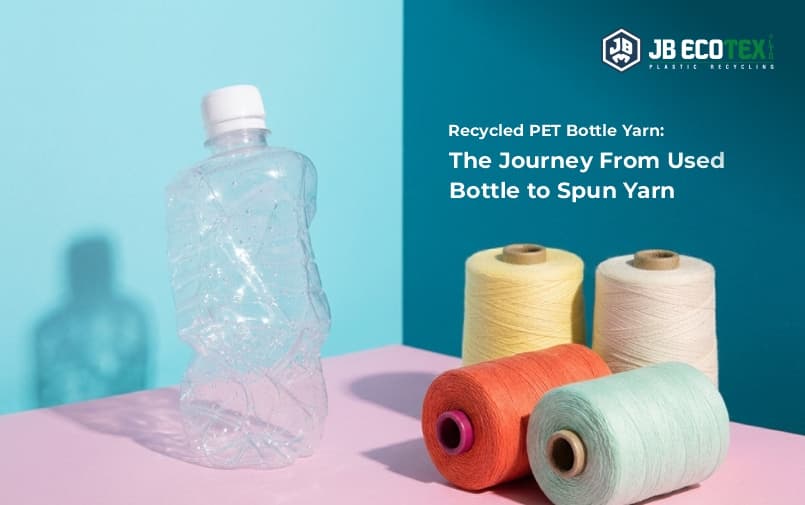
Recycled PET bottle yarn starts as a used drinks bottle and ends as a cone of yarn on a knitting or weaving floor, with a fibre plant and a spinning mill in between. Buyers searching for recycled plastic yarn in India often meet the finished cone first and the supply chain behind it much later. That chain has a clear order: bottle, flake, fibre, yarn. We work in the middle of it, producing recycled polyester staple fibre, known as RPSF, which spinning mills convert into polyester staple yarn. The sections below explain what PET yarn is, how the staple route differs from recycled PET chips yarn made as filament, what happens to our fibre inside a spinning mill, and how a brand can verify the recycled content it is paying for.
What Is PET Yarn Made From Recycled Bottles
PET stands for polyethylene terephthalate, the polymer used for beverage bottles and for polyester textiles. The bottle and the shirt share one chemistry, which is why a bottle can be turned into fibre and then into yarn. PET yarn made from recycled bottles is polyester yarn whose polymer has already served one life as packaging.
The term covers two different products. Spun yarn is made by twisting short fibres together, in the same way cotton yarn is made. Filament yarn is made from continuous strands extruded directly from molten polymer. Both can begin with the same bottle, and they reach the fabric maker through different machines, different suppliers and different quality checks.
For a sourcing team, the first useful question is which of the two a product needs. A soft, cotton-like T-shirt fabric usually calls for spun yarn. A smooth sportswear fabric usually calls for filament. Once that is settled, the right upstream material and the right supplier become much easier to identify.
Two Routes From Bottle to Yarn: Staple and Filament
The staple route runs from bottle to flake, from flake to staple fibre, and from staple fibre to spun yarn. Bottles are sorted, crushed into flakes and washed. The flakes are melted and extruded into fine filaments, which are drawn, crimped and cut into short lengths. Those short lengths are staple fibre. A spinning mill then opens the bales, aligns the fibres and twists them into yarn. This is the route our RPSF follows.
The filament route produces what many buyers call recycled PET chips yarn. Here the washed flakes are converted into chips, which are small pellets of resin. The chips are melted and extruded into continuous filaments that are wound directly as yarn, commonly as partially oriented yarn or fully drawn yarn. Under this route the strands stay continuous from start to finish, and the yarn leaves the extrusion plant ready for texturising, knitting or weaving.
Both routes matter to the recycling chain. Our rPET Flakes are used in our own fibre line and are also sold to processors, with filament yarns among their end uses. Our wholly owned subsidiary, JB RPET Industries Private Limited, produces Chemically Recycled Resins whose end uses include filament yarns. Our article on chemically and mechanically recycled rPET explains how the two recycling methods differ.
From Bottle to Fibre: The Stage We Run
Yarn quality is shaped long before the spinning mill. It begins with how the bottle is sorted, washed and turned into fibre, so it is worth knowing what that stage involves.
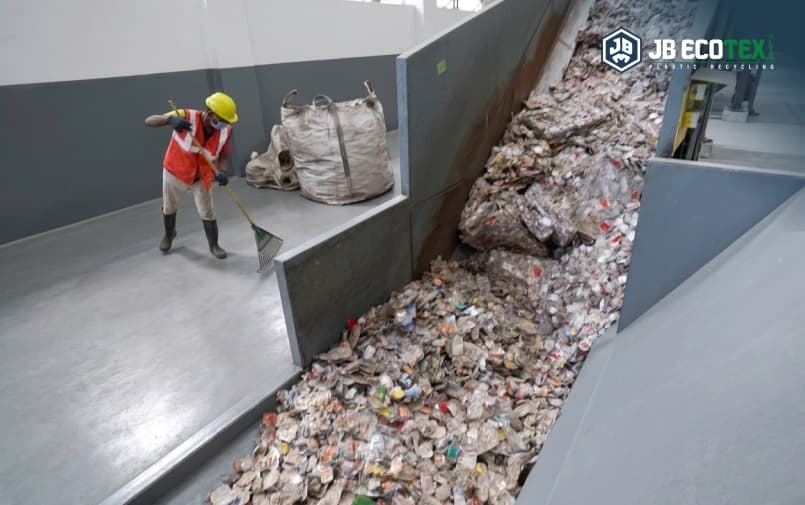
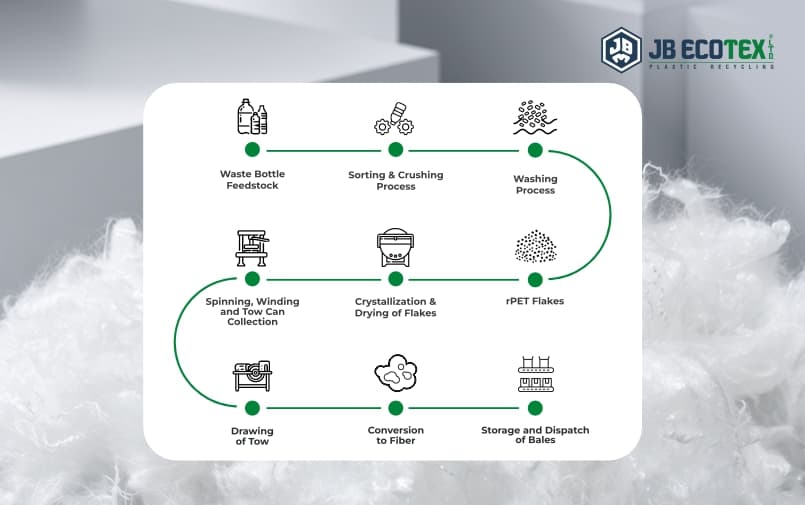
Our RPSF is produced through recycling of post-consumer PET materials, primarily used PET bottles and industrial PET waste. Bottles are segregated and inspected to remove other materials, then sorted by polymer type and colour. Caps and labels are removed before the bottles are crushed into uniformly sized flakes. The flakes go through intensive washing and drying. Other processed PET waste is fed into the fibre line along with the flakes.
The feedstock is then crystallised and dried to prepare it for melt spinning. Molten polymer is extruded through spinnerets into continuous filaments, which are cooled and collected as tow. The tow is drawn to align the polymer molecules, which builds tensile strength and dimensional stability. Finally the drawn tow is crimped, heat-set, dried and cut into staple lengths, and the finished fibre is packed in bales of approximately 350 kg.
That is a short account of a long process. For the full sequence, see our article on how PET bottles are transformed into recycled polyester staple fibre.
How RPSF Becomes Polyester Staple Yarn at the Spinning Mill
Our part of the chain ends at the bale. The spinning mill takes over from there, and its process has five broad stages. Each stage asks something specific of the fibre, which is why mills pay close attention to fibre specifications.
Opening and Blending
Bales are opened and the compressed fibre is loosened into small tufts. When the yarn is a blend, this is where polyester meets cotton or viscose in measured proportions. Fibre that opens easily and evenly gives the mill a uniform mix from the start.
Carding
The carding machine separates the tufts into individual fibres, removes short fibres and forms a soft rope called a sliver. Crimp matters here. The small waves set into each fibre help neighbouring fibres hold together as a web, so the sliver stays intact on its way to the next machine.
Drawing
Several slivers are combined and stretched on the draw frame. Doubling evens out thick and thin places, and drafting straightens the fibres so they lie parallel. Consistent fibre length helps this stage, because the rollers are set according to the length of fibre they are handling.
Spinning
The drawn sliver is converted into yarn by one of three main systems, covered in the next section. Twist or air wrapping binds the fibres together and gives the yarn its strength.
Winding
The yarn is wound onto cones or packages, and electronic clearers remove faults such as thick places and foreign fibres. The cone that leaves this stage is the product a knitter or weaver buys as polyester staple yarn.
Mills that want to match fibre to their machinery can find the detail on our page covering RPSF for ring, open-end and vortex spinning.
Ring, Open-End and Vortex: Three Spinning Systems, Three Yarn Characters
The spinning system gives a yarn much of its character, and each system treats fibre differently.
Ring spinning first turns the sliver into a thin strand called roving, then drafts and twists it on a ring frame. It is widely used for fine and medium counts, and it produces a strong yarn with a soft handle. Because the yarn is fine, fibre fineness and cleanliness have a visible effect on the result.
Open-end spinning, also called rotor spinning, feeds the sliver directly into a fast-turning rotor that assembles and twists the fibres in one step. It is commonly used for coarser counts and is valued for high output. Rotor yarn tends to be bulkier and more even, and it is often chosen for denim, towels and heavier knits.
Vortex spinning, a form of air-jet spinning, uses a swirling air stream to wrap outer fibres around a parallel core. The resulting yarn has low hairiness, which helps fabrics resist pilling. Polyester and polyester-rich blends are widely processed on this system.
A mill usually runs more than one system, so a fibre supplier is asked for material suited to each. Yarn count, the measure of yarn fineness, depends partly on the fineness of the fibre itself. Our explainer on denier in recycled polyester staple fibre covers how fibre fineness is measured.
Fibre Properties That Decide Yarn Quality
A spinner judges staple fibre on a handful of properties. Each one links directly to something the mill can see in the yarn.
Denier describes how fine each fibre is. Finer fibres allow finer yarns, because more fibres fit into the cross-section of the yarn and share the load.
Cut length is the length to which the tow is cut. Mills choose it to suit the spinning system and any fibre it will be blended with. Uniform length supports smooth drafting.
Tenacity is the strength of the fibre relative to its fineness. It carries through to yarn strength and to how well the yarn withstands the stresses of knitting and weaving. Drawing the tow, the stage that aligns the polymer molecules, is where this property is built.
Crimp gives fibres the cohesion they need at the card and adds bulk to the yarn.
Spin finish is a thin coating applied to the fibre to control static and friction. It has a large effect on how smoothly fibre runs at high machine speeds.
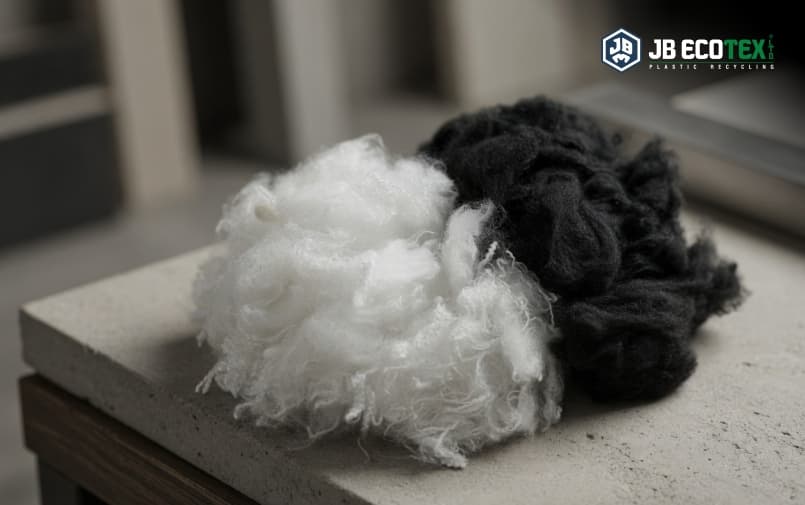
Colour and consistency matter most at the dye house. Fibre that is uniform from bale to bale dyes evenly, while variation shows up as shade differences in fabric. Mills that dye pale or bright shades often ask for a whiter base fibre, and our page on super-white recycled polyester staple fibre addresses that need.
We produce RPSF to customer specifications in a wide range of colours, deniers, cut lengths and value-added finishes. Buyers comparing recycled and virgin material can read our article on virgin and recycled polyester staple fibre for a property by property view.
Blends: Where Recycled Polyester Staple Meets Cotton and Viscose
A large share of spun polyester is used in blends. Polyester brings strength, resilience and durability, and it resists wrinkles, shrinking and abrasion. Cotton and viscose bring moisture absorbency and a natural handle. Combining them gives fabric makers a balance of comfort, easy care and cost.
Polyester and cotton blends are common in shirting, workwear, bed linen and knitwear. Polyester and viscose blends are common in suiting and uniforms. In each case the polyester portion can be recycled staple fibre, which lets a brand introduce recycled content into a familiar fabric while keeping the product design as it is.
Blending places its own demands on the fibre. The polyester should be close to its partner fibre in length and fineness so that the two draft together evenly. This is one reason fibre is cut to different lengths for different customers. Our article on the role of recycled polyester staple fibre in textiles looks at how the fibre fits into wider fabric development.
What Recycled PET Bottle Yarn Is Used For
Spun yarn is the first end use listed for our RPSF, and that yarn travels into many products. Apparel is the most visible, from T-shirts and polo shirts to trousers and school uniforms. Home textiles follow closely, including curtains, upholstery and bed linen. Carpets and furnishing fabrics use coarser yarns.
Sewing thread is a more demanding use. Thread has to survive high needle speeds and repeated abrasion, so thread makers ask for high tenacity polyester fibre as their raw material.
Staple fibre also has a life outside yarn. A good deal of it goes straight into non-woven fabrics, wadding, filling materials, automotive interiors, filtration media and geotextiles, skipping the spinning stage altogether. Our page on fibre for non-woven manufacturing covers that route.
The distinction helps buyers who see "made from recycled bottles" on very different products and want to know which process stands behind each.
How Recycled Content in Yarn Is Verified
A recycled claim on a garment depends on the paperwork that follows the material through each change of ownership. The fibre maker, the spinner, the fabric mill and the garment maker each hold one link in that chain.
The Global Recycled Standard, or GRS, is the certification most often requested for recycled polyester. It covers recycled content and chain of custody, along with social, environmental and chemical requirements at certified sites. When certified material is sold, the seller can request a transaction certificate from its certification body for that shipment. A spinner who buys certified fibre and holds its own certification can then pass the claim forward to its yarn customers in the same way.
OEKO-TEX Standard 100 answers a different question. It concerns testing for harmful substances and says little about where the polymer came from. Ocean Bound Plastic Certification relates to material collected in areas where it was at risk of reaching the sea. A buyer should match the certificate to the claim being made on the product.
Our products are certified under the Global Recycled Standard and OEKO-TEX Standard 100, and we hold Ocean Bound Plastic Certification and Sedex registration. The role of each one is set out on our page about textile industry certifications.
Who Makes Recycled PET Yarn in India and Where a Fibre Producer Fits
Buyers looking for recycled PET yarn manufacturers are usually looking for one of three kinds of company. Spinning mills make spun yarn from staple fibre. Filament producers make continuous yarn from chips or flakes. Integrated groups do both under one roof.
A fibre producer sits one step upstream of the spinning mill. For a brand, this has a practical consequence. The recycled content of a spun yarn is decided by the fibre that went into it, so the fibre supplier is where the recycled claim originates. Some brands nominate the fibre source to their spinners for exactly that reason.
India has a long-established spinning industry and a growing base of PET recycling capacity, which places bottle collection, fibre production and yarn spinning within one country. We began RPSF production in October 2015 and expanded to an installed capacity of 60,000 MTPA in November 2017. The quality of our RPSF has supported our expansion across Europe, the Middle East, Africa and Asia.
There is also a route that begins with used textiles in place of bottles. Our article on textile-to-textile recycling explains how polyester waste and discarded fabric can be returned to resin through chemical recycling.
Questions to Ask Before Sourcing Fibre for Recycled Yarn
Spinners and brand sourcing teams can save weeks of trial time by settling a few points with the fibre supplier at the start:
- What feedstock is used, and how is each lot traced back to it?
- Which deniers, cut lengths and colours are available, and can fibre be made to our specification?
- Which spinning systems has the fibre been supplied for?
- How consistent is the fibre from bale to bale, and what test report comes with each lot?
- Which certifications cover the product and the site, and can transaction certificates be issued?
- What is the bale weight and packing format?
- What lead time and supply volume can be planned over a season?
A fuller version of this list appears in our procurement checklist for recycled polyester buyers.
Our RPSF for Spun Yarn
We have produced RPSF since October 2015, and our installed capacity for this product is 60,000 MTPA. The fibre is made from post-consumer PET materials, primarily used PET bottles and industrial PET waste, and it retains core properties such as high tensile strength, resilience and durability.
Production is tailor-made to customer specifications, in a wide range of colours, deniers, cut lengths and value-added finishes. Finished fibre is packed in bales of approximately 350 kg. Our manufacturing facility holds certifications including IS 17263:2022, ISO 9001:2015 and ISO 14001:2015, and our products are certified under the Global Recycled Standard and OEKO-TEX Standard 100.
If you run a spinning mill, share your spinning system, target yarn count and blend, and we will recommend a fibre to trial. If you are a brand, tell us the fabric you are developing and we can work with your nominated spinner.
Common Questions About Recycled PET Bottle Yarn
What is recycled PET bottle yarn?
Recycled PET bottle yarn is polyester yarn made from used PET bottles. The bottles are sorted, crushed into flakes and washed, then converted into staple fibre or filament. Spinning mills turn staple fibre into spun yarn for knitting and weaving.
What is PET yarn?
PET yarn is polyester yarn. PET stands for polyethylene terephthalate, the polymer used in both beverage bottles and polyester textiles. It is sold as spun yarn made from staple fibre, or as filament yarn made from continuous strands.
How is yarn made from plastic bottles?
Bottles are sorted, crushed into flakes, washed and dried. The flakes are melted and extruded into filaments, which are drawn, crimped and cut into staple fibre. A spinning mill then cards, draws and spins that fibre into yarn.
What is the difference between recycled PET chips yarn and polyester staple yarn?
Recycled PET chips yarn is filament yarn, extruded from resin chips as continuous strands. Polyester staple yarn is spun from short cut fibres twisted together. Filament suits smooth fabrics such as sportswear, and staple yarn suits cotton-like fabrics.
Is yarn from recycled bottles as strong as virgin polyester yarn?
Yarn strength depends on fibre tenacity, fineness, length and the spinning system. Recycled polyester staple fibre retains core properties such as high tensile strength, resilience and durability, and mills select a fibre grade to match the yarn they need.
How can a brand verify recycled content in yarn?
Ask each supplier in the chain for its Global Recycled Standard scope certificate and for a transaction certificate covering the shipment. These documents trace certified material from the fibre producer through the spinner to the fabric and garment maker.
From One Bottle to One Cone
Recycled PET bottle yarn is the product of two industries working in sequence. Recyclers turn bottles into clean flake and consistent fibre, and spinners turn that fibre into yarn with the count, strength and handle a fabric needs. The quality of the yarn and the credibility of its recycled claim both trace back to the fibre.
If you are sourcing fibre for spun yarn, or building a recycled yarn programme for a brand, contact our team with your requirements and we will share fibre specifications and samples for trial.