
rPET Resin Specifications: What Every Line on a Food Grade Data Sheet Tells You
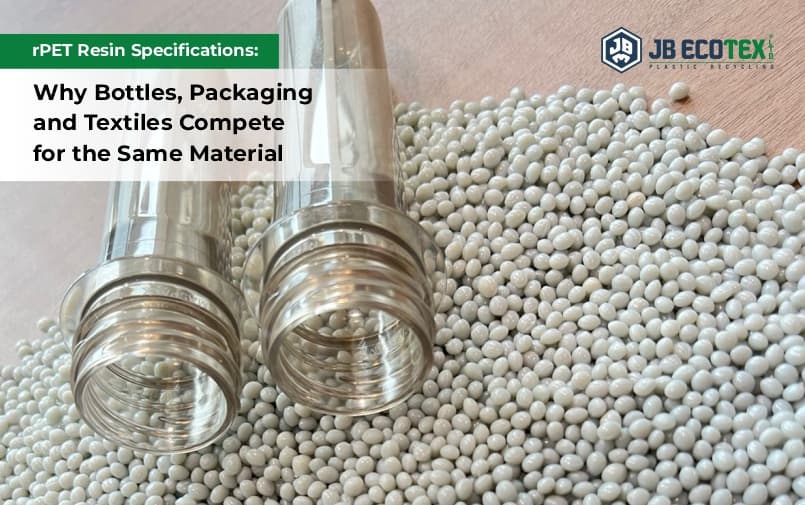
rPET resin specifications decide whether a recycled grade runs cleanly on your line, and they arrive as a single page of numbers that few buyers are taught to read. An rPET chip technical data sheet lists intrinsic viscosity, acetaldehyde, colour, moisture and bulk density, each with a unit and a test method beside it. Every one of those lines answers a practical question about preform quality, bottle clarity or food contact suitability. We manufacture Food Grade rPET Resins from post-consumer PET bottles, and we field the same questions from packaging converters and brand procurement teams each week. What follows is the reading method we share with them: how the documents differ, what each rPET resin property means on the shop floor, and which details sit outside the sheet altogether.
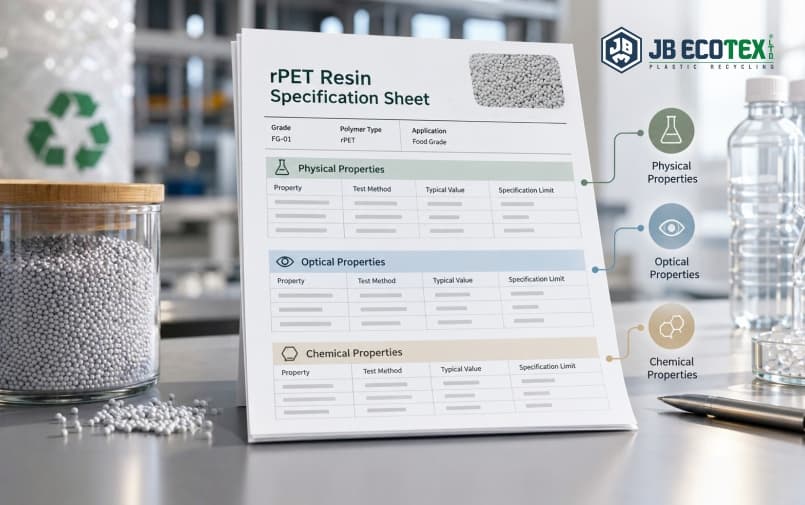
What an rPET Resin Specification Sheet Is
A specification sheet is a supplier's written description of a resin grade. It names the grade, states the polymer type, and lists the properties the supplier measures, together with the range each property is expected to fall within. For food grade rPET resin, the sheet usually runs to a single page and covers physical, optical and chemical properties in that order.
The sheet describes a grade. It describes every tonne the supplier intends to ship under that grade name, which makes it a statement of intent backed by process capability. A buyer uses it at the qualification stage to decide whether a grade deserves a trial, and later as the reference point against which each delivery is checked.
Two features separate a useful sheet from a decorative one. The first is a test method beside every value, because a number without a method leaves the reader guessing how it was produced. The second is a clear label on each figure saying whether it is a typical value or a specification limit. We return to both points below, because they change how much weight a line can carry in a supply agreement.
Technical Data Sheet, Certificate of Analysis and Compliance File: Three Separate Jobs
Buyers often use "spec sheet" for three different documents. Each one does a separate job, and reading rPET resin specifications well starts with knowing which document is in your hand.
The technical data sheet, or TDS, describes the grade in general. It carries typical values or ranges, the test methods, recommended drying conditions and packaging formats. It stays the same from one shipment to the next until the supplier revises the grade.
The certificate of analysis, or COA, describes one batch. It carries the lot number, the production date and the measured result for each property on that specific lot. When a delivery arrives, the COA is the document your quality team compares against the agreed specification. Batch testing and lot traceability are covered in more depth in our piece on quality assurance in food-grade rPET.
The compliance file holds the regulatory evidence: food contact approvals, licences, registrations and certification scope documents. These papers confirm that the recycling process behind the resin is authorised for food contact use in a given market. A resin can show attractive numbers on a TDS and still be unsuitable for a beverage bottle if the compliance file is incomplete, so the three documents are read together.
How to Read rPET Resin Specifications Line by Line
The order of lines varies between suppliers, and the same core properties appear on almost every sheet for bottle grade PET resin: intrinsic viscosity, acetaldehyde, colour, moisture, bulk density and melting point, followed by contamination lines on recycled grades. The sections below take them one at a time and explain what each line measures and why a converter checks it.
Intrinsic Viscosity
Intrinsic viscosity, written as IV and reported in decilitres per gram, is usually the first technical line on the sheet. It indicates the average length of the polymer chains. Longer chains give a higher IV, and a higher IV generally brings greater melt strength and mechanical performance in the finished container.
The right IV depends on the application. Carbonated beverage bottles commonly call for a higher IV than still water bottles, because the container has to hold pressure. Sheet extrusion and thermoforming have their own preferred ranges. A buyer reading this line should ask one question: does the stated IV range sit inside the window my process and my container design were built around?
Our Food Grade rPET Resins are available in multiple IV grades ranging from 0.76 to 0.86 dl/g. For a closer look at how two widely used points in that range behave, see our explainer on 0.80 and 0.84 IV rPET resin.
Acetaldehyde
Acetaldehyde, shortened to AA and reported in parts per million, forms when PET is exposed to heat during melt processing. It carries a faint fruity note, which matters most in still water, where there is little flavour to mask it.
Two details help when reading this line. First, the value on a resin sheet describes the pellet. Fresh acetaldehyde forms again when the pellet is melted to make a preform, so the preform value depends on your drying and moulding conditions as well as on the resin. Second, the method is usually headspace gas chromatography, and the sheet should say so. The stage where residual volatiles are reduced in the pellet is solid state polycondensation, which we describe in our article on bottle-to-bottle rPET resin.
Colour Values
Colour appears as three figures on the CIE L*a*b* scale. L* describes lightness, a* describes the red to green axis, and b* describes the yellow to blue axis. For a clear bottle, buyers look for a high L*, an a* close to zero and a low b*, since a rising b* shows as a yellow tint in the preform.
Check what form the sample was in when it was measured. Crystallised pellets are opaque and read differently from amorphous pellets or moulded plaques, so two sheets can show different L* values for resins that look alike in a finished bottle. We have written separately about L*, a* and b* colour testing for rPET resin, including why yellowing happens and what it reveals about the feedstock.
Moisture Content
PET absorbs water from the air. If that water enters the melt, it breaks polymer chains, and the IV you paid for falls before the material reaches the mould. The moisture line on a sheet tells you the condition of the pellet as packed.
Read this line as a starting point for your dryer. A pellet packed at a low moisture level will still pick up water during storage and transport, so drying before processing remains essential whatever the sheet says. A well-prepared TDS also states recommended drying temperature and residence time. Our article on injection moulding with virgin PET and rPET resin explains why drying discipline has such a strong effect on preform quality.
Bulk Density and Pellet Form
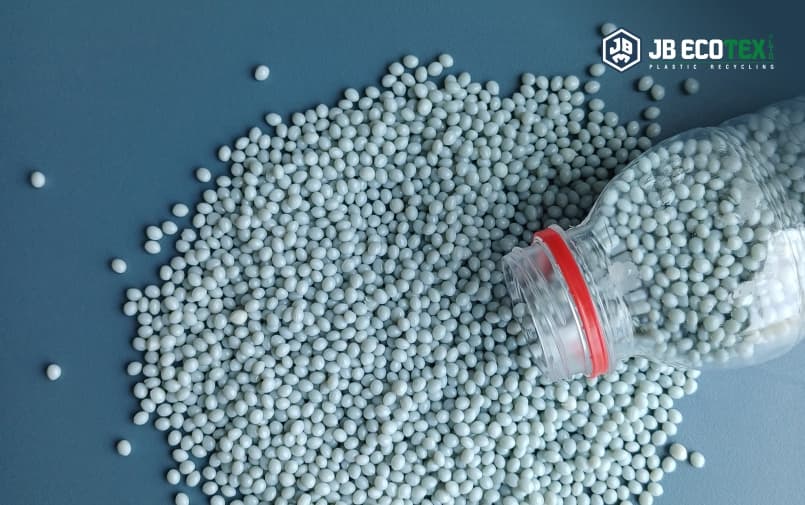
Bulk density is the mass of pellets that fills a given volume, reported in grams per cubic centimetre or kilograms per cubic metre. It affects how the resin flows from a hopper, how much a silo holds and how a pneumatic conveying system should be set.
Pellet shape sits alongside this line. Some processes produce spherical pellets and others produce cylindrical ones, and the two feed slightly differently. Many sheets also state pellet weight or pellets per gram. When you blend recycled resin with virgin resin, similar pellet size and bulk density help the two materials stay evenly mixed on the way to the screw.
Melting Point and Crystallinity
The melting point, measured by differential scanning calorimetry, tells a processor where the crystalline regions of the pellet melt. It guides barrel temperature settings. Bottle grade PET resin is usually a copolymer, and the level of comonomer shifts the melting point and the rate of crystallisation, which influences clarity in thick-walled preforms.
Some sheets also report crystallinity as a percentage. Pellets leaving solid state polycondensation are crystallised, which lets them be dried at high temperature without sticking together in the dryer.
Contamination Lines
Recycled resin sheets often carry lines that a virgin sheet leaves out. Common examples are black speck count, PVC content, polyolefin content and, on some sheets, residual substances such as benzene and limonene. These lines describe how effectively the feedstock was sorted and cleaned, and how effectively the process removed substances absorbed during the bottle's first life.
Units vary widely here. Black specks may be counted per kilogram or per defined number of pellets, and PVC is commonly stated in parts per million. Ask how the sample size was chosen, because a count taken on a small sample tells you less than a count taken on a large one. The cleanliness of a resin begins with how thoroughly the bottle material is washed before extrusion. Washing is central to our resin line and to our rPET Flakes, which pass through multiple stages of hot and cold washing.
Test Methods and Units: The Small Print That Changes the Number
Every value on a sheet is the product of a method. Change the method and the number moves, even when the resin stays the same. This is the detail most often skipped when two rPET chip technical data sheets are compared.
Intrinsic viscosity is a clear example. Solution methods dissolve the polymer in a solvent and measure flow time, and different solvent systems give slightly different results for the same sample. Melt-based instruments calculate an equivalent value from melt flow. A supplier quoting ASTM D4603 and a supplier quoting an in-house melt method may both be accurate, and their figures should still be compared with care.
Units deserve the same attention. Moisture can appear as a percentage or in parts per million. Bulk density can appear in grams per cubic centimetre or kilograms per cubic metre. Colour can be reported on the CIE L*a*b* scale or on the older Hunter Lab scale, and the two scales give different numbers for the same pellet. Before judging any line, confirm three things: the method, the unit and the sample form.
Typical Value, Specification Limit and Batch Result
Three kinds of number appear in resin documents, and they carry different weight.
A typical value is what the supplier usually observes. It informs you about the centre of the range, and it is descriptive. A specification limit is a boundary the supplier commits to, written as a minimum, a maximum or a range. It is the figure that belongs in a purchase agreement. A batch result is the measured value for one lot, printed on the COA, and it should fall within the specification limit.
When a sheet shows a single figure with the word "typical" beside it, ask for the limits. When it shows a range, ask whether the range is a guaranteed limit or an observed spread. A range for IV that is narrow enough to keep your process stable is more useful to a converter than an attractive single figure with undefined tolerance.
What Sits Behind the Sheet: Process and Feedstock
A data sheet reports outcomes. The process that produced those outcomes is described elsewhere, and a careful buyer asks for it, because process design determines how consistently the numbers can be repeated.
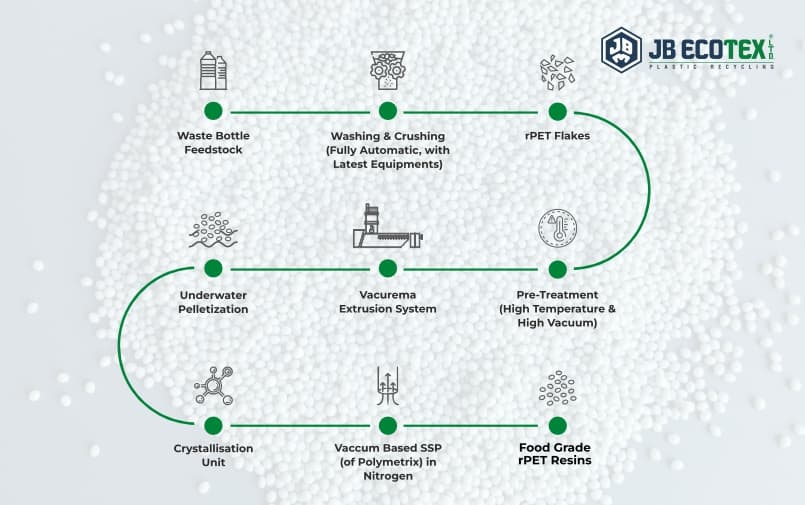
For Food Grade rPET Resins, our process begins with sorting and crushing post-consumer PET bottles, followed by intensive hot washing, friction cleaning and drying. The cleaned material then passes through EREMA VACUNITE or EREMA VACUREMA extrusion, together with Solid State Polycondensation (SSP) technology from Polymetrix. Extrusion under vacuum and the SSP stage are where volatile substances are reduced and where intrinsic viscosity is built to the grade required.
Understanding these stages helps a buyer interpret the sheet. A stable IV range points to control at the SSP stage. Low contamination lines point to sorting and washing upstream. We explain how regulators and converters assess this in our article on decontamination efficiency in mechanical recycling.
Food Contact Status: The Lines That Sit Outside the Data Sheet
Food contact suitability is established through regulatory approval of the recycling process, and it is documented in the compliance file. A TDS may mention it in a single line, and the evidence is the underlying licence or registration.
In India, the Food Safety and Standards Authority of India authorises recycled PET for food contact use, and buyers should ask for the supplier's current FSSAI licence. For the United States market, buyers ask for the supplier's standing with the US Food and Drug Administration. We hold an FSSAI licence for our Food Grade rPET Resins and we are registered with the USFDA. Our article on FSSAI and food-grade rPET resins sets out what packaging manufacturers in India should check.
Regulation also shapes how much recycled resin a brand needs. Under India's Plastic Waste Management Rules, Category I rigid plastic packaging carries phased recycled content targets of 30%, 40%, 50% and 60% from FY 2025-26 to FY 2028-29. Our summary of the Plastic Waste Management Rules covers the categories and timelines. For a procurement team, that mandate turns the specification sheet into a compliance document as well as a technical one, since the resin has to perform on the line and count towards the target.
Matching Bottle Grade PET Resin Specifications to Your Application
A specification is only good or poor in relation to a use. The same sheet can suit one converter well and suit another poorly, so start from your own requirement and read the sheet against it.
For preform and bottle production, the lines that deserve the closest reading are IV, acetaldehyde and colour. IV governs how the preform stretches and how the bottle holds its shape. Acetaldehyde matters in proportion to how sensitive the packed product is to taste. Colour matters in proportion to how visible the container wall is to the consumer.
For sheet extrusion and thermoforming, IV still leads, with bulk density and pellet form gaining importance because they influence feeding stability at the extruder. Contamination lines matter in every application, since specks and gels show in thin, clear walls.
If you are moving a product from virgin resin to recycled resin, place the two sheets beside each other and compare method by method. Our comparison of mechanically recycled rPET resin and virgin PET covers where the two materials behave alike and where processing settings may need adjustment.
Comparing Two rPET Chip Technical Data Sheets Side by Side
Comparing suppliers on paper works when both sheets are brought onto the same basis first. A simple sequence keeps the comparison fair:
- Confirm that both sheets describe the same grade type, for example bottle grade, and the same intended application.
- Line up the test method for each property, and mark any line where the methods differ.
- Convert units so that moisture, bulk density and colour are expressed on one scale.
- Separate typical values from specification limits, and compare like with like.
- Request three recent COAs from each supplier to see how batch results sit within the stated range.
- Check that the compliance file covers the market where the finished packaging will be sold.
The COA step is the one that reveals consistency. A TDS shows what a grade is designed to be, and a run of COAs shows what the plant delivers lot after lot.

Questions to Send a Supplier Before You Approve a Grade
A short list of written questions, sent before a trial, saves time on both sides and gives your quality team a record to refer to later:
- Which test method and which sample form were used for each property on the sheet?
- Which figures are specification limits that you will commit to in a supply agreement?
- What IV grades are available, and what tolerance applies to each grade?
- What drying conditions do you recommend before processing?
- Which food contact licences and registrations cover this resin, and for which markets?
- What feedstock is used, and how is each lot traced back to its production record?
- What certifications apply to the site and to the recycled content claim?
Clear answers to these questions tell you as much about a supplier as the sheet does. Our page for buyers evaluating a PET resin supplier sets out how we approach supply, documentation and grade selection.
Our Food Grade rPET Resins are produced from post-consumer PET bottles and are available in multiple IV grades ranging from 0.76 to 0.86 dl/g. They are made using EREMA VACUNITE or EREMA VACUREMA extrusion together with Solid State Polycondensation (SSP) technology from Polymetrix. As of 31 August 2026, our installed capacity for Food Grade rPET Resins stood at 56,160 MTPA. We hold an FSSAI licence for these resins and we are registered with the USFDA.
Grade selection is a conversation. Tell us the container, the filling product and the process, and we will point you to the IV grade that fits and send the matching data sheet. Where your internal standard asks for a property measured by a particular method, share that method with us at the start so that both teams read the same number in the same way.
Common Questions About rPET Resin Specifications
What Are rPET Resin Specifications?
rPET resin specifications are the measured properties a supplier states for a recycled PET grade, with a range and a test method for each. They usually cover intrinsic viscosity, acetaldehyde, colour, moisture, bulk density and melting point, and they guide grade selection for packaging applications.
What Is the Difference Between a Technical Data Sheet and a Certificate of Analysis?
A technical data sheet describes a resin grade in general, with typical values, limits and test methods. A certificate of analysis reports the measured results for one production lot. Buyers qualify a grade using the first and check each delivery using the second.
What Does Intrinsic Viscosity Mean on an rPET Chip Technical Data Sheet?
Intrinsic viscosity, reported in dl/g, indicates the average length of the polymer chains in the resin. A higher value generally brings greater melt strength and mechanical performance. Converters match the IV range on the sheet to their container design and process.
Which Properties Matter Most for Bottle Grade PET Resin?
For bottle production, converters usually read intrinsic viscosity, acetaldehyde and colour first. Intrinsic viscosity affects stretch behaviour and strength, acetaldehyde affects taste sensitivity, and colour affects clarity. Moisture, bulk density and contamination lines then confirm how the resin will handle and process.
How Do I Confirm That an rPET Resin Is Food Grade?
Food grade status comes from regulatory approval of the recycling process, held in the supplier's compliance file. In India, ask for the current FSSAI licence. For the United States, ask for the supplier's USFDA status. Review these papers alongside the data sheet.
Why Do Two Suppliers Show Different Numbers for Similar Resin?
Values depend on the test method, the unit and the form of the sample. Intrinsic viscosity measured in different solvent systems, or colour read on crystallised and amorphous pellets, will differ. Align methods and units before comparing any two sheets.
Read the Sheet, Then Read the Supplier
A specification sheet rewards a slow, methodical reading. Start with the document type, confirm the method and unit behind each figure, separate typical values from committed limits, and then test the sheet against a run of batch certificates. Finish with the compliance file, because food contact status rests on regulatory approval of the process.
Read that way, rPET resin specifications become a practical tool for choosing a grade, setting up a trial and holding a supply agreement to account. If you are qualifying food grade rPET resin for bottles, preforms or sheet, contact our team with your application details and we will share the relevant data sheet and documentation.